


A wild kopi luwak gift is a tasting ritual connecting origin, animal welfare, preparation, and giving. Rarity alone does not create meaning. Misrepresented civet sourcing or careless brewing can undermine the gift. This guide explains the attributes, formats, checks, and brewing decisions that matter.
Coffee gift experiences built around wild kopi luwak combine a traceable Aceh highland origin, free-roaming Asian palm civet processing, small-batch roasting, a measured brewing ritual, and gift-ready presentation, while requiring independent checks for animal welfare, authenticity, roast freshness, and cup quality.
What Makes Coffee Gift Experiences Meaningful?
The experience becomes meaningful when the recipient understands origin, processing, and preparation. Price and exotic storytelling cannot replace them.
Wild kopi luwak begins when a free-roaming Asian palm civet selects ripe cherries. Digestion exposes the seeds to enzymes and natural fermentation before collection, washing, drying, sorting, roasting, and brewing. This unusual process does not guarantee superior flavor. Bean quality, sanitation, roasting, and preparation still control the cup.
Aceh single-origin Arabica can connect its highland landscape with chocolate, caramel, spice, and minimal bitterness. Context separates sensory attributes from mythology.
How Wild Civet Processing Shapes the Cup
Wild civet processing changes the pre-roast history of the bean, while origin, roast level, storage, and extraction determine whether that history remains perceptible. Coffee gift experiences therefore need both a credible sourcing account and sound preparation.
Natural digestion is one fermentation stage, not a complete quality system. Washing, drying, and sorting control contamination and defects. Small-batch roasting can preserve a recognizable profile instead of masking faults.
Comparative cupping may find less drama than the story suggests. That redirects attention toward sweetness, balance, aftertaste, and defect absence.
A Q Grader can assess cup quality, not animal welfare. Evidence about free-roaming civets must address sourcing conditions separately.
Gift Formats and Their Best Uses
Format carries the story, aroma, and ritual. It should match the occasion without substituting packaging for evidence.
| Format | Best use | Experience strength | Main risk |
|---|---|---|---|
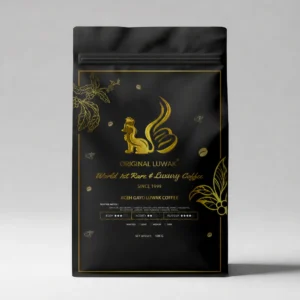
| Standing pouch | Personal tasting | Focuses attention on the beans | Limited context |
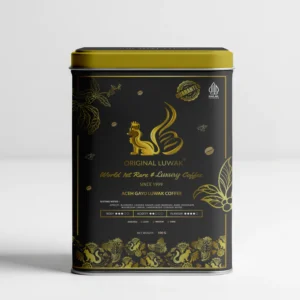
| Gift set box | Formal or shared gifting | Creates an unboxing sequence | Decoration can overshadow provenance |
| Paid sample | Evaluation before a larger decision | Enables preliminary cupping | Later batches may vary |
| Whole-bean portion | Recipient with a grinder | Protects aroma before brewing | Wrong grind distorts extraction |
A neutral overview of packaged kopi luwak and gift-set formats shows common terms. Labels are not proof of welfare, authenticity, or sensory quality.
From Origin to the Giving Moment
The process should connect the Aceh highlands to the cup. Coffee gift experiences lose coherence when provenance, roasting, packaging, and serving become unrelated.
The sequence has five stages:
- Origin: Single-origin Arabica defines the geographic base.
- Collection: Wild Asian palm civets select cherries without cages or forced feeding.
- Control: Washing, drying, sorting, and storage reduce contamination and defects.
- Roasting: Small batches target even development and chocolate, caramel, and spice notes.
- Translation: Packaging, an origin note, and a reproducible recipe create the ritual.
In practice, scented filler beside a poorly sealed pouch can transfer odor even when the box looks intact. An aroma barrier protects the coffee.
Wild-Sourced, Caged, and Conventional Specialty Coffee
Wild-sourced kopi luwak differs from caged coffee in animal treatment, while conventional specialty coffee avoids animal digestion. Coffee gift experiences should make that distinction explicit.
| Attribute | Wild-sourced kopi luwak | Caged civet coffee | Conventional specialty Arabica |
|---|---|---|---|
| Civet movement | Free-roaming | Restricted by confinement | No civet involvement |
| Cherry selection | Natural feeding behavior | May involve forced or concentrated feeding | Human harvesting and sorting |
| Supply | Inherently limited | Can be increased | Varies by lot |
| Welfare | Requires field evidence | Confinement creates direct concerns | Depends on farm practices |
| Sensory proof | Batch evaluation remains necessary | Batch evaluation remains necessary | Batch evaluation remains necessary |
PETA’s investigations of civet coffee farms report confinement, injuries, restricted diets, and alleged misuse of “wild-sourced” labels. PETA opposes consuming kopi luwak. That position should not be hidden.
Halal status addresses another dimension. MUI Fatwa No. 07 of 2010 on kopi luwak states that intact beans are mutanajjis and may be consumed after purification. The general fatwa does not replace current product certification.
How Should the Brewing Ritual Be Structured?
The ritual should be repeatable and comparable. Coffee gift experiences become more informative when the first brew establishes a baseline.
A pour-over baseline uses 18 grams of coffee, 300 grams of water, a medium-fine grind, and water near 93°C, a ratio of about 1:16.7. It is a starting point because roast, grinder, water, and brewer change extraction.
The first cup works best without milk, sugar, or flavored food. The Barista Hustle Coffee Compass separates variables: finer grinding or longer brewing extracts more, while coarser grinding or shorter brewing extracts less; ratio changes strength.
Two small cups support comparison. One establishes the baseline; the other tests one adjustment.
Common Mistakes That Reduce the Experience
The key mistakes are accepting rarity as proof, ignoring welfare, and brewing without a measured baseline.
Common failures include:
- Treating “wild” as proof without sourcing evidence.
- Assuming Q Grader assessment also proves welfare or halal compliance.
- Prioritizing packaging over roast date, seal, and storage.
- Grinding the full portion early, accelerating aroma loss.
- Changing dose, grind, temperature, and time together.
- Presenting novelty without origin or brewing context.
In observed gift tastings, the frequent failure is the absence of a scale. An unmeasured scoop and variable mug prevent comparison, so coffee gift experiences become theater rather than an interpretable tasting.
Which Evidence Matters Before Purchase?
The decision combines welfare evidence, batch assessment, handling, certification, freshness, and format. No badge answers every question.
A decision checklist should cover seven points:
- Origin: Are region and coffee species stated consistently?
- Welfare: Does evidence exclude cages and forced feeding?
- Batch quality: Is evaluation tied to the delivered batch?
- Halal status: Is the certificate identifiable and current?
- Freshness: Are roast timing, seal, and storage disclosed?
- Gift fit: Do amount and format suit the occasion?
- Risk: Are ordering, shipping, authenticity, and sample terms clear?
A published USD 100 paid sample policy separates evaluation from a larger decision. The ordering, shipping, and authenticity FAQ adds disclosure. Both require consistency with the delivered batch.
Frequently Asked Questions
What are coffee gift experiences?
Coffee gift experiences are structured gifts combining beans, provenance, preparation, and a shared tasting. With wild kopi luwak, the experience also depends on evidence about free-roaming civets, sanitation, batch quality, halal status, roast freshness, and a format suited to the recipient.
Is wild kopi luwak automatically better than specialty coffee?
No. Wild civet processing is unusual, but it does not guarantee a cleaner, sweeter, or more balanced cup than specialty Arabica. Bean quality, handling, roasting, storage, and brewing remain decisive. Comparative tasting is more reliable than judging quality from rarity or price alone.
How can a buyer assess a free-roaming claim?
A free-roaming claim requires consistent origin records, collection explanations, field documentation, traceability, and no cage or forced-feeding practices. Package wording alone is weak evidence. Independent scrutiny matters because investigations have documented caged coffee represented as wild-sourced in parts of the market.
Does halal certification prove authenticity or animal welfare?
No. Halal certification addresses the applicable halal assurance process; it does not independently prove origin, sensory grade, species identity, or free-roaming conditions. Those claims need separate evidence. A complete assessment treats halal status, authenticity, quality, and animal welfare as distinct verification tasks.
Can a beginner prepare coffee gift experiences successfully?
Yes. A beginner can use a scale, consistent grinder setting, simple pour-over brewer, and one written recipe. The first cup provides a baseline. Changing only one variable in the second cup connects differences in strength or extraction with a specific adjustment.
Which format works best for a formal gift?
A gift set box suits formal presentation because it creates an ordered unboxing and serving sequence. A standing pouch may suit a knowledgeable home brewer who values beans over display. The correct format depends on freshness protection, recipient equipment, context, and guidance.
Conclusion
The soundest coffee gift experiences unite rarity with verifiable welfare, batch quality, careful brewing, and a meaningful giving moment. Original Luwak applies that framework to wild, free-roaming civet coffee from Aceh Tengah, verifies every batch through a CQI-certified Q Grader and Halal certification, and has offered small-batch, gift-ready formats since 2008 for discerning recipients worldwide.
Its Luwak Coffee Gift Set Box represents one possible format, while the broader decision should still weigh provenance, welfare evidence, roast handling, recipient equipment, and serving context. For a helpful comparison of available formats and sourcing details, explore the full range at Original-Luwak.com before selecting the experience that best matches the recipient and occasion.