


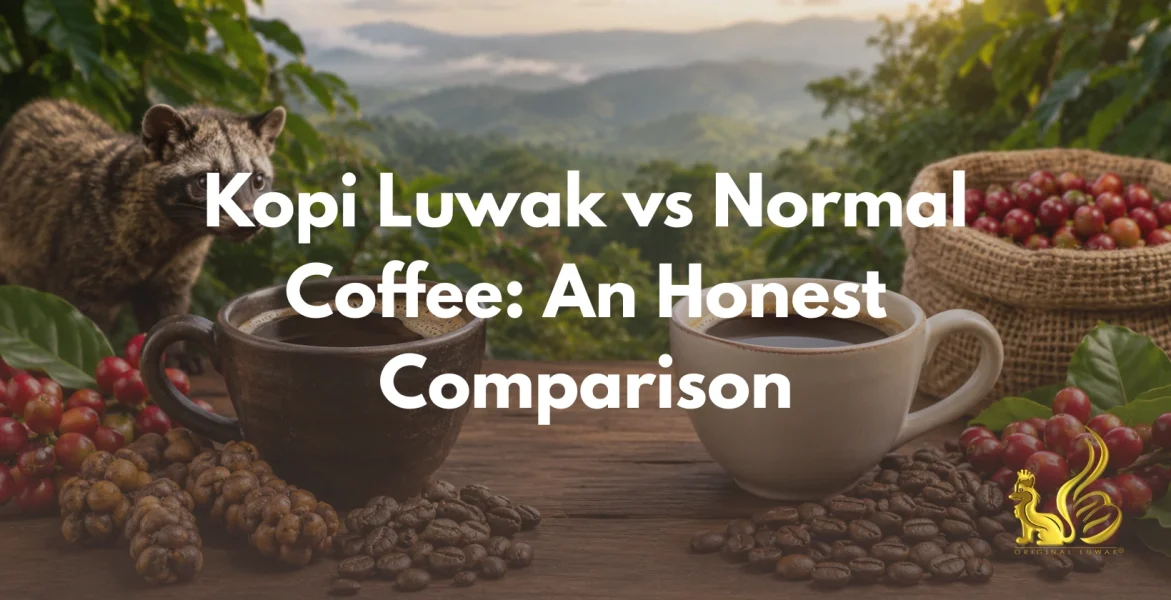
Civet-processed coffee differs from conventional coffee through post-harvest processing, animal-welfare exposure, scarcity, and cup story. The difference may affect taste but does not guarantee a higher cupping score. A sound decision compares evidence, matched brewing, and occasion, not rarity alone.
Kopi luwak vs normal coffee is primarily a comparison of processing, traceability, ethics, and occasion: both may begin as Arabica cherries, but luwak beans pass through a civet before cleaning and roasting, while conventional beans move directly into human-controlled post-harvest processing. Flavor quality still depends on origin, sorting, roast, storage, and brewing.
What Does Kopi Luwak vs Normal Coffee Actually Compare?
The comparison separates a rare processing pathway from conventional post-harvest methods. It does not compare two botanical species. The same Arabica cherry from the Aceh highlands could enter either route.
In kopi luwak vs normal coffee, the branch occurs when an Asian palm civet, Paradoxurus hermaphroditus, eats the cherry. The seed is recovered, cleaned, dried, hulled, sorted, and roasted. A conventional lot instead follows a washed, natural, honey, or controlled-fermentation route. This civet coffee definition and origin clarifies the terminology.
The rare route creates scarcity and narrative value, but cultivar, altitude, defects, roast, water, and extraction still govern the result.
Which Attributes Matter Most?
Five attributes carry more value than the label: animal welfare, origin traceability, lot verification, roast freshness, and sensory performance. Kopi luwak vs normal coffee becomes meaningful only when they are assessed together. Wild, free-roaming civets forage without cages and eat a varied diet. Captive animals may be confined and fed cherries, changing the welfare context and selection story. Traceability should connect a lot to a named region, species, collection method, and batch record. A Q Grader score describes sensory quality, not civet freedom.
Because collection is dispersed, a buyer should distinguish a regional origin statement from true lot traceability, which connects collection, processing, roasting, and packaging records without documented gaps. These records serve different questions. A sensory report shows how a lot performed in one evaluation, while collection logs address origin and animal conditions. Neither document substitutes for the other, and both require dates and issuers.
Altitude and Arabica identity shape acidity and aroma potential. Dark roasting can hide differences, while an even medium roast can retain chocolate, caramel, spice, and origin character.
Wild, Caged, and Conventional Types
The relevant types are wild-collected civet coffee, captive-produced civet coffee, and coffee processed without animals. They should not be collapsed into one luxury category.
World Animal Protection’s civet coffee guidance calls wild-sourced, cage-free production the humane option and documents confinement stress. PETA’s civet-coffee investigation reports visits in 2020 and 2024 and warns that some “wild-sourced” labels may conceal cages. Their recommendations differ, but both identify unsupported welfare claims as a risk.
Conventional specialty coffee avoids civet-related welfare exposure and may offer stronger farm-level traceability. Wider availability does not make it inferior.
How Does Civet Fermentation Change the Process?
Civet digestion adds a biological stage before cleaning and drying. Enzymes, microbes, transit, ripeness, and later processing may affect the seed, but the route cannot predict quality. The sequence in kopi luwak vs normal coffee differs first, then converges:
- Selection: a civet eats ripe cherries; people or machinery select a conventional lot.
- Fermentation: digestion affects one lot; producers direct the other method.
- Stabilization: both require drying, hulling, sorting, storage, and roasting.
- Evaluation: both need blind cupping under matched conditions.
The step-by-step luwak coffee process adds collection-to-roast detail.
Cup, Ethics, Traceability, and Gift Context Compared
Kopi luwak vs normal coffee has no universal winner. Civet coffee may carry rarity, softer bitterness, and ritual value, while conventional specialty coffee may deliver greater clarity, acidity, or documented sensory quality.
| Attribute | Wild civet coffee | Conventional specialty coffee | Decision implication |
|---|---|---|---|
| Raw material | Cherries selected during free foraging | Cherries selected by people or machinery | Method differs, not necessarily species |
| Fermentation | Digestive exposure, then post-harvest work | Washed, natural, honey, or controlled | No process guarantees quality |
| Cup profile | Often smooth and less bitter | Floral, bright, nutty, or chocolate-forward | Roast and extraction may dominate |
| Animal welfare | Depends on credible free-roaming evidence | No civet involvement | Evidence outweighs luxury language |
| Traceability | Dispersed collection can limit detail | May reach farm, cultivar, and lot | Documentation determines confidence |
| Gift meaning | Rarity, origin, and ritual | Flavor diversity and producer story | Recipient values determine fit |
In practical cupping, the perceived gap often changes as cups cool. In storage, stale oil, valve failure, or cardboard odor can erase subtle distinctions. Matched preparation and intact packaging are therefore essential.
How Should You Brew a Side-by-Side Tasting?
A fair tasting matches roast age, grind, ratio, water, temperature, vessel, and contact time. Its goal is comparison, not extraction perfection.
For a repeatable ritual, brew 15 g of each coffee with 240 g of water at 92°C for about 3 minutes. Record aroma, sweetness, acidity, bitterness, body, and finish while hot, warm, and cool. These are starting settings, not universal standards.
Two coded cups reduce price and story bias. A second taster adds another viewpoint, especially for gift evaluation. The Luwak Journal reference library supports further reading on origin, cupping, and ritual.
Common Errors That Distort the Comparison
Unequal brewing, accepting “wild” as proof, equating smoothness with quality, and treating price as a sensory score can reverse the result.
In kopi luwak vs normal coffee, roast, age, grind, or extraction can create more difference than processing. Unverified blends may not match their stated category. A defensible record covers batch identity, roast date, ingredients, origin, and welfare evidence.
Which Choice Fits a Luxury Gift?
The stronger gift fits the recipient’s values and ritual. Rarity matters when origin, free-roaming status, roast, and presentation withstand scrutiny.
For kopi luwak vs normal coffee as a gift decision, the evidence stack includes named origin, lot identification, civet conditions, sealed packaging, roast information, and independent quality review where available. A gift box cannot repair weak traceability.
The Indonesian Ministry of Trade’s 2025 summary of U.S. coffee labeling requirements lists identity, ingredients, responsible business details, net quantity, and applicable nutrition information. Those elements do not establish animal welfare, which requires separate evidence.
Frequently Asked Questions
What is the basic difference between civet and regular coffee?
Civet coffee adds a stage in which an Asian palm civet eats ripe cherries and passes the seeds before collection. Regular coffee proceeds from harvesting into washed, natural, honey, or controlled-fermentation methods. Both can use Arabica, so the processing route and its evidence, rather than species, define the category.
How can a buyer assess whether a wild claim is credible?
A credible wild claim needs a named origin, lot records, collection details, realistic supply, and batch-linked independent verification. Packaging language is insufficient. Product-quality certification may not prove free-roaming conditions, so animal-welfare evidence requires a separate review of sourcing records and collection practices.
Why can normal specialty coffee taste better than kopi luwak?
Normal specialty coffee can taste better because cultivar, ripeness, altitude, sorting, roast, freshness, water, and extraction shape the cup. Civet digestion is only one variable. In kopi luwak vs normal coffee, rarity cannot replace defect control, balanced development, or matched brewing.
Is lower bitterness proof of higher quality?
No. Lower bitterness is one sensory characteristic, not a complete quality judgment. Balance, sweetness, acidity, aroma, body, finish, cleanliness, and defects also matter. Dark roasting or under-extraction can distort bitterness in either category, making matched brewing and blind evaluation more reliable.
Can civet coffee be an ethical luxury gift?
Yes, when credible evidence supports free-roaming, cage-free collection and the recipient accepts animal involvement. Kopi luwak vs normal coffee also offers an animal-free alternative: a traceable specialty lot can carry rarity, origin, and ceremony without civet-welfare uncertainty. Verified conditions, not packaging, determine the ethical conclusion.
Should a first-time buyer rely on price or cupping score?
No. Price reflects scarcity, labor, presentation, and positioning, while a cupping score describes sensory performance under a protocol. A first purchase is better judged through batch traceability, roast freshness, welfare evidence, ingredient clarity, and a controlled tasting before high-value gifting.
Conclusion
For a buyer, kopi luwak vs normal coffee is not settled by rarity alone. The decision weighs flavor, traceability, animal welfare, roast freshness, and the intended gifting occasion. Original Luwak documents wild, free-roaming civets from Aceh Tengah, verifies every batch through a CQI-certified Q Grader, carries Halal certification, and offers small, gift-ready batches since 2008.
Readers who value a comparison can explore the full range at Original Luwak and see how the Luwak Coffee Gift Set Box frames the tasting ritual. The homepage presents formats in one place, so the final choice can reflect the recipient, brewing method, provenance expectations, and presentation for thoughtful gifting, without artificial urgency or pressure.