

The masked palm civet is the most widespread civet in Asia, a grey, fruit-eating, tree-living animal with a white stripe down its face, and it is not the animal behind kopi luwak. People reach this species from three directions: a sighting in a roof or an orchard, the 2003 SARS story, and a search for the civet that produces coffee. This guide answers all three with the published figures, and ends with the one difference that matters to a coffee buyer.
We write from Aceh Tengah, where we collect coffee from a different civet. The species facts below come from the University of Michigan’s Animal Diversity Web; the coffee facts are ours.
Last updated: 10 November 2026
Masked Palm Civet at a Glance
The masked palm civet is Paguma larvata, a member of the civet family Viverridae, not a cat. Animal Diversity Web’s account of Paguma larvata gives the core figures, and the table below collects them so you do not have to.
| Fact | Masked palm civet |
|---|---|
| Scientific name | Paguma larvata |
| Family | Viverridae (civets and genets), not Felidae |
| Adult weight | 3.6 to 5 kg |
| Body length | 50 to 76 cm, with a tail of 50 to 64 cm |
| Coat | Short grey with orange, buff or yellow-red tinges; no spots, stripes or bands |
| Diet | Omnivore, mainly fruit; also small vertebrates, insects and birds |
| Activity | Nocturnal, solitary, arboreal |
| Litter | 1 to 4 young, averaging 2.3; two breeding seasons |
| Lifespan | About 10 years in the wild, up to 20 in captivity |
| Status | Least Concern on the IUCN Red List; CITES Appendix III |
Two of those rows do most of the work for the rest of this article. The weight puts a masked palm civet at the heavier end of the palm civets, and the diet row explains why it turns up in orchards, in roofs, and in the coffee question.
How to Recognise the Mask
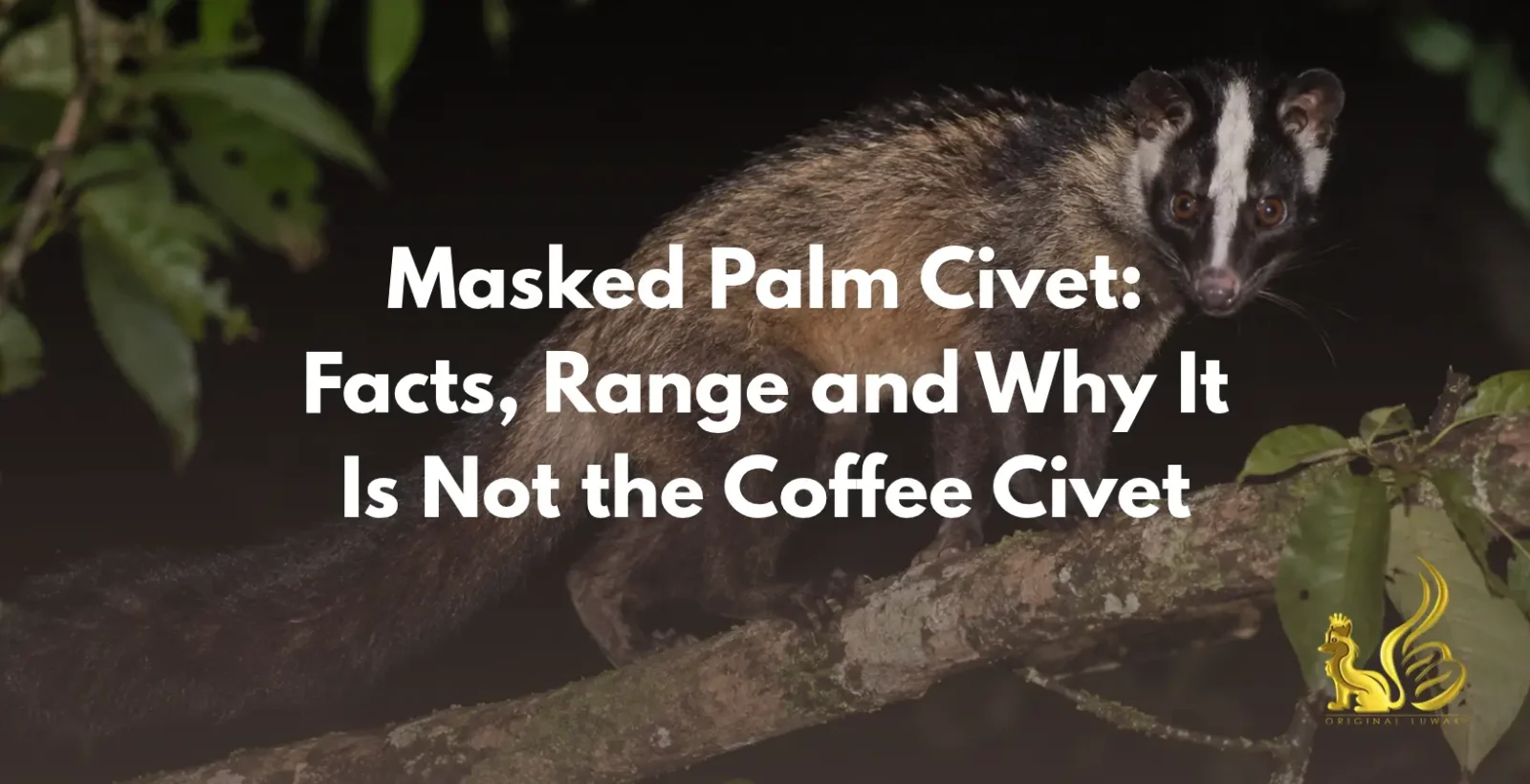
This civet is easiest to identify by its face, and that is where its English name comes from. Animal Diversity Web describes a white median stripe running from the top of the head to the nose, white marks above each eye reaching the base of the ears, and white marks below each eye. On a grey, unmarked body that pale mask stands out even in torchlight.
The rest of the body is plain. There are no spots or bands, which separates it at once from the small Indian civet and the African species, both patterned. The feet are blackish, each with five retractable claws, and the animal carries four anal glands that release a strong secretion when it is threatened. If you want the musk story, it belongs mostly to the African civet cat, not this one.
Size helps too. At 50 to 76 cm of body plus a tail nearly as long, one seen on a branch looks like a long, low, grey animal with a face that seems lit from inside.
Where the Masked Palm Civet Lives
The masked palm civet has the largest range of any civet. Animal Diversity Web traces it from northern Pakistan and Kashmir across Indochina and the Malay Peninsula, through Sumatra, Borneo, Taiwan and Hainan, into much of eastern and southern China, and out to the Andaman and Nicobar Islands. People introduced it to the Japanese islands of Honshu and Shikoku in the early to mid 1900s, where it is now established.
Within that range it is a forest animal that tolerates people. It lives in deciduous, evergreen and mixed forests, in mountains and in tropical rainforest, and it is often found near settlements. It spends more than 80 percent of its time in tree “day beds”, usually in the top tenth of the tree, holds a home range of about 1 to 2 square kilometres, is active for roughly half the night, and can cover up to 2 km in a night’s foraging.
Sumatra is on that list, which is why the species matters to anyone who buys coffee from this island. For the coffee civet’s own geography, our Asian palm civet habitat guide maps where that smaller species lives.
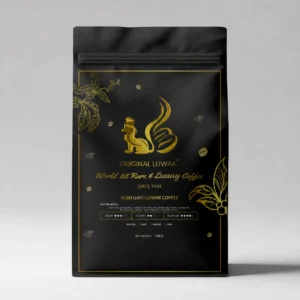
Original Luwak collects coffee only from wild, free-roaming civets in the forests and shade gardens of Aceh Tengah. The 100 g pouch is roasted to order and ships worldwide.
The Masked Palm Civet and SARS in 2003
This is the species most people have read about without knowing its name, because it sat at the centre of the 2003 SARS investigation. In October 2003 the US Centers for Disease Control reported antibody tests on animal traders in Guangdong province: 13.0 percent of traders carried IgG antibody to the SARS coronavirus, against 1.2 to 2.9 percent in three control groups, and among traders who mainly sold masked palm civets the figure was 72.7 percent.
The same report notes that a coronavirus found in masked palm civets from a Shenzhen live-animal market was 99 percent identical to the human SARS virus. It also says, in plain words, that the findings were not sufficient to identify the natural reservoir. The civets in those markets carried the virus; whether they were its source was never settled by that study.
What this means for you is narrow. The risk documented in 2003 was in live-animal markets where wild civets were caged, traded and butchered, not in a forest animal eating figs. If your question is about bites, rabies or disease from a civet near your home, our guide to is civet cat dangerous goes species by species. None of the traders in the CDC study had been diagnosed with SARS.
Masked Palm Civet vs the Civet That Makes Kopi Luwak
The civet behind kopi luwak is the Asian palm civet, Paradoxurus hermaphroditus, a smaller relative, and our guide to the kopi luwak animal covers it in full. The two species share a family, a night shift and a taste for fruit, and they overlap on Sumatra, so the confusion is understandable. The table sets them side by side.
| Fact | Masked palm civet | Asian palm civet (luwak) |
|---|---|---|
| Scientific name | Paguma larvata | Paradoxurus hermaphroditus |
| Adult weight | 3.6 to 5 kg | 1.3 to 5 kg, averaging about 3 kg |
| Range | Pakistan to Japan, including Sumatra and Borneo | India and Sri Lanka to southern China, Southeast Asia, Indonesia and the Philippines |
| Coffee | Not the animal behind kopi luwak | The luwak of kopi luwak |
At Original Luwak every bean comes from wild, free-roaming Asian palm civets working the forest edges and shade-grown gardens of Aceh Tengah, never from caged animals. The caged model, where civets are confined and fed coffee cherries to force volume, exists in this industry and is the reason the category has a welfare problem; our answer to is kopi luwak cruel describes both models without softening either. Our own sourcing is covered by MPKG certification and traced to named harvest areas, and the documents are on our certifications page.
Our own harvest areas, Takengon, Bener Meriah, Angkup, Sukarame, Bies and Pondok Baru, sit between 1,200 and 1,700 metres in the Gayo highlands, where coffee cherries take nine months to ripen from flower. Collectors there work the forest edges and shade-grown gardens where the luwak feeds. A masked palm civet may share the same Sumatran forest, but the coffee in our pouch comes from the Asian palm civet alone.
Frequently Asked Questions
Is the masked palm civet dangerous?
Not in normal circumstances. It is a shy, nocturnal fruit eater that avoids people and bites only when cornered or handled. The 2003 SARS link involved caged animals in live-animal markets, not wild civets in forests. Keep pet food indoors, do not corner one in a roof space, and it moves on.
What does a masked palm civet eat?
Mostly fruit. Animal Diversity Web lists the species as an omnivore that eats fruit first and adds small vertebrates, insects and birds. That diet is why it raids orchards and sometimes takes poultry, and why villagers in parts of its range keep it as a ratter to control rodents around stores.
Where do masked palm civets live?
Across a wider area than any other civet: from northern Pakistan and Kashmir through Indochina, the Malay Peninsula, Sumatra, Borneo, Taiwan, Hainan and much of eastern and southern China, plus the Andaman and Nicobar Islands. People introduced it to Honshu and Shikoku in Japan in the early to mid 1900s, where it still lives today.
Is the masked palm civet endangered?
No. The IUCN Red List classes it as Least Concern, and it is listed on CITES Appendix III. Animal Diversity Web warns that logging and human encroachment could make it more vulnerable over time, and populations introduced to Japan have shown high susceptibility to canine distemper virus.
Does the masked palm civet make kopi luwak?
No. Kopi luwak comes from the Asian palm civet, Paradoxurus hermaphroditus, the luwak of Indonesia. The masked one is a larger relative with a white facial stripe that also eats fruit and also lives on Sumatra, but the coffee tradition, and Original Luwak’s collection in Aceh Tengah, involve only the Asian palm civet.
Try Wild Kopi Luwak from Original Luwak
Original Luwak has sold kopi luwak coffee from the Gayo highlands since 2008, collected from wild Asian palm civets, never from cages, and cupped at 84+ by a CQI-certified Q Grader before any batch is packed. The beans are semi-washed and dry-hulled by hand, which keeps the cup clean instead of muddy, and roasted to order in light, medium or dark.
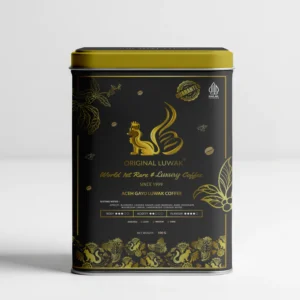
The 100g pouch is $79, whole bean or ground, and gives roughly seven cups. The 100g gift tin is $99 with an engraved box and a tasting card. Our kopi luwak price guide explains why those figures sit where they do. You can buy kopi luwak directly from us in Aceh Tengah, and we ship worldwide.