


The kopi luwak price you should expect in 2026 runs between $600 and $1,300 per kilogram for verified wild civet coffee, and between $100 and $700 per kilogram for caged production. That gap is not a discount. It is two different products sold under one name.
This guide gives you the full price table across every unit you will see quoted: per 100 grams, per kilogram, per pound, and per cup. It also covers where those numbers come from, and the price floor below which wild sourcing stops being plausible.
Original Luwak sells wild kopi luwak from Central Aceh, so our own prices sit in the tables below alongside everyone else’s.
Last updated: 15 September 2026
Kopi Luwak Price in 2026: The Short Answer
The kopi luwak price splits along a single line: whether the civets were wild or caged. As of September 2026, verified wild, free-roaming civet coffee retails between $600 and $1,300 per kilogram. Caged production sells between $100 and $700 per kilogram. Wikipedia’s widely cited reference figures put farmed beans at $100 per kilogram and wild-collected beans at $1,300 per kilogram, and both still hold at the extremes.
Almost nobody sells kopi luwak by the kilogram at retail, so you will rarely see those numbers on a product page. You see a 100 gram pouch, or a small tin, and a two-figure price that feels manageable. Converting is the most useful thing you can do before comparing two sellers. Divide the pack price by the pack weight in grams, then multiply by 1,000.
A 100g pouch at $79 is $790 per kilogram. A 100 gram tin at $125 is $1,250 per kilogram. Larger packs almost always lower the per-kilogram figure, because packaging and freight are fixed costs spread across more weight. Cafe pricing follows different logic again. A single cup runs $5 to $15 in Bali, and $30 to $100 in New York or London, where the coffee itself is a small fraction of what you are paying for.
Price by Format, Weight, and Serving
This is the complete cross-unit table. Every other price figure on this site, whether per pound, per cup, or per kilogram, converts back to these ranges.
| Unit | Verified wild | Caged or unverified |
|---|---|---|
| Per 100 grams, retail | $69 to $125 | $20 to $60 |
| Per 250 grams, retail | $250 | Rarely offered |
| Per pound (454g) | $375 to $590 | $45 to $200 |
| Per kilogram, retail | $600 to $1,300 | $100 to $700 |
| Per cup, brewed at home (15g dose) | $9 to $19 | $1.50 to $10 |
| Per cup, specialty café | $25 to $100 | $5 to $15 |
| Green beans, wholesale per kg | $50 and up | $25 to $35 |
Named sellers, converted to a common per-kilogram figure, show how wide the retail field actually is. Prices below were checked in September 2026.
| Seller | Pack | Price | Per kg | Sourcing claim |
|---|---|---|---|---|
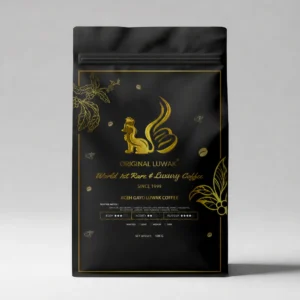
| Original Luwak, Aceh | 100g pouch | $79 | $790 | Wild, MPKG certified |
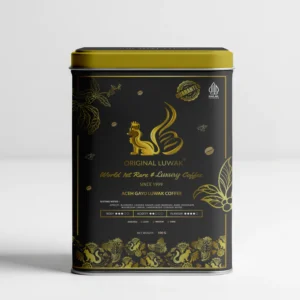
| Original Luwak, Aceh | 100g gift tin | $99 | $990 | Wild, MPKG certified |
| Pure Kopi Luwak, Java | 100g | $125 | $1,250 | Wild, organic |
| Pure Kopi Luwak, Java | 250g | $250 | $1,100 | Wild, organic |
| 1st in Coffee | 100g | $109 | $1,090 | Not specified |
| Volcanica Coffee | 16oz (454g) | $399.99 | $882 | Free-range |
| Kaya Kopi, West Java | 100g | $69 | $690 | Claims wild |
| Kaya Kopi, West Java | 1kg | $649 | $649 | Claims wild |
| Marketplace listings | 100g | $20 to $50 | $200 to $500 | Usually unverified |
Two things stand out. Verified wild sellers cluster between $650 and $1,250 per kilogram regardless of country. And the marketplace tier sits an order of magnitude below the rest, which is the subject of the last section. Green coffee trades on a separate market. Wholesale green Arabica kopi luwak from Sumatra exporters starts around $50 per kilogram FOB, rising to roughly $92 per kilogram once roasted. Retail pricing is not a markup on that figure so much as a different business: small batches, roast-to-order, worldwide shipping, and packaging built to survive a month in transit.
Trying wild kopi luwak for the first time? The 100g pouch from Original Luwak is $79, roasted to order, and works out to roughly seven cups.
Why Two Bags Can Differ by $1,000
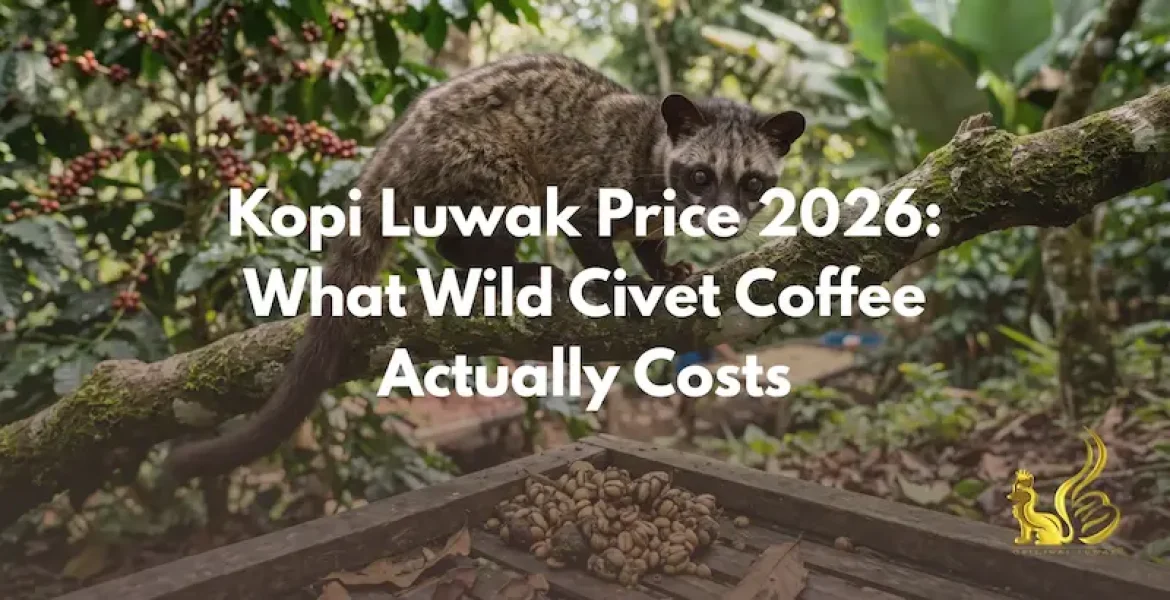
Kopi luwak is produced two ways, and the production model explains most of the price spread. In caged production, civets are confined and fed a coffee-cherry-only diet so that output can be scheduled. Volume becomes predictable, cost per kilogram falls, and the beans reach the market cheaply. In wild production, free-roaming Asian palm civets (Paradoxurus hermaphroditus) select ripe cherries across their own range in the forest, and the season yields whatever it yields.
Nobody schedules that, and nobody scales it. The second model carries costs the first does not. Collectors walk forest ground rather than empty a cage. Yield per collector per day is low and unpredictable. Certification, traceability, and batch grading all add cost on top. That is the structural reason a verified wild lot lands near $1,000 per kilogram while caged product clears at $200.
Scarcity does the rest. Wild supply is capped at a few hundred kilograms per crop year across the whole category, which is why genuine wild kopi luwak is rare in a way that the shelf space in airport duty-free does not reflect. Grading separates lots further. A specialty-graded lot verified by a CQI-certified Q Grader carries a documented cupping score, screen size, moisture reading, and defect count. An ungraded lot carries a story. Buyers pay for the first and are frequently charged for the second. For how kopi luwak sits against other luxury coffees, see our guide to the most expensive coffee in the world.
What Original Luwak Charges
Original Luwak sells in 100 gram formats only, and there is a reason the range stops there. The 100g pouch is $79, reduced from $109. The 100g gift tin is $99, reduced from $149, and arrives with an engraved box and a tasting card. Both are roasted to order, whole bean or ground, in light, medium, or dark roast, and both ship worldwide from Aceh Tengah.
At $79, the pouch works out to $790 per kilogram, which places it below every verified wild seller in the table above. A hundred grams is roughly seven cups at a 15 gram dose, so the coffee itself costs a little over $11 a cup at home, against $30 to $100 for the same cup in a New York cafe. We do sell kilos, and volume pricing is available on request through the contact page. We do not publish a kilo price, and we do not push the format, because a kilogram of kopi luwak sitting open in a cupboard slowly loses the thing you paid for.
What the price covers: single-origin Aceh Gayo grown at 1,200 to 1,700 metres, semi-washed and manually dry-hulled, specialty graded and cupped at 84+ by a CQI-certified Q Grader, screen size 15 to 19, moisture under 13%, defect triage 3 to 6%. Sourcing is covered by MPKG certification through the Gayo Coffee Protection Community, and the coffee is Halal certified. Both are documented on our certifications page.
How to Tell a Fair Price from a Warning Sign
A low kopi luwak price is the most reliable fraud signal in this category, and the arithmetic is simple enough to do in your head. Wild collection produces a few hundred kilograms a year worldwide. Retail packaging, roasting, and international freight alone cost more per 100 grams than some listings charge in total. When a 100 gram pack sells for $20, one of three things is true: the civets were caged, the lot is blended with ordinary Arabica, or there is no civet processing at all.
The duty-free pattern is the clearest example. Walk through an airport in Jakarta, Bali, or Singapore and you will find kopi luwak boxed, ribboned, and stacked in quantities that no wild harvest could supply. Volume on a shelf is itself the tell. Three checks worth more than any price tag:
- Named origin. Not “Indonesia” but a region and collection areas. Ours are Takengon, Bener Meriah, Angkup, Sukarame, Bies, and Pondok Baru.
- Batch-level grading. A cupping score attached to the specific lot, verified by a named qualification, not a brand adjective.
- A certification you can look up. Check the issuing body exists and covers what the seller says it covers.
For the full checklist, see how to tell if kopi luwak is good.
Frequently Asked Questions
How much does kopi luwak cost?
Verified wild kopi luwak costs $600 to $1,300 per kilogram, or roughly $69 to $125 per 100 gram pack. Caged production sells for $100 to $700 per kilogram. In specialty cafés a single cup ranges from $5 in Bali to $100 in New York or London.
How much is kopi luwak per kg?
Wild kopi luwak runs $600 to $1,300 per kilogram at retail in 2026. Caged or unverified product sells for $100 to $700 per kilogram. Wholesale green beans from Sumatran exporters start near $50 per kilogram, rising to roughly $92 once roasted, packed, and ready to ship.
How much does a cup of kopi luwak cost?
Brewed at home, a cup of wild kopi luwak costs $9 to $19 using a 15 gram dose. A 100 gram pouch makes roughly seven cups. In a specialty café the same cup costs $25 to $100, depending on the city and the venue.
Why is kopi luwak so expensive?
Wild civets select their own cherries across forest ground, so yield cannot be scheduled or scaled, and global wild supply runs to a few hundred kilograms a year. Collection labour, batch grading, certification, and roast-to-order production add the rest of the cost.
Is cheap kopi luwak real?
Usually not. Below roughly $30 per 100 grams, the economics of wild collection stop working. Cheap kopi luwak is typically caged production, a blend cut with ordinary Arabica, or not civet-processed at all. Treat an unusually low price as a question rather than a bargain.
Buy Wild Kopi Luwak from Aceh
Original Luwak collects from wild, free-roaming civets in the forests around Aceh Tengah, holds MPKG certification for that sourcing, and has every batch cupped at 84+ by a CQI-certified Q Grader before it is packed. We roast to order, whole bean or ground, light, medium, or dark.
The 100g pouch is $79 and runs to roughly seven cups. The 100g gift tin is $99 and arrives with an engraved box and a tasting card. Both ship worldwide from Aceh Tengah. Not ready to commit to a full pouch? A sample package is available at $100. That is the whole offer. No story attached that the cupping sheet cannot support.