


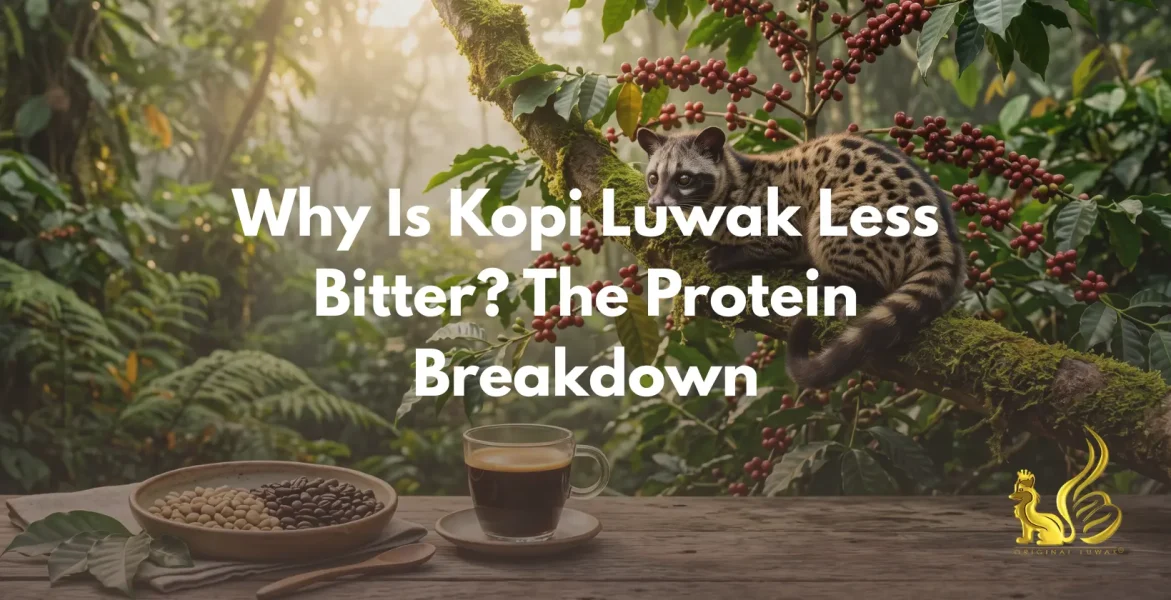
For centuries, wild civet coffee has captivated epicureans worldwide, commanding prestige as one of the most intriguing and velvety beverages in specialty gastronomy. When exploring the distinct sensory profile of civet coffee, coffee connoisseurs and curious epicureans frequently ask: why is kopi luwak less bitter than standard specialty brews?
The answer lies far beyond myth, folklore, or mere novelty. To understand why is kopi luwak less bitter, one must examine the intersection of digestive biochemistry, selective foraging, and thermal roasting physics. Rather than an accidental culinary curio, authentic civet coffee owes its silky texture and low astringency to a profound enzymatic process that occurs at the molecular level. By exploring how proteins cleave inside the digestive tract of the Asian palm civet (Paradoxurus hermaphroditus), we can uncover how nature strips away harshness, leaving behind an exceptionally smooth, full-bodied cup celebrated at Original Luwak.
The Chemistry of Coffee Bitterness: What Normally Causes the Bite?
Understanding why is kopi luwak less bitter requires a foundational look at what makes ordinary coffee bitter in the first place. Most drinkers assume caffeine is the sole culprit behind coffee’s astringent bite. However, caffeine accounts for only 10% to 15% of the perceived bitterness in an average brew, according to sensory and chemical research published by the Specialty Coffee Association (SCA). The dominant contributors to harsh coffee bitterness belong to two distinct chemical classes:
- Chlorogenic Acid Lactones: Formed during light to medium roasting through the thermal degradation of green coffee’s native chlorogenic acids (CGA).
- Phenylindanes: Formed during extended dark roasting when chlorogenic acid lactones break down further, imparting a lingering, harsh acridity on the back of the palate.
- Diketopiperazines (Cyclic Dipeptides): Bitterness precursors generated when intact coffee bean proteins break down under high heat during the Maillard reaction and pyrolysis.
In typical commercial arabica and robusta processing, large structural storage proteins remain locked inside the dense coffee endosperm. When these intact proteins hit the intense thermal energy of the roaster, they undergo pyrolysis, cross-linking into intensely bitter cyclic dipeptides. Without an organic mechanism to diminish these protein precursors prior to roasting, the resulting cup retains a sharp, biting edge.
The In-Vivo Enzymatic Fermentation: How Civet Digestion Alters Bean Biology
The biological journey of genuine civet coffee introduces a natural refining process unmatched by mechanical washed or dry processing methods. When an Asian palm civet ingests ripe coffee cherries, the sweet, sugar-dense fruit pulp (mucilage) undergoes wet digestive fermentation within the animal’s gastrointestinal tract over a 24 to 36-hour transit window.
While the thick, protective parchment layer (endocarp) remains intact, shield-protecting the inner seed from being dissolved, it is porous enough to allow endogenous gastric juices to seep through. When researchers investigated why is kopi luwak less bitter, they discovered that the civet’s gastric juices act as a natural tenderizer for the coffee seed’s protein matrix.
Inside the civet’s stomach and small intestine, gastric proteases primarily pepsin-like and trypsin-like proteolytic enzymes permeate the parchment envelope. These powerful digestive enzymes initiate proteolysis, systematically cleaving large, complex storage proteins into shorter-chain oligopeptides and free amino acids. This enzymatic cleavage directly answers why is kopi luwak less bitter at a cellular level: it dismantles the specific macromolecular proteins before they ever reach the roasting chamber, preventing them from turning into harsh roasting byproducts later on.
[Intact Seed Proteins]
       │
       ▼  (Civet Gastric Proteases: Pepsin / Trypsin-like enzymes)
[Short Oligopeptides + Free Amino Acids]
       │
       ▼  (Controlled Thermal Roasting)
[Volatile Aromatics & Smooth Phenols]  <-- vs. Harsh Diketopiperazines in Standard Beans
Dr. Massimo Marcone’s Research on Civet Digestion
The scientific community did not fully grasp the microscopic reality of this digestive transformation until Dr. Massimo Marcone, an adjunct professor and food scientist at the University of Guelph in Canada, conducted seminal investigations into authentic Indonesian civet coffee. Dr. Massimo Marcone’s pioneering study at the University of Guelph provided empirical data explaining why is kopi luwak less bitter.
Using Scanning Electron Microscopy (SEM), Dr. Marcone compared standard wet-processed Indonesian coffee seeds with beans recovered from civet scat. His findings revealed clear physical and chemical distinctions:
- Surface Micro-Pitting: The outer surface of the civet coffee beans exhibited distinct micro-pores and pitting caused by acidic gastric fluids and proteolytic enzymes boring through the cellular layers.
- Leached Storage Proteins: Electrophoretic protein profiling confirmed that civet beans had significantly lower total protein concentrations than control beans harvested from the exact same agricultural terroir.
- Selective Elemental Leaching: A measurable fraction of water-soluble proteins and bitter-tasting alkaloids had leached out during digestive transit.
His biochemical analysis demonstrated that proteolytic enzymes cleave large protein molecules into small peptides and free amino acids, resolving the scientific mystery of why is kopi luwak less bitter. Research archived on PubMed / National Center for Biotechnology Information consistently correlates this targeted degradation of storage proteins with a marked reduction in downstream cyclic dipeptide generation.
Standard Arabica vs. Wild Kopi Luwak: Biochemical Comparison
To appreciate the molecular contrast, consider how conventional processing diverges from authentic civet processing across key physical and chemical metrics:
| Biochemical Marker | Conventional Washed Arabica | Authentic Wild Kopi Luwak |
| Parchment Integrity | Sealed, solid cellular exterior | Micro-pitted from gastrointestinal acid exposure |
| Endosperm Protein Structure | Intact macro-proteins & globulins | Hydrolyzed into short-chain peptides & amino acids |
| Primary Fermentation Agent | External ambient yeast & bacteria | Internal lactic acid flora & endogenous proteolytic enzymes |
| Post-Roast Diketopiperazines | High (yielding sharp, bitter undertones) | Substantially diminished (yielding mild, clean finish) |
| Inherent Sensory Bitterness | Moderate to high astringency | Extremely low; dominated by sweetness and round body |
| Mouthfeel & Body | Varies by varietal; medium to bright | Heavy, syrupy, lingering chocolate richness |
Roast Reactions: Maillard Dynamics and Reduced Diketopiperazines
Roasting coffee is essentially a complex cascade of non-enzymatic browning reactions. The two most critical thermodynamic events are the Maillard reaction (the reaction between reducing sugars and amino acids) and caramelization.
In standard green coffee beans, long-chain storage proteins require extended roasting temperatures to degrade. During this thermal stress, cyclic dipeptides (specifically proline-containing diketopiperazines) proliferate rapidly, concentrating in the brew as sharp, medicinal bitterness. Because the civet’s gastrointestinal transit has already broken these macro-proteins down into free amino groups, the chemical dynamic changes completely:
- Free amino acids react immediately with simple sugars at lower temperatures, expediting favorable aromatic compound creation (furans, pyrazines, and maltols).
- The precursors required to synthesize bitter cyclic dipeptides are depleted before pyrolysis accelerates.
- This reduction in thermally generated bitter compounds during roasting clarifies why is kopi luwak less bitter across medium and dark roasts.
Rather than developing acrid, burned undertones, coffee produced through this pathway yields aromatic profiles featuring notes of baker’s chocolate, molasses, roasted almond, and clean cedar.
Wild Foraging vs. Caged Feeding: Impact on Ripeness and Palatability
While gastrointestinal biology provides the structural machinery, the ethical and natural foraging habits of wild civets provide another crucial dimension to why is kopi luwak less bitter. In the high-altitude volcanic jungles of Sumatra, Java, and Bali, wild Asian palm civets are discerning nocturnal frugivores. Equipped with keen olfactory senses, a wild civet will inspect hundreds of coffee cherries across several trees before eating only the sweetest, fully ripened cherries at peak Brix levels (sugar content).
Immature/Under-ripe Cherries (High astringent tannins, malic acid)
       │  [REJECTED BY WILD CIVET]
       ▼
Peak Ripeness Cherries (Highest sucrose, balanced organic acids)
       │  [SELECTED BY WILD CIVET]
       ▼
Complete Pulp Digestion + Proteolysis = Ultimate Smoothness
In contrast, industrial human harvesting even selective hand-picking invariably includes a modest percentage of unripe or semi-ripe cherries containing harsh astringent tannins and undeveloped acids. Caged animals in unethical battery farms are force-fed whatever cherries are harvested, regardless of ripeness, destroying this natural selection advantage.
Selective harvesting by wild animals explains a significant part of why is kopi luwak less bitter compared to mass-harvested commercial beans. When you source ethical beans through the Original Luwak wild collection, you are tasting the output of pure natural selection: coffee made exclusively from flawless, sugar-dense cherries.
Sensory Evaluation: Cupping Notes and Flavor Profile of Authentic Kopi Luwak
When coffee tasters evaluate specialty coffee, they score balance, clean cup clarity, sweetness, and aftertaste. During professional SCA cupping sessions, tasters seeking to verify why is kopi luwak less bitter note an exceptionally velvety mouthfeel with notes of chocolate and almond. The sensory journey of authentic wild civet coffee presents distinct taste milestones:
- Aromatics: A fresh, nutty fragrance of vanilla, chocolate, and almond, completely devoid of pungent or grassy aromas.
- Acidity: Remarkably gentle. The natural digestive wash neutralizes sharp, volatile malic and citric acids without eliminating the refreshing brightness that gives coffee structure.
- Body and Texture: Unusually thick, creamy, and coating. The microscopic pitting of the bean allows lipids to emulsify readily during extraction.
- The Finish: A sweet, enduring chocolate aftertaste that lingers cleanly without demanding milk or sugar to mask astringency.
This extraordinarily smooth cup demonstrates how natural biochemistry can transform a daily morning beverage into a soothing, low-acid luxury.
Brewing Guidelines to Highlight Smoothness
Even the finest organic chemistry can be muted by improper extraction. Dialing in your extraction parameters will visibly demonstrate why is kopi luwak less bitter when poured side by side against conventional origins.
To experience this flavor clarity, follow these preparation principles from our comprehensive brewing guide:
- Brewing Method: Pour-over systems (like V60 or Chemex) and French Press immersion bring out the best in civet coffee. French Press highlights the unctuous, syrupy body, while a paper filter clarifies delicate aromatic florals.
- Water Temperature: Keep your water between 90°C and 93°C (194°F to 200°F). Avoid boiling water (100°C), which can scald remaining delicate chlorogenic lactones and cause secondary bitterness.
- Grind Calibration: Use a consistent medium-coarse grind for immersion or medium for pour-over. Uneven fine dust creates channeling and localized over-extraction.
- Water-to-Coffee Ratio: A 1:15 to 1:16 ratio (15 grams of water per 1 gram of freshly ground coffee) provides the ideal extraction balance, allowing the underlying nutty sweetness to shine through.
How to Ensure You Are Getting Genuine Low-Bitterness Civet Coffee
Because wild civet coffee is one of the rarest crops on earth, yielding only small quantities globally each year the market is flooded with synthetic imitations, chemical flavorings, and unethically farmed beans. Discerning buyers seeking authentic beans must understand why is kopi luwak less bitter so they can identify genuine 100% wild harvests versus counterfeit blends.
Counterfeit or industrially farmed beans fail to deliver this smooth taste profile:
- Synthetic Chemical Soaks: Counterfeiters often soak ordinary robusta beans in artificial flavoring agents to mimic civet coffee. These imitations smell sweet in the bag, but brew into an astringent, bitter cup because the underlying storage proteins were never broken down.
- Caged Confinement Operations: Stressed animals in cages produce inconsistent digestive enzymes, and forced feeding eliminates selective foraging. The resulting beans lack both flavor nuance and ethical credibility.
- Traceable Origins: Authentic civet coffee is collected bean-by-bean by highland foraging communities in protected mountain ecosystems.
When purchasing from the Original Luwak online store, every batch is sustainably gathered from wild civets, thoroughly laboratory-cleaned, sun-dried, and expertly roasted to preserve the natural protein transformation.
Taste the Difference of True Protein Breakdown
The delicate smoothness of authentic civet coffee is an extraordinary showcase of natural chemistry. When the instinctive fruit selection of wild civets pairs with in-vivo proteolytic fermentation, coffee bean storage proteins are transformed before they ever enter the roaster.
Ultimately, answering why is kopi luwak less bitter reveals that this rare delicacy is not merely a novelty, but a genuine masterpiece of organic biochemistry. By trading bitter diketopiperazines and harsh acids for sweet aromatics, gentle acidity, and a deep chocolate body, it delivers an incomparable cup of coffee. Experience the authentic, silky elegance of single-origin wild civet coffee by visiting Original-Luwak.Com. Explore our certified, ethically gathered beans and savor a truly smooth brew, perfected by nature.