

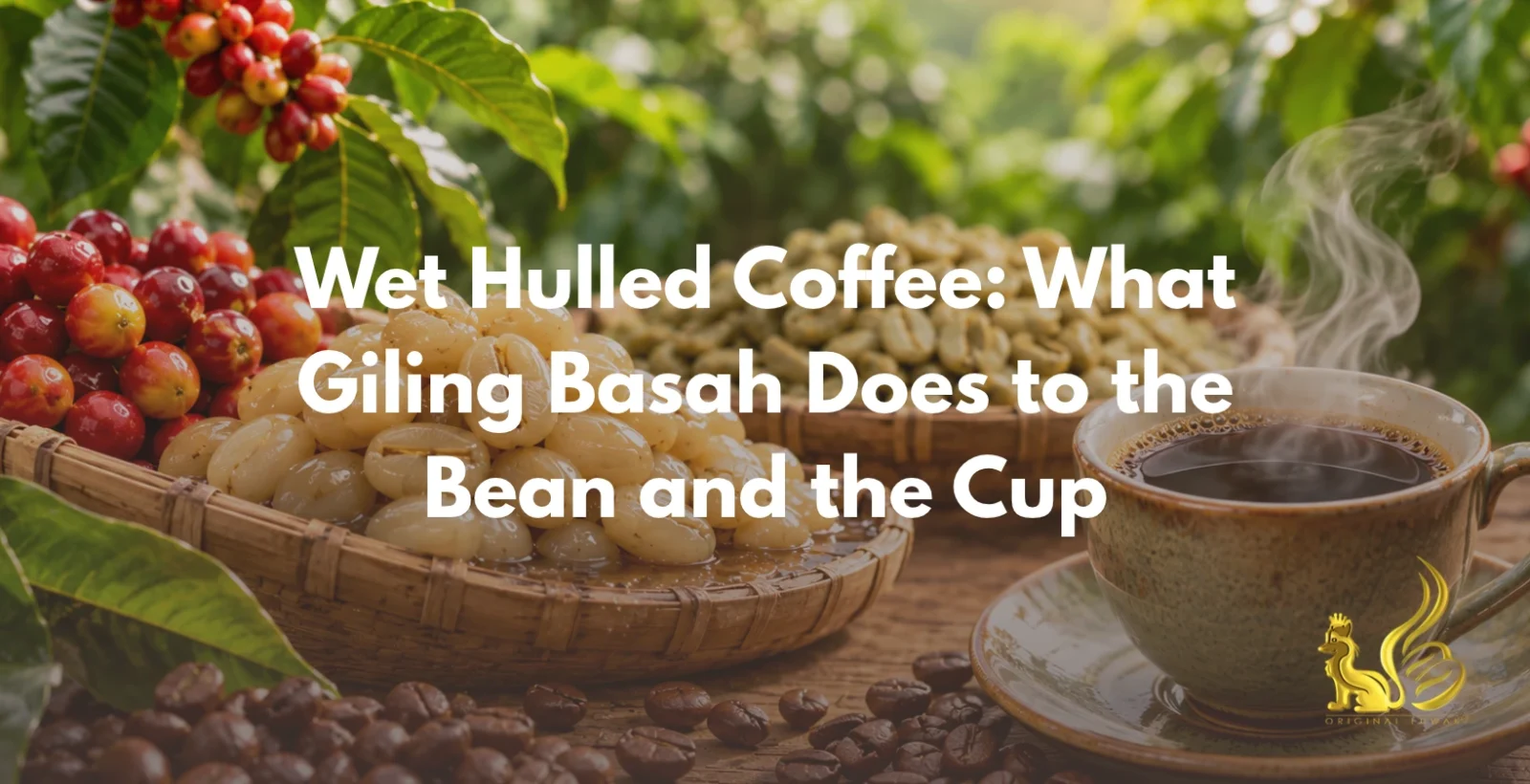
Wet hulled coffee is coffee whose parchment, the papery husk around the green bean, is stripped off while the bean is still wet. In Indonesia the method is called giling basah, and researchers tie it to the heavy, earthy, low-acid taste so much Sumatran coffee is known for. This guide covers how it works, why Sumatra uses it, what it does to the cup, and how to tell from a label whether your coffee was hulled wet or dry.
We write from Aceh Tengah, in the Gayo highlands, where wet hulling is the local norm. Our own beans are not wet-hulled, and we explain why.
Last updated: 4 November 2026
What Wet Hulled Coffee Is
Wet hulled coffee starts like any washed coffee and then takes a shortcut. Elsewhere, washed coffee dries inside its parchment until the husk is brittle, and only then is it hulled. Sumatra commonly reverses the order, and our guide to what is Sumatra coffee covers the island’s regions and trade names.
The steps, as a 2015 Perfect Daily Grind guide to Indonesian wet hulling describes them:
- The cherry is pulped, fermented overnight and washed.
- The wet parchment is sun-dried for only two to three days.
- A huller built for semi-dry parchment strips the husk while the bean is still soft.
- The naked bean finishes drying in the sun, to 12 to 13 percent moisture.
Why Sumatra Hulls Its Beans Wet
Three pressures push Sumatra towards wet hulling: the climate, the way smallholders sell their harvest, and speed.
Humidity
The Perfect Daily Grind guide puts Indonesian humidity at 70 to 90 percent all year, and notes that an average coffee takes at least two to three weeks to dry in parchment even in a warm climate. Without the parchment, the bean dries two to three times faster. On a wet island, fewer days on the patio means fewer days for mould to work.
Smallholder Cash Flow
An FAO project report on the origins of Mandheling coffee character describes North Sumatran Arabica as mostly smallholder coffee, traded wet at around 50 percent moisture from farmer to trader. A farmer who sells wet parchment does not tie up the harvest on a drying floor for weeks before getting paid. The drying, and its risk, moves down the chain.
Speed Through the Chain
The same report describes a standard Indonesian huller refitted for wet coffee that puts through around 800 kilograms of wet green bean an hour, feeding long chains from the mountains of North Sumatra and Aceh to the port of Medan. Our guides to Mandheling Sumatra coffee and Gayo coffee from the Aceh highlands cover those two regions.
Want a Sumatran cup without the wet-hulled weight? Every 100 g pouch we sell is semi-washed and dry-hulled by hand in Aceh Tengah, cupped at 84+ and roasted to order.
What Wet Hulling Does to the Cup
Wet hulling pushes taste in a recognisable direction. In the FAO trial, a control lot dried in its parchment and never wet hulled came out cleaner and more acidic. Wet hulled coffee tends to show four traits:
- Heavy body: rich, strong and syrupy.
- Earthy, herbal flavour: spice, herbs, earth, sometimes cedar or tobacco.
- Low acidity: smooth and flat rather than bright, with little sweetness.
- Uneven consistency: a fast, harsh process leaves more defects.
Roasters use that weight on purpose. A small share of wet hulled coffee boosts the body of a blend, and too much turns it muddy.
You can often see the process before you taste it. Export-ready wet-hulled beans are dark green and patchy, and some buyers call them blue.
Moisture Levels and Defect Risk
The defining number is the moisture left in the bean when the parchment comes off. Figures differ between sources, so the table sets the FAO report beside a 2010 Flores trial by the Indonesian Coffee and Cocoa Research Institute and the Perfect Daily Grind guide.
| Stage | Moisture | Source |
|---|---|---|
| Normal dry hulling | 11 to 14% | FAO |
| Wet hulling | 35 to 45% | FAO |
| Wet hulling | 30 to 40% | ICCRI, 2010 |
| Wet hulling after two to three days of sun | 20 to 24% | Perfect Daily Grind |
| Wet hulled green bean at export | 12 to 13% | FAO, Perfect Daily Grind |
High moisture at hulling is where the risk sits. Hullers can split the soft bean at the ends, a defect known as kuku kambing, or goat’s nail. The FAO report warns that the process leaves coffee susceptible to mould and possible ochratoxin A contamination; in its trial, mould rose the longer wet parchment was stored, and low levels of ochratoxin A appeared in 7 of 42 samples.
That is why grading matters more for wet hulled coffee than for most lots. Our guide to how specialty coffee is graded explains how moisture and defects are checked.
How Original Luwak Processes Its Beans
Original Luwak works in the same humid highlands, and we chose not to wet-hull. Our beans are semi-washed and manually dry-hulled: the parchment stays on until the bean has dried to a stable moisture, then comes off by hand. Drying in parchment is slower. On a wet island, that is the cost of the choice.
The green coffee sits under 13 percent moisture, with screen sizes of 15 to 19 and defect triage of 3 to 6 percent. Every batch is cupped at 84+ by a CQI-certified Q Grader. The cup opens nutty, with vanilla, chocolate and almond, then turns herbal with a gentle spice, soft to medium acidity and a mild body.
Our coffee is also kopi luwak, produced in two very different ways. In caged production, civets are confined and fed a coffee-only diet to force volume; we source only from wild, free-roaming civets across six named harvest areas of Aceh Tengah: Takengon, Bener Meriah, Angkup, Sukarame, Bies and Pondok Baru. Our guide to the luwak coffee process follows each stage from forest floor to roast.
How to Tell Wet Hulled Coffee from a Label
Most bags do not say how the coffee was hulled. Work through these four checks:
- Look for the process words. “Wet hulled” or “giling basah” settle it. “Fully washed” or “dry-hulled” means the bean dried in its parchment.
- Treat “semi-washed” with care. Importers often list wet-hulled lots as semi-washed. Our label reads “semi-washed, manual dry-hulled (not wet-hulled)” for exactly that reason.
- Read the tasting notes. Heavy body, earth, cedar and low acidity point to wet hulling.
- Ask the seller. A producer who knows the hulling method, export moisture and altitude will tell you.
None of this makes wet hulled coffee bad. Plenty of drinkers want that heavy, low-acid cup. The point is to know which one you are paying for.
Frequently Asked Questions
What is wet hulled coffee?
Wet hulled coffee is coffee whose parchment is stripped while the bean is still wet, well above the 11 to 14 percent moisture at which coffee is normally hulled, and then sun-dried to about 12 percent. Called giling basah in Indonesia, it is the dominant method there and gives a heavy, earthy, low-acid cup.
Why is Sumatran coffee wet hulled?
Three reasons: climate, cash flow and speed. Sumatra is humid all year, and stripping the parchment lets beans dry two to three times faster. Smallholders can sell wet parchment to traders instead of drying it for weeks. Mills then hull and dry quickly, moving coffee through a long trading chain to the port of Medan.
Is wet hulled coffee lower quality?
Not by definition, but it is harder to keep consistent. Hulling a soft, wet bean can split it, and holding wet parchment or semi-dry beans invites mould and musty flavours. A carefully handled wet-hulled lot can still cup cleanly. Look for a named producer, a moisture figure and a cupping score before you buy.
Is semi-washed coffee the same as wet hulled?
Not always. Many importers list wet-hulled Sumatran lots as semi-washed, so the term alone does not tell you how the parchment came off. Ask whether the coffee was hulled wet or dry. Original Luwak’s beans are semi-washed and manually dry-hulled, after the bean has dried to a stable moisture.
Taste a Dry-Hulled Sumatran Cup
Original Luwak sells kopi luwak coffee from wild, free-roaming civets in six named harvest areas of Aceh Tengah, semi-washed and dry-hulled by hand, cupped at 84+ by a CQI-certified Q Grader and roasted to order, light, medium or dark, whole bean or ground. We ship worldwide.
The 100g pouch is $79 and gives you roughly seven cups. The 100g gift tin is $99. Our kopi luwak price guide puts those figures in context. When you are ready, buy kopi luwak direct from the people who collect it.