

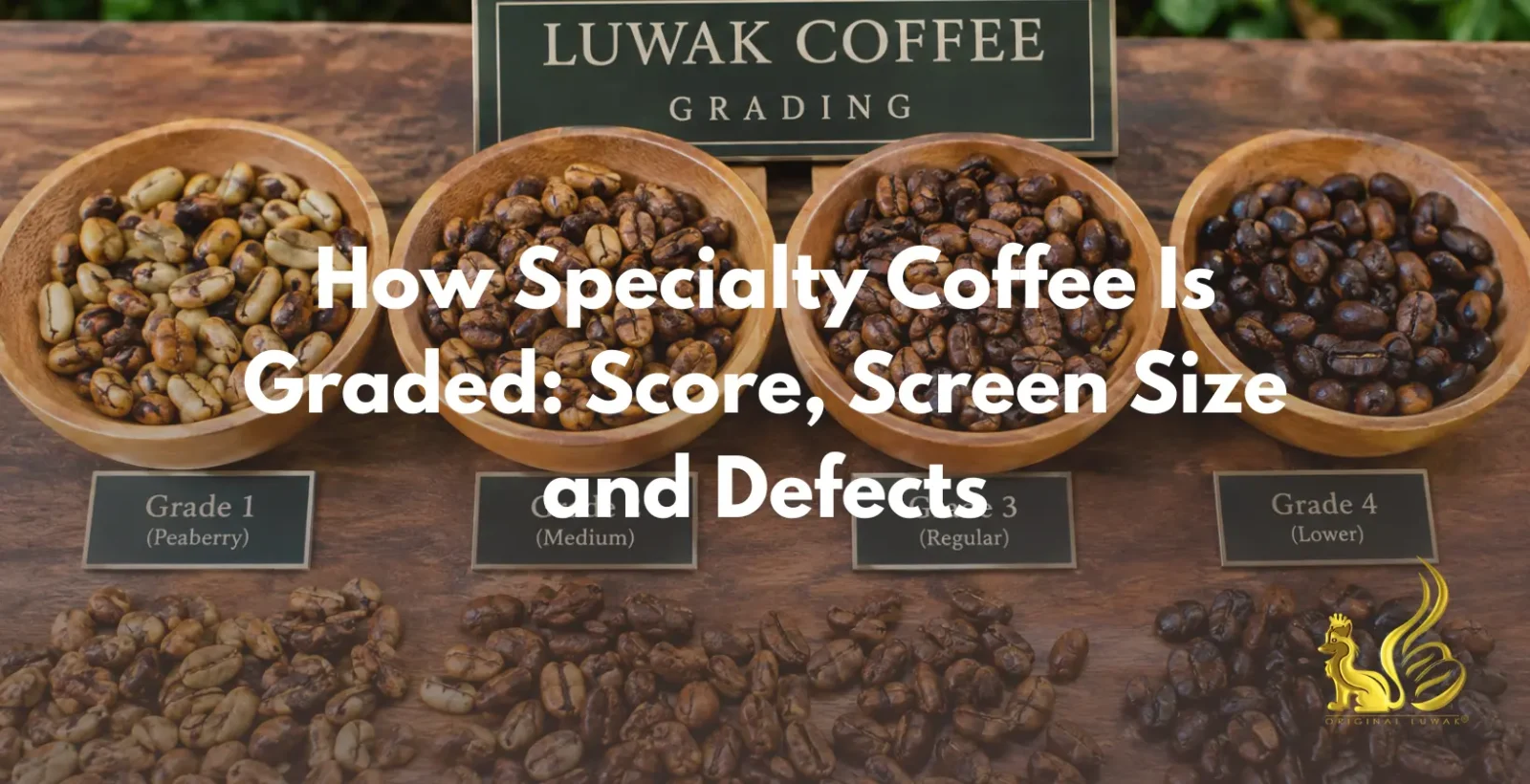
Specialty coffee grading is the set of checks that lets a seller write “specialty grade” or “84+” on a bag and be held to it. Half of it is done on the green bean before roasting: screen size, moisture and a defect count on a weighed sample. The other half is done in the cup, by a trained grader, on a 100-point form. Kopi luwak is sold almost entirely on trust, so knowing which of those checks a seller can actually show you is the most useful thing you can learn before spending $79 on 100 grams. This guide explains both halves, then grades one batch of our own coffee in front of you.
Last updated: 05 October 2026
What Specialty Coffee Grading Measures
Specialty coffee grading answers two questions about a lot of coffee: is the green bean physically sound, and does the roasted cup score well enough to be called specialty. For most of the last twenty years the working rule in the trade has been that a coffee scoring 80 points or more on the 100-point cupping form is specialty grade, and anything below it is commercial. That line still decides prices at origin and it is still what most labels mean.
The Specialty Coffee Association, which publishes the standards, now defines specialty coffee more broadly, as coffee “recognized for its distinctive attributes” that earn it extra value in the market, and it has replaced its 2004 cupping form with a Coffee Value Assessment that separates describing a coffee from scoring it. In practice the grading a buyer meets in 2026 is still the two-part check below: green grading first, then the cup.
Kopi luwak adds one complication. The civet has already selected the cherry and the bean has passed through an animal, so the green grade tells you how carefully the beans were collected, cleaned and sorted afterwards. A poor green grade on kopi luwak points to careless collection, cleaning or sorting after the civet, whatever the production model, wild or caged.
Green Grading: Screen Size, Moisture and Defects
Green grading happens before the roaster, on raw beans, and it is the part most sellers never mention. Three measurements matter.
- Screen size. Green beans are shaken through a stack of perforated screens, numbered by hole size in 64ths of an inch. The FAO’s classification annex records screen 18 at 7 millimetre holes, screen 16 at 6.3 and screen 14 at 5.5. A bean that stops on screen 15 is a little under 6 millimetres across; one on screen 19 is about 7.5. Size alone is not quality, but an even screen range roasts evenly, and a declared range means someone sorted the lot.
- Moisture. Green coffee is read with a moisture meter. Too wet and the lot risks mould in transit; too dry and the beans turn brittle and roast unevenly. The older classification in the FAO annex allowed 9 to 13 percent for specialty grade; most exporters now work to a tighter band inside that.
- Defects. A weighed sample is spread on a table and every defective bean is counted: black, sour, insect-damaged and broken beans, stones and sticks. The SCA’s 2004 green standard, which the association now describes as superseded by the Coffee Value Assessment but still cites as the historical benchmark, allowed zero category 1 defects and no more than five full category 2 defects in a 350 gram sample. Category 1 defects are the serious ones, such as full black beans; category 2 are lesser faults, several of which add up to one full defect.
The table below sets those measurements beside what Original Luwak publishes for its own wild kopi luwak.
| Measurement | What the check is | Original Luwak’s published spec |
|---|---|---|
| Screen size | Beans sorted by size through numbered screens | Screen 15 to 19 |
| Moisture | Meter reading on the green bean | Under 13 percent |
| Defects | Counted on a weighed sample | 3 to 6 percent of each lot removed at sorting |
| Processing | How the parchment came off | Semi-washed, manual dry-hulled, not wet-hulled |
| Species | Botanical check | Arabica, single-origin, Aceh Tengah |
We publish the share of beans removed at sorting, 3 to 6 percent, rather than a count per 350 grams, because with wild-collected kopi luwak the sort is the point: the beans arrive from forest edges, not from a mill, and the triage separates a clean lot from a rough one.
Cupping: How the Score Is Built
Cupping is the second half of specialty coffee grading and the half that produces the number on the bag. A sample is roasted light, ground, and steeped in several bowls of hot water. The grader breaks the crust, clears the foam, and tastes each bowl with a spoon as it cools, scoring the attributes on a form: fragrance and aroma, flavour, aftertaste, acidity, body, balance, uniformity across the bowls, clean cup, sweetness, and an overall impression. The scores add to a total out of 100, and 80 is the specialty line.
The person doing this should be a Q Grader. The credential is issued by the Coffee Quality Institute; a grader passes 20 exams across 9 modules, covering cupping protocols, olfactory and gustatory skill, green defect identification and roast level identification, then returns for an in-person calibration every third year to keep it. Calibration is what makes an 84 in Aceh mean the same as an 84 in Antwerp. Every batch of Original Luwak kopi luwak is cupped by a CQI-certified Q Grader and scores 84+ before it is packed; MPKG certification, Halal certification and our AEKI-AICE membership are documented on our certifications page.
One sentence on the cup, because this article is about the grade: our batches open nutty, with vanilla, chocolate and almond, then turn herbal and gently spicy, with soft to medium acidity and a mild, clean finish. The full notes, stage by stage, are on our kopi luwak taste page.
Every 100 g pouch comes from a batch that has been screen-sorted, moisture-checked, defect-triaged and cupped at 84 or above by a Q Grader before it is roasted to your order.
A Worked Example: One Batch of Wild Kopi Luwak
Here is the standard green-grading and cupping sequence, with the figures Original Luwak publishes for its wild kopi luwak from the harvest areas around Aceh Tengah placed where each check falls. The figures are ours; the order of steps is the trade’s standard one.
- Step 1, the sample. A weighed sample is drawn from the dried, hulled lot. By this point the beans are semi-washed, dried to a stable moisture and dry-hulled by hand.
- Step 2, the screens. The sample goes through the screen stack. Our lots are sorted to screen 15 to 19.
- Step 3, the meter. Moisture is read on the green bean. Our published figure is under 13 percent.
- Step 4, the sort. Defective beans are triaged out. Across our lots that removes 3 to 6 percent of the beans.
- Step 5, the roast sample. In standard cupping practice a small portion is roasted light for the table, separately from the roast you will eventually receive.
- Step 6, the cup. The CQI-certified Q Grader cups the sample across several bowls and scores it. 84+ is the figure we publish for every batch we sell.
- Step 7, the roast to order. The batch is then roasted to order, light, medium or dark, whole bean or ground, and packed into the 100 g pouch or the 100 g gift tin.
The step most sellers skip is the sixth. A cupping score is cheap to print and expensive to earn, so the question to ask is not “what does it score” but “who cupped it, and are they certified”.
How a Buyer Checks the Grade
Specialty coffee grading only protects you if you can see it. Kopi luwak is produced in two very different ways: in caged production, civets are confined and fed a coffee-only diet to force volume, and in wild production, free-roaming civets select ripe cherries from their own range and the yield is whatever the season gives. Original Luwak sources only the second, from wild civets around Aceh Tengah, verified through MPKG certification and traceable to six named harvest areas.
So look for these on the page before you look at the price:
- A cupping score, with who cupped it. “84+ by a CQI-certified Q Grader” can be checked; “premium quality” cannot.
- A screen range and a moisture figure. Their presence tells you the lot was green-graded at all.
- The processing method named. Semi-washed and dry-hulled is a specific claim; “carefully processed” is not.
- Named harvest areas, not a country. Takengon, Bener Meriah, Angkup, Sukarame, Bies and Pondok Baru are on a map.
- The wild or caged question answered in plain words, with the verification next to it.
The grade is one of several checks. Our buyer’s guide to spotting real kopi luwak covers the others.
Frequently Asked Questions
What score makes a coffee specialty grade?
By the convention the coffee trade has used for about two decades, a coffee that scores 80 points or more out of 100 on the cupping form is specialty grade. The Specialty Coffee Association now defines specialty coffee more broadly by its attributes, but the 80-point line still decides most prices and labels.
What is a Q Grader?
A Q Grader is a coffee taster certified by the Coffee Quality Institute after passing 20 exams across 9 modules covering sensory skill, cupping, green grading and roast identification. Certified graders attend an in-person calibration course every third year to keep the credential, so their scores stay comparable with other graders worldwide.
What does screen size mean in coffee grading?
Screen size is the size of a green coffee bean, measured by the numbered sieve it stops on. The numbers run in 64ths of an inch, so a screen 16 bean is about 6.3 millimetres across. Original Luwak sorts its wild kopi luwak to screen 15 to 19, so the beans roast evenly.
How many defects are allowed in specialty coffee?
Under the SCA’s 2004 green coffee standard, a 350 gram sample of specialty grade coffee may contain zero category 1 defects, the serious faults such as full black beans, and no more than five full category 2 defects, the lesser faults. Original Luwak publishes its triage rate instead: 3 to 6 percent of each lot is removed at sorting.
Is kopi luwak graded the same way as other coffee?
Yes. Wild kopi luwak from Original Luwak goes through the same green grading, screen size, moisture and defect sorting, and the same cupping by a CQI-certified Q Grader, as any specialty Arabica. What differs is the collection before grading, which is why the sort rate and the wild-or-caged question matter more for kopi luwak.
Buy Specialty-Graded Wild Kopi Luwak from Original Luwak
Original Luwak sells wild kopi luwak coffee from the Gayo highlands of Aceh Tengah, collected from wild, free-roaming civets, verified through MPKG certification, screen-sorted to 15 to 19, and cupped at 84+ by a CQI-certified Q Grader before it is roasted. We roast to order, light, medium or dark, whole bean or ground, and ship worldwide from Aceh.
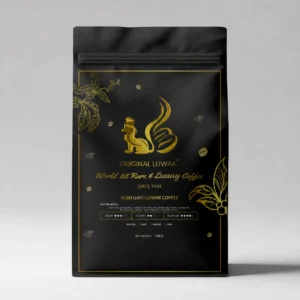
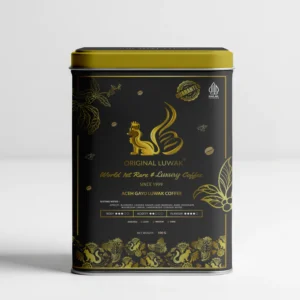
The 100 g pouch is $79 and gives you roughly seven cups; the 100 g gift tin is $99, with an engraved box and a tasting card. Our kopi luwak price guide shows how those figures compare with the rest of the market. When you are ready, buy kopi luwak that has been cupped by a CQI-certified Q Grader before it is roasted.