

A civet cat skunk is a spotted skunk. In parts of the United States, “civet cat” is an old local name for the small spotted skunks of the genus Spilogale, and it has nothing to do with the civets of Asia and Africa. The two animals sit in different families, live on different continents and do different things with their scent. This guide explains where the name is recorded, how a spotted skunk differs from a real civet, and why the mix-up matters if you came here from a cup of kopi luwak. We write from Aceh Tengah, Sumatra, where the only civet we know is the real one.
Last updated: 22 October 2026
What Is a Civet Cat Skunk?
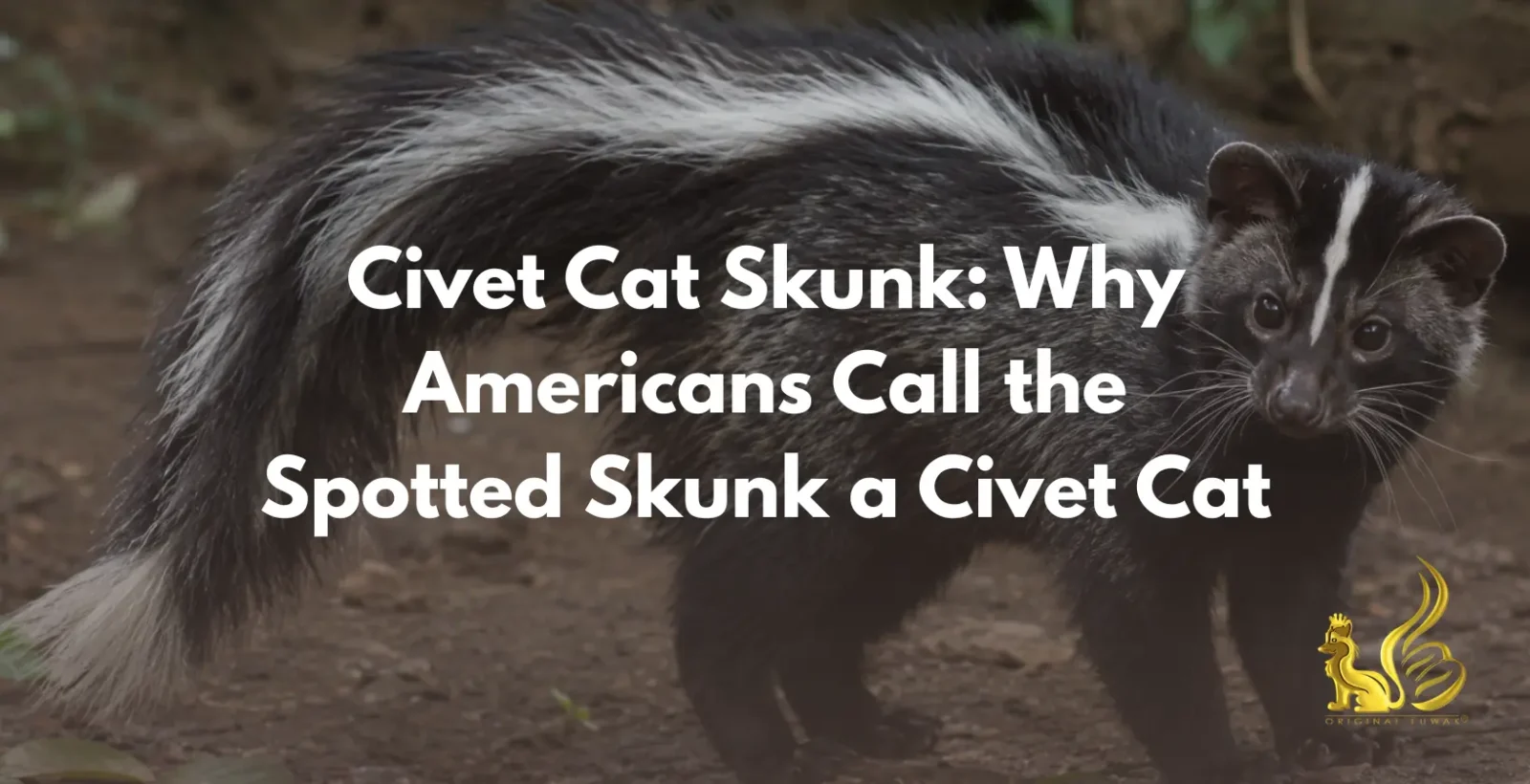
State wildlife agencies record the name directly. The Alabama Department of Conservation’s page on the eastern spotted skunk lists its other names as civet cat, polecat and hydrophoby cat, the last an old word for rabies. The North Carolina Wildlife Resources Commission says the species is often nicknamed a civet or polecat.
So when an American hunter, farmer or grandparent talks about a civet cat in the barn, they almost always mean a spotted skunk. There are two common species in the United States, according to Animal Diversity Web, the University of Michigan’s species database:
- Eastern spotted skunk (Spilogale putorius): from Minnesota and Pennsylvania south through the Appalachians, the Midwest and Florida, and as far west as eastern Wyoming and Colorado.
- Western spotted skunk (Spilogale gracilis): the western counterpart, an agile climber and an excellent digger.
Neither is a civet, and neither is a cat. No source we found explains how the name started. Our reading is that a small, spotted, strong-smelling night animal reminded people of the civets known from the perfume trade.
The Spotted Skunk Up Close
The eastern spotted skunk is about the size of a squirrel. Outdoor Alabama puts its average weight at one to one and a half pounds, under a kilogram. It is mostly nocturnal, secretive and rarely seen.
Its defence is famous. When threatened, it does a handstand on its front legs, raising its body and tail so it can watch the threat while it aims its scent glands. Animal Diversity Web’s account of the eastern spotted skunk says the spray can reach up to 4 metres, usually at the face, and that it is the only member of the skunk family that can climb. Its diet changes with the seasons: rabbits and corn in winter, mice and insects in spring, insects with some fruit, birds and eggs in summer, and mostly insects in autumn.
The North Carolina commission adds that spotted skunks are very localised. In that state they are found only in the mid to upper elevations of the mountains.
Civet Cat Skunk vs Real Civet
Put the two side by side and the shared name falls apart:
| Spotted skunk (“civet cat”) | Asian palm civet (the luwak) | |
|---|---|---|
| Family | Mephitidae (skunks and stink badgers) | Viverridae (civets and genets) |
| Where it lives | North and Central America | South and Southeast Asia |
| Weight | About 1 to 1.5 lb (under 1 kg) | 1.3 to 5 kg, about 3 kg on average |
| Diet | Mostly insects and small animals, some fruit | Mostly ripe fruit, plus small animals and insects |
| Scent | Sprays a defensive secretion up to 4 m | Uses its scent glands mainly to mark its ground |
| Life in trees | The only skunk that climbs | Spends most of its time in fruit trees |
The family line matters most. Animal Diversity Web’s overview of the Mephitidae explains that skunks were long treated as part of the weasel family, Mustelidae, until molecular evidence set them apart as a family of their own, with 13 species in four genera. Three of those genera live in the Americas. The fourth, the stink badgers of the genus Mydaus, lives on islands in Indonesia and the Philippines, so Indonesia does have a skunk relative, just not one that makes coffee.
The real civet is behind every 100 g pouch we sell: wild Asian palm civets in Aceh Tengah, never caged, with each batch cupped at 84+ and roasted to order.
Scent: The One Thing They Share
Both animals are known for smell, which is probably why the names crossed. They use it very differently.
A skunk’s scent is a weapon. All members of the skunk family can project a sticky, foul-smelling secretion from glands under the tail. Stink badgers spray over a metre, and the striped skunk more than 6 metres.
A civet’s scent is mostly a signature. Civets mark their ground by pressing glands near the tail against objects, and the African civet’s version was prized for centuries as a perfume fixative. Our guide to civet musk tells that story. Nobody ever made perfume from a skunk.
Health and Safety: Rabies and Bites
The skunk side carries a real disease concern. Animal Diversity Web describes rabies as a significant problem for skunks, and the striped skunk as a notorious carrier. That is one reason “hydrophoby cat” appears among the spotted skunk’s old names. Treat any skunk that behaves strangely in daylight as a job for a wildlife officer, not a broom.
Civets have their own, smaller list of risks, mostly bites from animals that are cornered or handled. If you came here worried about the real civet, our answer to is civet cat dangerous goes through it species by species.
Why the Mix-Up Matters for Coffee
Search results blur these animals together all the time. “Civet cat” brings up skunks, and kopi luwak weasel coffee, a name used in Vietnam, makes people picture a weasel. The animal behind the coffee is neither. Our civet vs mongoose guide clears up the other common misidentification, and the African civet cat profile covers the heavier civet of the perfume trade.
The coffee comes from the Asian palm civet alone. Animal Diversity Web’s account of the Asian palm civet describes a tree-living animal that picks the best and ripest fruit and leaves the rest for later, which is exactly the habit that makes kopi luwak possible. Our kopi luwak animal guide covers what the luwak is and what its digestion does to the bean.
How the civet lives decides what you are buying. Caged production keeps civets in pens and feeds them cherries; that is a different and cheaper product. Our civets in Aceh Tengah are wild and free-roaming, and we collect only what they leave on the forest floor in six named harvest areas at 1,200 to 1,700 metres. For the full picture of the coffee itself, start with what is civet coffee.
Frequently Asked Questions
What is a civet cat skunk?
It is a spotted skunk. In parts of the United States, “civet cat” is a traditional local name for the eastern and western spotted skunks, genus Spilogale. State wildlife agencies in Alabama and North Carolina record the nickname. The animal is a true skunk, family Mephitidae, and only distantly related to Asian or African civets.
Is a spotted skunk a civet?
No. Spotted skunks belong to Mephitidae, the skunk and stink badger family, while civets belong to Viverridae. Spotted skunks live in North and Central America and weigh under a kilogram. Civets live in Asia and Africa, and the Asian palm civet behind kopi luwak weighs about 3 kilograms.
Why is a spotted skunk called a civet cat?
No source we found records the origin. The likeliest reason is resemblance: a small, spotted, strong-smelling night animal reminded people of the civets known from the perfume trade. Other old names for the eastern spotted skunk include polecat and hydrophoby cat, according to Alabama’s state wildlife agency.
Does a civet cat skunk have anything to do with kopi luwak?
No. Kopi luwak comes only from the Asian palm civet, which eats ripe coffee cherries in Indonesia and other parts of Asia. Spotted skunks live in the Americas and mostly eat insects and small animals. The shared nickname is the only link between them.
Meet the Real Civet’s Coffee
Original Luwak sells kopi luwak coffee collected after wild, free-roaming Asian palm civets in Aceh Tengah, cupped at 84+ and roasted to order, light, medium or dark, whole bean or ground. We ship worldwide.
The 100g pouch is $79 and gives you roughly seven cups. The 100g gift tin is $99. Our kopi luwak price guide puts those figures in context. When you are ready, buy kopi luwak direct from the people who collect it.