

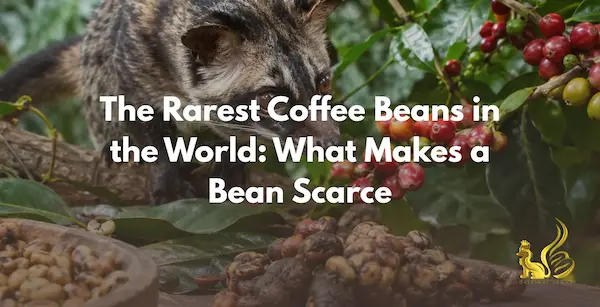
Rarest coffee beans in the world are rare for three different reasons, and most lists blur them together. Some exist in tiny annual volumes, some can only grow inside a narrow band of mountain, and some lose most of their raw cherry in processing. This guide separates the three, puts a sourced figure on each coffee where one exists, and leaves out what nobody can measure. We write from Aceh Tengah, where our own scarcity is set by a wild animal.
What Makes the Rarest Coffee Beans Rare
Scarcity in coffee can be measured, once you say which measure you mean:
- Annual production: how many kilograms exist in a year, worldwide.
- Growing range: where the plant can grow and still carry the name.
- Process yield: how much raw cherry survives to become finished coffee.
Price is a fourth number, and it is not a measure of rarity. A coffee can top the list of the most expensive coffee because a few roasters bid for one lot on one evening. That tells you how much they wanted it, not how much of it exists. This guide keeps the two apart.
St Helena coffee is often named too. We found no current, island-wide production figure we could cite, so it is left out rather than guessed at.
Four Rare Coffees, Three Kinds of Scarcity
What limits each coffee, the figure behind it, and its source:
| Coffee | What limits it | Sourced figure | Source |
|---|---|---|---|
| Black Ivory, Thailand | Herd size and process yield | About 500 lb (roughly 225 kg) produced in 2023 | National Geographic, Dec 2023 |
| Record Panama Geisha lot | Size of the competition lot | One 20 kg lot, Best of Panama 2025 | Global Coffee Report, Aug 2025 |
| Jamaica Blue Mountain | Growing range | Grown at 3,000 to 5,500 ft; 239,885 boxes in 2022 | Jamaica Information Service |
| Wild kopi luwak, Aceh Tengah | The wild animal | No fixed annual figure: the yield is whatever the season gives | Original Luwak |
The smallest volumes come from animal-processed coffees. The best-known mountain name is produced at commercial scale: its scarcity is a boundary, not a shortage.
Black Ivory: Scarcity Built Into the Process
Black Ivory is an Arabica coffee fed to elephants in Surin province, Thailand, then recovered from their dung. Its scarcity starts with the herd. National Geographic reported in December 2023 that the founder works with the owners of seven elephants, and that production came to about 500 pounds in 2023, roughly 225 kilograms for the whole world.
Process yield does the rest. The producer’s own pages put the conversion at 20 to 33 kilograms of cherry per kilogram of finished coffee, depending on the page, because many beans are chewed or never recovered.
That is why Black Ivory coffee is one of the few coffees whose world output is counted in kilograms. It is also captive production: the same report quotes researcher Neil D’Cruze, who notes that little is publicly known about the elephants’ living conditions and that they are still captive, penned animals. Every 100 g pouch we sell is a wild lot from named harvest areas in Aceh Tengah, cupped at 84+ by a CQI-certified Q Grader and roasted to order.
Panama Geisha Auction Lots: Scarcity by the Lot
Panama Geisha is the coffee professional tasters most often call rare, and its scarcity works differently. Geisha is grown on many farms, so the coffee as a whole is not tiny. The competition lot is.
At the 2025 Best of Panama auction, the record-setting coffee from Hacienda La Esmeralda was a single 20 kilogram lot of washed Geisha scored 98 out of 100, as Global Coffee Report recorded in August 2025. After roasting, that is roughly a thousand cups at a 15 gram dose, and one buyer took all of it.
This is scarcity by selection. A farm splits its harvest into small lots, and the year’s best lot is rare because it is the best one. Next year there will be another. It is the kind of rarity most tied to price.
Jamaica Blue Mountain: Scarcity by Altitude
Jamaica Blue Mountain is rare because of where it has to grow to carry the name. According to the Jamaica Information Service, only coffee grown between 3,000 and 5,500 feet, about 915 to 1,675 metres, can be classified as Jamaica Blue Mountain. Coffee from below 3,000 feet is sold as Jamaica High Mountain.
The volume is not small by the standards of this list. Jamaica counts its crop in boxes, and the government reported 239,885 boxes of Blue Mountain coffee for 2022. The mountain has only so much slope inside that band, so supply has a ceiling. Inside it, the crop is exported like any serious origin.
From our side of the world: the gardens we work with in Aceh Tengah sit at 1,200 to 1,700 metres, almost the same band. Altitude gives you a dense, slow-ripening bean. It does not, on its own, give you a rare one.
Wild Kopi Luwak: Scarcity Set by the Animal
Wild kopi luwak is the one coffee here whose supply nobody can plan. Kopi luwak is produced in two very different ways. In caged production, civets are confined and fed a coffee-only diet to force volume, so output can be scheduled to demand. In wild production, free-roaming civets, the Asian palm civet (Paradoxurus hermaphroditus), select ripe cherries from their natural range, and the yield is whatever the season gives. Original Luwak sources only the second.
We do not publish an annual tonnage, because wild collection does not produce a fixed one. Our collectors work the civets’ feeding range at forest edges and in shade-grown gardens around Takengon, Bener Meriah, Angkup, Sukarame, Bies and Pondok Baru, and bring back what is there. Nothing in that sequence responds to an order. Our story page explains how we have sold wild kopi luwak this way since 2008.
Process yield narrows it further. Each lot is semi-washed and manually dry-hulled, then sorted to screen 15 to 19, moisture under 13% and defect triage of 3 to 6%, before a CQI-certified Q Grader cups it at 84+. The sourcing carries MPKG certification, listed on our certifications page with our Halal certification and AEKI-AICE membership.
Caging is the only way to make more, and it changes the product. A civet fed nothing but coffee is not choosing a ripe cherry from a mixed diet, so the argument that its digestion improves the bean stops being plausible. The supply side, season by season, is in our answer to is kopi luwak rare.
Which Kind of Rarity Matters to a Buyer
A tiny annual volume says supply cannot be stretched. A legal growing band says the name is protected. A small auction lot says a jury preferred it that year. None of them says the coffee in your cup is good.
Ask any seller of the rarest coffee beans, us included, for three things: a production figure or an honest reason there isn’t one, the place it grew, and a batch cupping score with the grader’s name. “Limited” printed on a box answers none of them.
Frequently Asked Questions
What are the rarest coffee beans in the world?
It depends on the measure. By annual volume, Black Ivory, at about 500 pounds in 2023, and wild kopi luwak, whose yield depends on free-roaming civets, are among the smallest. By lot size, the record Panama Geisha of 2025 was a single 20 kilogram lot. By growing range, Jamaica Blue Mountain is limited by altitude.
Does a rarer coffee always cost more?
No. Price and rarity are separate measurements. Record auction prices are set by a few buyers competing for one small lot, while a coffee that is scarce every year can sell for far less. Jamaica Blue Mountain is range-limited yet produced at commercial scale. Check the production figure and the cupping score, not the price alone.
Why is Jamaica Blue Mountain coffee considered rare?
Because only coffee grown between 3,000 and 5,500 feet on Jamaica’s Blue Mountains can carry the name; lower-grown coffee is sold as Jamaica High Mountain. The crop itself is commercial in scale, with 239,885 boxes of Blue Mountain reported for 2022, so its scarcity is a fixed growing area rather than a tiny harvest.
Can wild kopi luwak production be increased?
No, not without changing what it is. Wild kopi luwak depends on free-roaming civets choosing ripe cherries in their natural range, so the yield is whatever the season gives. The only way to raise output is caging civets on a coffee-only diet, which is caged production, a different and cheaper product.
Try Wild Kopi Luwak from Original Luwak
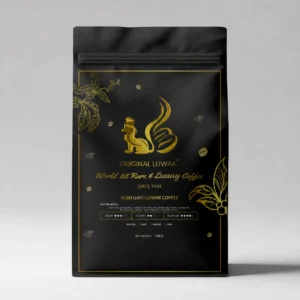
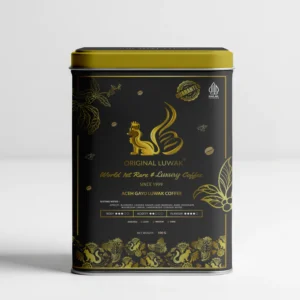
Original Luwak sells kopi luwak coffee from wild, free-roaming civets in six named harvest areas of Aceh Tengah, MPKG certified and cupped at 84+. We roast to order, light, medium or dark, whole bean or ground, and ship worldwide.
The 100g pouch is $79 and gives you roughly seven cups. The 100g gift tin is $99 and arrives with an engraved box and a tasting card. Our kopi luwak price guide puts those figures in context. When you are ready, buy kopi luwak direct from the people who collect it.