


Black Ivory coffee and kopi luwak are the two animal-refined coffees people actually consider buying, and they get confused constantly. One passes through an elephant in Thailand, the other through a civet in Indonesia. They cost different amounts, taste nothing alike, and raise different questions about the animal. If you are weighing one against the other, or arrived here from a list of the most expensive coffee in the world, this is the straight comparison.
Last updated: 25 September 2026
What Black Ivory Coffee Actually Is
It is made by feeding Arabica cherries to elephants in Surin province, northeast Thailand, then recovering the beans from their waste. The beans are grown further north, in Chiang Rai. The company was founded by Blake Dinkin in 2012, and mahouts, the elephants’ keepers, do the collecting.
Scarcity is the economic story, but the published numbers are shakier than they look. The producer’s own website gives the conversion ratio as 33 kilograms of cherry per kilogram of finished coffee on one page and 20 on another, so treat it as a range, not a settled figure. Transit time through the animal is given as 12 to 72 hours by the company, 10 to 72 elsewhere, and 15 to 30 in 2012 press coverage. Output is small and specific: the producer puts recent harvests at around 500 pounds, roughly 225 kilograms.
One thing is not in dispute: the cherries are mixed into the elephants’ feed with rice, bananas and tamarind. This is managed feeding on a working elephant camp, not an animal foraging by choice. Black Ivory coffee beans were once sold almost entirely to luxury hotels; the company now sells direct to individual buyers online as well.
What Kopi Luwak Actually Is
Kopi luwak is made the same way in principle and differently in every detail that matters. The animal is the Asian palm civet, Paradoxurus hermaphroditus, a fruit-eating omnivore that is not a cat and not in the cat family at all. It belongs to Viverridae.
Here the wild and caged distinction decides everything. In caged production, civets are confined and fed a coffee-only diet to force volume. In wild production, free-roaming civets select ripe cherries from their natural range, and the yield is whatever the season gives. Original Luwak sources only the second, from wild civets in the forests around Aceh Tengah, in the Gayo highlands of Sumatra.
That distinction is not marketing. Animal Diversity Web records the palm civet as a frugivorous omnivore eating figs, mango, rambutan and papaya, plus insects, eggs and small animals. A civet on that diet has a working digestive enzyme system. A caged civet fed nothing but coffee cherry does not. That is a plausibility argument rather than proof, and it only holds for wild sourcing. For the wider family of coffees refined by other animals, we keep an overview of animal-processed coffees separately.
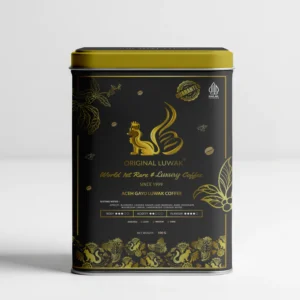
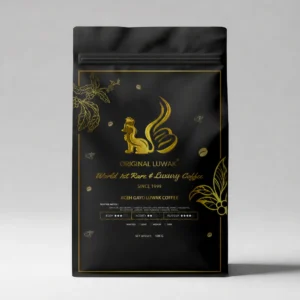
Want to skip the comparison? Original Luwak’s wild Aceh Gayo lot ships worldwide in a 100 g pouch, roasted to order. About seven cups at a 15 gram dose.
What You Pay Per Cup
As of September 2026, the Black Ivory coffee producer’s own shop lists 40 grams at $170 and a half pound at $900, with a second, cheaper line at $90 for 40 grams and $440 for a half pound. That works out to roughly $1,940 to $4,250 per kilogram depending on which line and pack size you choose. At a 15 gram dose, a single cup lands somewhere between about $34 and $64. Served in a hotel, it has been reported at around $50 a cup.
Original Luwak’s 100 gram pouch is $79, reduced from $109. That is about $790 per kilogram, or roughly $11 a cup at the same 15 gram dose. So Black Ivory coffee runs roughly two and a half to five times our price per kilogram. Whether that gap buys you anything is the actual question, and the answer depends less on the animal than on what the roaster did with the bean. For the full breakdown of what wild civet coffee costs by format and why the band is so wide, see our kopi luwak price guide.
One thing worth knowing before you compare any two prices in this category. In our reading of the market as of 2026, verified wild kopi luwak does not sell below about $600 per kilogram, while caged kopi luwak retails from about $100 per kilogram. That is our assessment as a producer rather than an independent survey, but a very cheap bag is telling you something.
How the Two Cups Taste
Black Ivory is described by its producer as cacao and spice with red fruit and tamarind, and notably little bitterness. Worth knowing: those descriptors are not consistent across the company’s own pages, which variously list chocolate, tobacco and leather, date and plum, and pu’erh tea. That is a producer’s marketing copy, not a cupping we ran, so take it as reported rather than measured. We have never tasted it.
Original Luwak’s Aceh Gayo lot is cupped at 84+ by a CQI-certified Q Grader, batch by batch. The aroma is fresh and nutty: vanilla and chocolate with a gentle almond note underneath. The cup reads herbal and refreshing with a gentle spice through the middle. Acidity is soft to medium, never sharp; the body soft and mild; the finish clean rather than heavy. Notes shift between batches, because different forest areas and a different fruit season move them. We say so rather than pretending every bag is identical.
Processing explains a lot of it. Original Luwak is semi-washed and manual dry-hulled, not wet-hulled, so the cup stays clean instead of carrying the heavy, earthy weight wet-hulled Sumatran coffee often carries. For the full notes and the protocol behind them, see what we publish on kopi luwak taste.
Research on the civet side is real but narrower than the marketing suggests. Marcone’s 2004 study in Food Research International found measurable protein changes in civet-processed beans. That finding is about civets. Do not assume it transfers to elephants; nobody has shown that it does.
The Animal Question, for Both
Neither coffee escapes this, and you should not buy either without asking. It would be easy for us to criticise the elephant side and go quiet about our own. We are not going to do that, so here is both.
Black Ivory’s producer states that its elephants are cared for by mahouts who feed and bathe them, and its founder says he works only with elephants he considers unsuitable for tourism work. That is the company’s own account of its own operation, which is worth exactly what any self-description is worth, ours included.
There is published criticism, and you should weigh it. National Geographic quotes wildlife researcher Neil D’Cruze pointing out that little is publicly known about the living conditions of elephants used for coffee, and that the animals are captive and penned whichever way you frame it. Having tasted the coffee, he said the flavour did not justify the price or the ethical questions around the wider industry. There is also a broader argument, made by animal-advocacy writers, that animal-processed coffee is unnecessary as a category. We think that argument deserves an answer rather than silence.
The structural difference is this: an elephant is a large captive animal that must be fed, housed and handled by people every day, while a wild civet is not handled at all. That is not a claim about how well either operation is run. It is a difference in what the model requires.
On the kopi luwak side, the welfare criticism is aimed squarely at caged production, and it is justified. Original Luwak’s answer is wild sourcing plus the things that can be checked: MPKG certification, Halal certification, AEKI-AICE membership, and batch verification by a CQI-certified Q Grader. Those are documented on our certifications page. Collectors work the civets’ feeding range at forest edges and shade-grown gardens in Takengon, Bener Meriah, Angkup, Sukarame, Bies and Pondok Baru. Nothing is caged and nothing is force-fed. If you cannot verify a producer’s sourcing, treat the welfare claim as unproven. That applies to us as much as to anyone else.
The Verdict
Buy Black Ivory coffee if the point is the experience: the rarity, the story, a single remarkable cup you will talk about. At $34 to $64 a cup it is an event, not a habit. Go in having read the welfare criticism above, not just the producer’s copy.
Buy wild kopi luwak if the point is the coffee. At about $11 a cup you can actually drink it through a month, compare batches, and decide for yourself whether the process does anything you can taste. You also get a verifiable chain: a named region, named harvest areas, a cupping score per batch, and a grader’s name behind it.
The honest summary is that these are not really competitors. One is a luxury experience sold by the gram; the other a specialty coffee with an unusual origin story.
Try It Yourself
Original Luwak’s wild Aceh Gayo lot is roasted to order, whole bean or ground, light, medium or dark. A 100 g pouch is about seven cups at a 15 gram dose. You can buy kopi luwak direct from Aceh, shipped worldwide, and judge the cup yourself!
Frequently Asked Questions
What is Black Ivory coffee?
Black Ivory coffee is an Arabica coffee refined by elephants in Surin province, Thailand, then recovered from their waste by mahouts. It was founded by Blake Dinkin in 2012. The producer gives the conversion ratio as between 20 and 33 kilograms of cherry per kilogram of finished coffee, depending on which of its pages you read, and puts recent annual harvests at around 500 pounds.
Is Black Ivory coffee better than kopi luwak?
Neither is objectively better. Black Ivory is described by its producer as cacao and spice with little bitterness, though its own tasting notes vary from page to page. Wild kopi luwak from Aceh reads nutty and herbal with soft acidity and a clean finish, cupped at 84+ per batch. Black Ivory costs roughly two and a half to five times more per kilogram.
Which is more expensive, Black Ivory or kopi luwak?
Black Ivory. As of September 2026 it runs roughly $1,940 to $4,250 per kilogram depending on pack and line. In our reading of the market, verified wild kopi luwak sits in a band of about $600 to $1,300 per kilogram. Anything far below that band is unlikely to be wild.
How is Black Ivory coffee made?
Arabica cherries are mixed into the elephants’ feed with rice, bananas and tamarind. The producer says the beans pass through the digestive system over roughly 12 to 72 hours, though other published figures range from 10 to 72 hours and, in 2012 press coverage, 15 to 30. Mahouts then recover, wash and dry them before roasting.
Is either coffee cruel to the animal?
Caged kopi luwak production is the documented welfare problem in this category and is worth avoiding. Wild production, where free-roaming civets choose their own cherries, involves no confinement. Black Ivory uses captive working elephants, and researchers quoted by National Geographic have questioned how much is publicly known about their conditions. Ask any producer, including us, what can be independently verified before you buy.