


The Black Ivory coffee cost, as of October 2026, is $170 for a 40 gram pack of the producer’s elephant-refined line, which the producer says is enough for two cups. That is $85 a cup before you have ground a bean, and the half-pound pack barely lowers it. This guide takes every pack the producer currently sells, converts each one to a price per 100 grams, per kilogram and per cup, shows the working, and then runs the same arithmetic on wild kopi luwak from Aceh so both sit on one page. If you want to know what the elephant coffee is and how it is made, our Black Ivory coffee price comparison covers that. This page is only about the money.
Last updated: 08 October 2026
Black Ivory Coffee Cost in October 2026: The Producer’s Prices
Black Ivory is sold direct by its producer in Thailand, in two lines and two pack sizes, and we read the shop prices on 2 October 2026. The table below gives the Black Ivory coffee price for those four listings, converted to a common basis. Nothing in it is estimated.
| Pack (as listed, October 2026) | Price | Per 100 g | Per kilogram |
|---|---|---|---|
| The Treasure, 40 g | $170 | $425 | $4,250 |
| The Companion, half pound (227 g) | $900 | $397 | $3,970 |
| The Mahout’s Treasure, 40 g | $90 | $225 | $2,250 |
| The Mahout’s Companion, half pound (227 g) | $440 | $194 | $1,940 |
The working, so you can check it: $170 divided by 40 grams is $4.25 per gram, which is $425 per 100 grams and $4,250 per kilogram. A half pound is 227 grams, so $900 divided by 227 is $3.97 per gram, or $3,970 per kilogram. The two cheaper packs convert the same way.
Two things the table hides. First, the two lines are not the same coffee. The producer describes the Mahout’s line as a blend of Black Ivory with Arabica beans that were not refined by elephants, made to be more affordable. So the Black Ivory coffee price for coffee that has actually passed through an elephant is $3,970 to $4,250 per kilogram; the $1,940 floor belongs to a blend. Second, the producer includes worldwide shipping in those prices, which is worth remembering when you compare them with anything else.
What One Cup of A Black Ivory Coffee Cost
A per-kilogram figure is useless unless you know the dose, and here the producer helps: its product pages state that 40 grams is “enough for two 8-ounce cups”, which is a 20 gram dose. At the producer’s own dose, the cost per cup is simply the pack price divided by the cups in the pack.
| Pack | Cups at 20 g | Cost per cup at 20 g | Cost per cup at 15 g |
|---|---|---|---|
| The Treasure, 40 g, $170 | 2 | $85 | $64 |
| The Companion, 227 g, $900 | about 11 | about $79 | $60 |
| The Mahout’s Treasure, 40 g, $90 | 2 | $45 | $34 |
| The Mahout’s Companion, 227 g, $440 | about 11 | about $39 | $29 |
The last column matters because most people do not brew at 20 grams. The common specialty dose, and the one printed on our own pouch, is 15 grams to about 240 ml, which is the same 8-ounce cup. At 15 grams the per-cup cost is the per-kilogram price multiplied by 0.015: $4,250 × 0.015 = $63.75, call it $64; $1,940 × 0.015 = $29.10. The half-pound Companion gives 227 ÷ 20 = 11.35 cups, so $900 ÷ 11.35 = $79.30.
So the honest one-line answer is this. A cup of Black Ivory costs $29 to $64 at a standard 15 gram dose and $39 to $85 at the producer’s 20 gram dose, and if you want only the elephant-refined coffee rather than the blend, the band narrows to $60 to $85 a cup. <p style=”border-left:4px solid #DFB13F;background:rgba(223,177,63,0.10);padding:16px 20px;margin:28px 0;”>Want the civet version of this category at about $12 a cup? You can <a href=”https://original-luwak.com/buy-kopi-luwak-coffee/”>buy kopi luwak</a> collected from wild civets in Aceh Tengah, roasted to order and cupped at 84+ before it is packed.</p>
The Same Arithmetic for Our Aceh Pouch
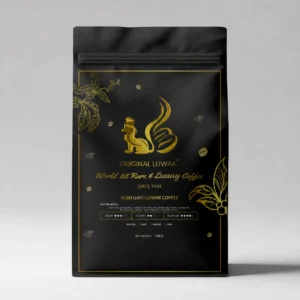
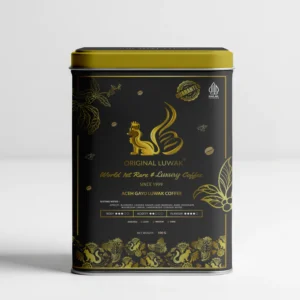
Original Luwak sells wild kopi luwak coffee in 100 gram formats only, and the same conversion applies. The 100 g pouch is $79 [confirm current price on the product page], which is $790 per kilogram. The 100 g gift tin is $99, or $990 per kilogram. At a 15 gram dose a pouch gives 100 ÷ 15 = 6.7 cups, which is why we say roughly seven, and the cost per cup is $790 × 0.015 = $11.85. The gift tin lands at $14.85 a cup. Those figures are the pack price alone, with nothing added for shipping, so compare them with that in mind.
Our pouch is one price point inside a wider band. In our reading of the market as of 2026, verified wild kopi luwak retails between $600 and $1,300 per kilogram, which is $9 to $19.50 a cup at 15 grams, while caged kopi luwak sells from about $100 to $700 per kilogram, or $1.50 to $10.50 a cup; the full table by format is in our kopi luwak price guide. The two bands exist because kopi luwak is produced in two very different ways. In caged production, civets are confined and fed a coffee-only diet to force volume. In wild production, free-roaming civets select ripe cherries from their natural range, and the yield is whatever the season gives. Original Luwak sources only the second, from wild civets in the forests around Aceh Tengah, in Takengon, Bener Meriah, Angkup, Sukarame, Bies and Pondok Baru, and that sourcing is verified through MPKG certification, documented on our certifications page alongside our Halal certification and AEKI-AICE membership.
Put the two coffees side by side at the same 15 gram dose and the ratio is plain. The elephant-refined line at $60 to $64 a cup is about five times our $11.85; the blended Mahout’s line at $29 to $34 is about two and a half to three times. Or count it in packs: $170 buys two cups of The Treasure at the producer’s dose, or two of our pouches with $12 to spare, which is about fourteen cups of wild kopi luwak. We are not going to tell you which of those is the better buy, because they are not the same product and the arithmetic cannot settle that for you. It can only tell you what each dollar is buying.
Why Elephant Coffee Costs This Much
Three things set the Black Ivory coffee price, and only one of them is in the cup. The first is yield. The producer’s own pages give the conversion as 33 kilograms of cherry per kilogram of finished coffee in one place and 20 in another, and a March 2024 report in Food Republic repeats the 33 figure, so treat it as a range of 20 to 33 kilograms. Many cherries are chewed, dropped or passed where nobody can recover them.
The second is total supply. The producer’s product page puts the 2025 harvest at about 495 pounds, roughly 225 kilograms, for the whole world. National Geographic reported about 500 pounds for 2023, so the figure barely moves from year to year. At that volume there is no economy of scale to find, and every kilogram has to carry the cost of feeding, housing and handling working elephants and paying the mahouts who collect the beans. That is managed feeding on an elephant camp, which is a cost structure, not a foraging animal.
The third is position. A coffee that sells at around $4,000 a kilogram and can actually be ordered sits at the top of the retail side of the most expensive coffee list, below the auction lots nobody can add to a cart. Being the answer to that question is itself worth money, and the price reflects it.
Frequently Asked Questions
How much does Black Ivory coffee cost?
As of October 2026 the producer’s shop lists the elephant-refined line at $170 for 40 grams and $900 for a half pound, which is $3,970 to $4,250 per kilogram. A cheaper Mahout’s line, a blend with Arabica not refined by elephants, is $90 for 40 grams and $440 for a half pound.
How much is a cup of Black Ivory coffee?
At the producer’s stated dose of 20 grams, a 40 gram pack makes two cups, so The Treasure costs $85 a cup and the blended Mahout’s pack $45. At the more common 15 gram dose the range is $29 to $64 a cup, with the elephant-refined line alone at $60 to $64.
How much does Black Ivory coffee cost per pound?
Using the October 2026 shop prices, the half-pound pack at $900 works out to $1,800 per pound, and the 40 gram pack at $170 converts to about $1,930 per pound. The blended Mahout’s line is $880 to $1,020 per pound. National Geographic reported $1,500 per pound in December 2023.
Why does Black Ivory coffee cost so much?
Yield and volume. The producer gives the conversion as 20 to 33 kilograms of cherry per kilogram of coffee, and puts the 2025 harvest at about 495 pounds for the whole world. Feeding, housing and handling working elephants, paying the mahouts, and worldwide shipping are all carried by those few hundred kilograms.
Is the cheaper Mahout’s Blend the same coffee?
No. The producer describes the Mahout’s line as Black Ivory mixed with Arabica beans that were not refined by elephants, sold at roughly half the price to be more affordable. If you want coffee that has actually passed through an elephant, the relevant cost is the Treasure and Companion packs, at $3,970 to $4,250 per kilogram.
Black Ivory Coffee Cost: Buy Wild Kopi Luwak from Aceh
Original Luwak sells wild kopi luwak from the forests around Aceh Tengah, collected from wild, free-roaming civets that are never caged and never force-fed, verified through MPKG certification, and cupped at 84+ by a CQI-certified Q Grader before it is packed. The beans are semi-washed and manually dry-hulled, and the cup opens nutty, with vanilla, chocolate and almond, then turns herbal with a gentle spice and a clean finish. We roast to order in light, medium or dark, whole bean or ground, and ship worldwide from Aceh.
The 100 g pouch is $79 and gives you roughly seven cups at about $11.85 each. The 100 g gift tin is $99 and arrives with an engraved box and a tasting card. If the arithmetic above makes sense to you, buy kopi luwak direct from the people who collect it.