

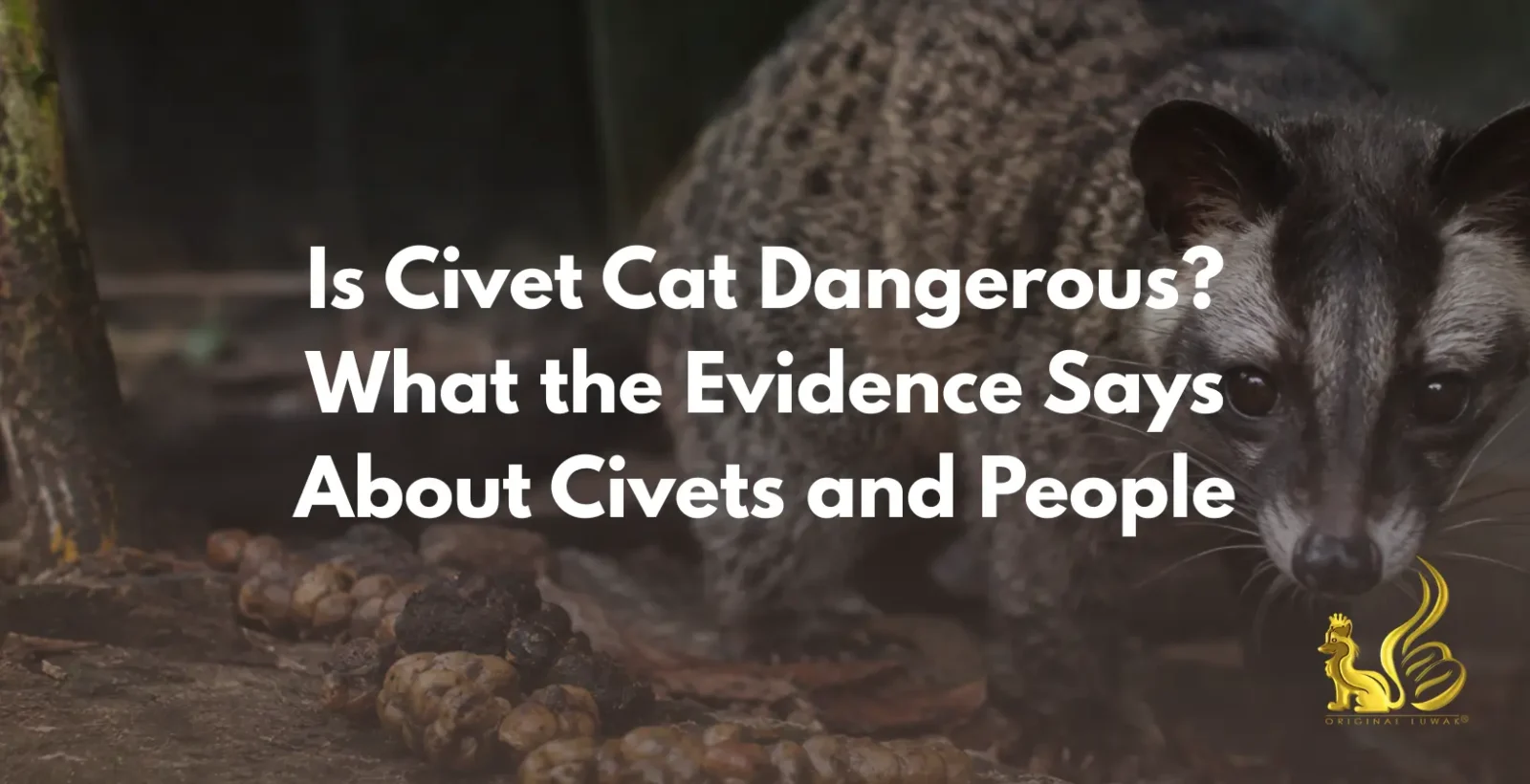
Is civet cat dangerous? For most people, most of the time, no. Civets are shy, solitary and nocturnal, and the species behind kopi luwak weighs about 3 kilograms. The full answer has three parts, though: a cornered civet bites, some civets can carry disease, and one civet species was caught up in the 2003 SARS outbreak in southern China. This guide takes each part in turn, with the source for every claim, and separates the species, because “civet cat” covers several different animals. We write from Aceh Tengah, Sumatra, where wild civets forage through the coffee gardens we collect from.
Last updated: 20 October 2026
Is Civet Cat Dangerous? The Short Answer
Here is what the evidence supports, risk by risk:
- Temperament: civets are solitary night animals that avoid people. The accounts we read describe no unprovoked attacks.
- Bites: a civet that is cornered, captured or handled defends itself with teeth and claws.
- Disease: some species can carry rabies, though rarely, and masked palm civets in Chinese wildlife markets carried a virus closely related to SARS in 2003.
- Nuisance: civets raid fruit orchards and poultry, and a civet living in a roof is loud at night.
None of that makes a wild civet in a forest a threat to you. It does make a captured or caged civet, and a crowded wildlife market, a different matter.
How Big Are Civets, and Do They Attack People?
“Civet cat” is a nickname, not a species. Civets belong to the family Viverridae, not to the cats, and our kopi luwak animal guide explains how the Asian palm civet, the luwak, got its feline name. Size varies a great deal across the family. Figures from Animal Diversity Web, the University of Michigan’s species database:
| Species | Typical adult weight | What it does near people |
|---|---|---|
| Asian palm civet | 1.3 to 5 kg | Raids orchards and plantations; noisy in roofs and barns |
| Small Indian civet | 2 to 4 kg | Takes chickens; bites if cornered or captured |
| Masked palm civet | 3.6 to 5 kg | Raids fruit crops near forest; takes poultry |
| Large Indian civet | 5 to 11 kg | Preys on chickens |
| African civet | 12 to 15 kg | Forages in henhouses; may kill lambs |
The pattern is clear. Civets come into conflict with people over fruit and poultry, not over people themselves. The largest of them, the African civet cat, is a farm nuisance in parts of Africa, and even there the damage recorded is to henhouses and lambs.
The Asian palm civet, the species in the coffee story, spends most of its life in trees. Animal Diversity Web’s account of the Asian palm civet notes that it is usually silent, but snarls, hisses and spits when alarmed or harassed. That is a warning, not an attack.
We never handle the animals. Every 100 g pouch starts as droppings collected from the forest floor in Aceh Tengah, then is cupped at 84+ and roasted to order.
Bites, Scratches and Handling
Bites are the realistic risk, and they follow handling. Animal Diversity Web’s account of the small Indian civet is direct about it: these civets bite if cornered or captured, in self-defence, and they bite and claw when confronted. A civet in a box, a cage or a pair of hands is a frightened wild animal with sharp teeth.
That is where most people actually meet civets: in tourist plantations, cafés and the pet trade, not in forest. A 2016 study in Animal Welfare of civet coffee tourism in Bali documented caged civets kept for visitors, and its concerns were for the animals’ welfare. A stressed, confined animal is also the one most likely to bite the person reaching in.
The practical advice is simple. Do not pick up, feed or corner a civet. If one moves into a roof, call a local wildlife service rather than trapping it yourself. In many places it is also protected: the Asian palm civet is covered by India’s Wildlife Protection Act of 1972, among other laws. Any animal bite deserves prompt medical advice.
Civets and Disease: What SARS Actually Showed
Rabies first. Animal Diversity Web notes that the small Indian civet can carry rabies, although rarely, and that its overall role as a disease vector seems minimal. It also records that masked palm civets in Japan proved highly susceptible to canine distemper, a disease of dogs rather than people.
The SARS link is real, but it is narrower than the headlines suggest. In 2003, the US Centers for Disease Control and Prevention summarised the evidence in its October 2003 report on animal traders in Guangdong. Researchers had found a coronavirus closely related to the SARS virus in masked palm civets offered for sale at a live animal market in Shenzhen, with a sequence 99% identical to the human virus. Among animal traders tested, 13.0% carried antibodies, against 1.2% to 2.9% in the control groups, and 72.7% of those who traded mainly masked palm civets did. The report also says plainly that these findings do not identify the natural reservoir of the virus.
A follow-up in Emerging Infectious Diseases in December 2004 sharpened the picture. About 78% of civets sampled from a live animal market in Guangzhou carried antibodies, against about 10% from farms, and none of the farm civets sampled in Henan and Hunan. The authors suggested the civets were infected mainly in markets, where many species were traded together, rather than being the natural source.
Three points follow. The animal involved was the masked palm civet, Paguma larvata, not the Asian palm civet behind kopi luwak. The setting was a crowded wildlife market, not a forest. And the risk ran through trading and handling live animals, which is exactly the contact that wild collection avoids.
What This Means for Kopi Luwak
Kopi luwak begins with a civet eating ripe coffee cherries and passing the seed. If you are new to it, our guide to what is civet coffee explains the process and the names. Whether the coffee is safe in the cup is a separate question about processing, and our guide to is kopi luwak safe to drink answers it, from washing and drying to roasting temperatures.
The animal side comes down to how the coffee is produced. Caged production confines civets, handles them and feeds them cherries, which is bad for the animals and the closest any coffee comes to the market conditions above. In Aceh Tengah, at 1,200 to 1,700 metres, our civets are wild and free-roaming: nobody catches, cages or touches them, and we collect only what they leave on the forest floor. Our certifications page sets out what stands behind each batch, from MPKG and Halal certification to cupping by a CQI-certified Q Grader.
Frequently Asked Questions
Is a civet cat dangerous to humans?
Not usually. Civets are shy, solitary and nocturnal, and they avoid people. The real risks are a bite from a civet that is cornered, captured or handled, and, rarely, disease. In 2003 masked palm civets in Chinese wildlife markets carried a virus closely related to SARS, a risk linked to trading live animals.
Do civets bite?
Yes, in self-defence. Animal Diversity Web notes that small Indian civets bite if cornered or captured, and Asian palm civets snarl, hiss and spit when harassed. A civet left alone has no reason to bite. Never pick one up, feed it or trap it yourself, and get medical advice after any animal bite.
Can civets carry diseases?
Some can. The small Indian civet can carry rabies, though rarely. Masked palm civets sold in a Shenzhen live animal market in 2003 carried a coronavirus 99% identical to human SARS, according to the US CDC. Studies pointed to infection in crowded markets rather than in wild or farmed civets.
Are civets dangerous to pets or livestock?
They can be a nuisance to poultry keepers. Small Indian, large Indian and masked palm civets all take chickens, and the African civet forages in henhouses and may kill lambs. The Asian palm civet mainly raids fruit orchards and plantations. Secure coops at night and keep fruit stores closed.
Coffee From Civets Nobody Touches
Original Luwak sells kopi luwak coffee collected after wild, free-roaming Asian palm civets in six named harvest areas of Aceh Tengah, cupped at 84+ and roasted to order, light, medium or dark, whole bean or ground. We ship worldwide.
The 100g pouch is $79 and gives you roughly seven cups. The 100g gift tin is $99. Our kopi luwak price guide puts those figures in context. When you are ready, buy kopi luwak direct from the people who collect it.