


Civet coffee, known in Indonesia as kopi luwak, is the world’s rarest and most talked-about coffee, made from coffee cherries that are eaten, partially digested, and passed by the Asian palm civet before the beans are collected, cleaned, and roasted. It is a drink built on a strange premise and an even stranger reputation: prized by collectors, doubted by critics, and dogged by real questions about animal welfare.
This guide explains what civet coffee actually is, how it is made from bean to cup, why it commands some of the highest prices in the coffee world, and how to tell genuinely wild, ethically sourced luwak from the caged production that has damaged the industry’s name.
Last updated: July 2026
What is Civet Coffee?
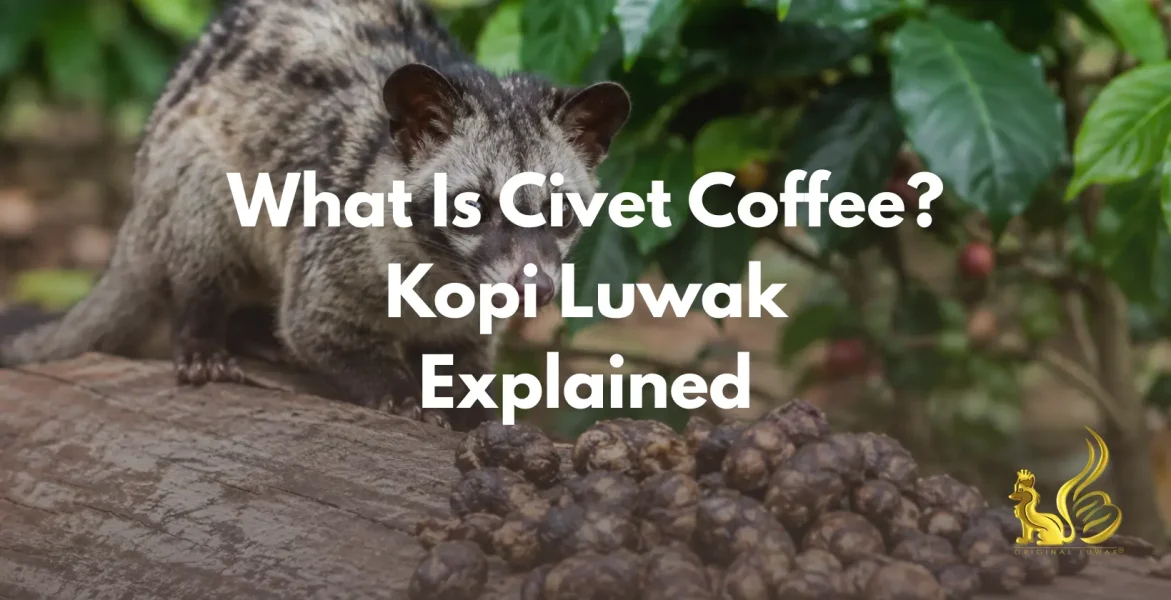
Civet coffee is coffee produced from beans that an Asian palm civet (Paradoxurus hermaphroditus) eats as whole coffee cherries and later excretes partially digested. The civet consumes only the ripe fruit and cannot break down the hard seed inside, so the bean passes through its gut intact. Producers collect these beans from the droppings, wash them thoroughly, dry them, and roast them into the coffee sold worldwide as kopi luwak.
The name explains itself once you know the words. In Indonesian, kopi means coffee and luwak is the local name for the palm civet; our guide to the kopi luwak animal explains why it is not a cat. Because of that origin, the drink picks up blunt nicknames online, from poop coffee and civet poop coffee to the cruder cat shit coffee. Those search terms all point to the same thing: civet coffee beans that owe their character to an animal’s digestion rather than a machine.
Two facts define its status. First, it is rare, because a wild civet eats a limited amount of cherry and its droppings must be gathered by hand across forest floors. Second, it is a luxury product, routinely ranked among the most expensive coffee in the world. That combination of scarcity and price is why kopi luwak became famous far beyond ordinary coffee circles.
How did Civet Coffee Originate?
Civet coffee originated on the coffee plantations of colonial Indonesia in the early nineteenth century, under Dutch rule. The Dutch introduced Arabica coffee to islands such as Java and Sumatra as an export cash crop, and forbade local farmers and laborers from harvesting the beans for their own use.
Denied the cultivated crop, plantation workers noticed that wild civets were entering the estates at night to feed on the ripest cherries, then leaving the undigested beans behind in their droppings. The workers gathered, cleaned, and roasted those beans to brew their own coffee. What began as a workaround became a discovery: the coffee tasted noticeably smooth and less bitter, and word of its unusual quality spread.
The drink stayed largely regional until the late twentieth century. Kopi luwak was first imported to the West around 1991, and international fame followed after high-profile television and film mentions in the 2000s pushed it into the global spotlight. From there, demand rose sharply, and with it came the commercial pressures that still shape the industry today.
How is Civet Coffee Made from Bean to Cup?
Civet coffee is made through a sequence that starts in the forest and ends in your cup, and every step matters to the final quality. For genuinely wild luwak, the process cannot be rushed or fully mechanized, which is exactly why authentic civet coffee beans stay rare.
- Selection by the civet. A free-roaming civet feeds at night and instinctively chooses only the ripest, sweetest coffee cherries. This is nature’s own quality control, and it is the reason wild luwak starts from better raw fruit than machine-picked lots.
- Digestion and natural fermentation. The cherries pass through the civet’s digestive tract over roughly a day, where enzymes and stomach acids ferment the beans from the inside.
- Collection by hand. Farmers walk the forest floor and hand-collect the droppings that contain the intact beans. This step is slow, labor-intensive, and impossible to scale artificially.
- Cleaning and washing. The beans are separated from the droppings and washed repeatedly to remove all external residue. Proper cleaning is non-negotiable for a safe, hygienic final product.
- Sun-drying. The washed beans are dried, usually under the sun, until they reach a stable moisture level for storage.
- Hulling and sorting. The dried outer parchment layer is removed, and defective beans are sorted out by hand.
- Roasting. The green beans are roasted in small batches. Because luwak beans are naturally low in bitterness, they are usually given a lighter roast to preserve their delicate origin flavors.
- Grinding and brewing. The roasted beans are ground fresh and brewed, releasing the smooth, full-bodied cup luwak is known for.
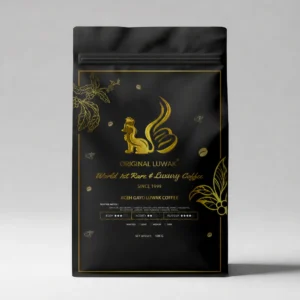
At Original Luwak, we source only from free-roaming wild civets in the highlands of Aceh, and every batch is small, hand-collected, cleaned, and roasted to protect that character. If you want to see the full journey visually, our team documents each stage from cherry to cup.
Curious to taste the result of this process? Browse our wild kopi luwak collection or request a sample.
Where is Civet Coffee Produced Around the World?
Civet coffee is produced mainly across Southeast Asia, with Indonesia as the original and largest source. The key producing countries are Indonesia, the Philippines, Vietnam, and Thailand, and flavor varies by region because of differences in coffee varietals, climate, and civet species.
| Country | Local name | Notes |
|---|---|---|
| Indonesia | Kopi luwak | The original home of civet coffee; Sumatra (including Aceh), Java, Bali, and Sulawesi are major sources |
| Philippines | Kape alamid | Produced by the Philippine palm civet; a smaller but growing market |
| Vietnam | Weasel coffee (cà phê chồn) | Often Robusta-based; much of the market uses enzyme-treated imitations |
| Thailand | No widely used local name | Smaller-scale civet production. Thailand is also home to Black Ivory coffee, which is processed by elephants rather than civets |
Within Indonesia, the highland forests of Aceh in northern Sumatra are prized for wild luwak because free-roaming civets there feed on high-grown single-origin Arabica cherries. That origin is the answer to a common question, where is kopi luwak from: while several countries now produce it, the drink is Indonesian by birth, and Sumatra remains its heartland.
Why is Civet Coffee So Expensive?
Civet coffee is so expensive because genuine wild production is scarce, extremely labor-intensive, and impossible to mass-produce. A single wild civet processes only a small quantity of cherries, its droppings must be collected by hand across forest terrain, and every bean is washed, dried, sorted, and roasted in small batches. Supply is naturally limited, and demand for a luxury novelty pushes prices to the top of the market.
Several factors stack the cost:
- Rarity of raw material. Wild civets eat what they choose, when they choose. There is no way to command a harvest.
- Manual collection. Gathering beans from the forest floor is slow, seasonal work with no mechanized shortcut.
- Low yield after cleaning. Rigorous washing and hand-sorting remove a large share of what is collected.
- Exotic appeal and branding. Kopi luwak sells partly on story and prestige, which supports luxury pricing and gift-market positioning.
For context on where it sits in the market, a reported 2021/22 survey found wild civet coffee beans selling for as much as $1,300 per kilogram, and by-the-cup prices in specialty venues have historically run into the tens of dollars. That places luwak far above ordinary specialty coffee. Exact retail pricing depends on grade, roast, and authenticity, so always confirm current figures with the seller.
What does Civet Coffee Taste Like Compared to Regular Coffee?
Civet coffee tastes noticeably smooth, full-bodied, and low in acidity, with far less bitterness than regular coffee and gentle notes often described as chocolate, caramel, and a subtle earthy or spiced finish. The signature trait is the absence of the sharp, bitter edge many everyday coffees carry, which makes luwak feel rounder and syrupy on the palate.
Compared with a standard cup, the differences show up in a few ways:
- Bitterness: Much lower in luwak, because digestion breaks down some bitter-tasting proteins.
- Acidity: Softer and less biting than a typical bright washed coffee.
- Body: Heavier and smoother, sometimes almost syrupy.
- Aroma: Rich and pronounced, which is why luwak is usually given a lighter roast to protect it.
Original Luwak’s Aceh wild luwak leans into that profile with layers of chocolate and almond and a hint of herbal spice. It is worth being honest, though: taste is subjective, and some critics have judged luwak as unremarkable or overhyped in blind tastings. The smoothness is real, but whether it justifies the price is a personal call.
Is Civet Coffee Safe and Hygienic to Drink?
Yes, civet coffee is safe and hygienic to drink when it is properly cleaned, dried, and roasted. Although the beans come from animal droppings, they are washed thoroughly, sun-dried, hulled, and then roasted at high temperatures that eliminate bacteria. Reputable producers follow strict cleaning and sanitizing steps precisely because hygiene is central to a safe final product.
The safety risk is not the concept but the handling. Poorly processed luwak from unregulated operations can carry contamination if cleaning is cut short, so where you buy matters. Look for producers who describe their washing and roasting standards and hold recognized certifications. Roasted, sealed, and sourced from a transparent supplier, civet coffee is as safe to drink as any other quality roast.
What are the Ethical Concerns in Civet Coffee Production?
The main ethical concern in civet coffee production is the caging and force-feeding of wild civets to meet commercial demand. As kopi luwak grew popular, many operations moved away from collecting droppings from truly wild animals and instead confined civets in small cages, feeding them coffee cherries continuously to boost output. This is the practice that has rightly damaged the industry’s reputation.
The welfare problems are well documented:
- Confinement. Civets are wild, solitary, nocturnal animals. Small cages cause stress, poor health, and abnormal behavior.
- Force-feeding. A forced coffee-cherry diet removes the natural selectivity that made wild luwak special in the first place, and harms the animals.
- Capture from the wild. Rising demand has driven the trapping of wild civets to stock farms.
- Mislabeling. A 2013 BBC investigation found luwak sold as “wild” in some Western markets that was actually produced by caged civets in Sumatra, showing that the “wild” label is sometimes abused.
This is the clear dividing line in the industry. Wild, free-roaming civet coffee avoids these harms because the animals are never confined, never force-fed, and simply forage as they naturally would. Caged production is what animal-welfare advocates and many coffee professionals object to. At Original Luwak, our position is unambiguous: no cages, no force-feeding, only wild civets that roam free in Aceh’s forests.
How can you Identify Ethically Sourced or Wild Civet Coffee?
You can identify ethically sourced, wild civet coffee by looking for verifiable traits of genuine wild production rather than marketing words alone. Truly ethical luwak comes from free-roaming civets, is traceable to a specific origin, and is backed by third-party certification you can check.
Practical markers to look for:
- Explicit wild, cage-free sourcing. The producer should state clearly that beans come from free-roaming civets, not farmed or caged animals.
- Single-origin traceability. Ethical suppliers name the region, and ideally the specific highlands or farms, so the coffee can be traced.
- Recognized certifications. Look for Rainforest Alliance, Fairtrade, USDA Organic, Halal, and SCA or Q-grader involvement as independent signals of standards and sourcing.
- Transparency about process. A trustworthy brand explains its collection, cleaning, and roasting openly rather than hiding behind luxury language.
- Realistic claims. Be cautious of sellers promising unlimited stock at low prices, which is a hallmark of caged or fake production.
Original Luwak carries Fairtrade, USDA, SCA, Q Arabica Grader, Rainforest Alliance, Halal, and AEKI markers and traces every batch to the highlands of Aceh Tengah, which is the kind of documentation ethical buyers should expect.
How does Kopi Luwak compare to the Regular Coffee bean?
Kopi luwak differs from a regular coffee bean mainly in how it is processed, not in the plant it comes from. Both start as the same Arabica or Robusta cherries; the difference is that the luwak bean is fermented inside a civet’s digestive tract before collection, while a regular bean is processed entirely by washing, natural drying, or honey methods after a human harvest.
That single difference cascades into the cup:
| Factor | Kopi Luwak | Regular Coffee Bean |
|---|---|---|
| Selection | Chosen by a wild civet, only the ripest cherries | Hand-picked or machine-harvested by people |
| Fermentation | Inside the civet’s gut, by natural enzymes | External, in tanks or on drying beds |
| Bitterness | Lower, proteins partially broken down | Standard to high, depending on roast |
| Acidity | Softer, rounder | Ranges from bright to mellow |
| Availability | Very scarce | Widely available |
| Price | Luxury-tier, among the highest | From budget to premium |
In short, kopi luwak is not a different species of coffee. It is a regular coffee bean that has taken a very unusual processing route, and that route is what buyers are paying a premium for.
What are the Key Differences Between Wild Civet Coffee and Captive Civet Coffee?
The key difference between wild and captive civet coffee is freedom of the animal and the quality that freedom produces. Wild civet coffee comes from free-roaming civets that select their own ripe cherries in the forest, while captive civet coffee comes from caged animals fed a forced coffee-cherry diet, usually to increase volume at the expense of both welfare and flavor.
| Aspect | Wild Civet Coffee | Captive Civet Coffee |
|---|---|---|
| Animal welfare | Civets roam free, never confined | Civets caged, often force-fed |
| Cherry selection | Natural, only the ripest fruit | Whatever is fed to the animal |
| Flavor quality | Smoother, more complex | Often flatter and less consistent |
| Supply | Genuinely limited | Artificially inflated |
| Ethics | Widely accepted | Widely criticized |
| Traceability | Usually strong | Often obscured or mislabeled |
The distinction is the single most important thing a buyer can understand about this coffee. When production stays wild, the qualities that made kopi luwak famous are preserved. When it moves into cages, both the ethics and the flavor break down. Choosing verified wild luwak is how you support the humane version of this trade.
What are the Environmental Impacts of Civet Coffee Farming?
The main environmental impacts of civet coffee farming are wildlife exploitation and the pressures that intensive production places on forest ecosystems. When demand is met by trapping wild civets and by clearing or degrading habitat for farmed operations, the trade works against the very forests and biodiversity it depends on.
Key concerns include:
- Wildlife capture. Trapping wild civets to stock cages removes animals from ecosystems where they play a role in seed dispersal.
- Habitat pressure. Expansion of intensive coffee operations can contribute to deforestation and loss of the shaded forest civets rely on.
- Biodiversity loss. Removing a native forager disrupts the local food web and the natural spread of plants the civet would otherwise help propagate.
There is a sustainable alternative, and it is the wild, forest-based model. Free-roaming civet coffee gives forests economic value while they stay standing, because the product depends on healthy habitat and wild animal populations. Genuinely wild, single-origin luwak connects ethics to environmental sustainability: protect the forest, and you protect the source. Farmed, caged, deforesting production does the opposite.
How can you Tell if Civet Coffee Is Authentic or Fake?
You can tell authentic civet coffee from fake by checking traceability, certification, and price realism. Genuine kopi luwak names its origin, backs its claims with third-party certification, and is never cheap. Fake or mixed products blend ordinary beans with a luwak label, or use enzyme-treated imitations that mimic the process without a civet.
Checks that separate real from fake:
- Verify the origin. Authentic luwak is traceable to a specific region and producer. Vague “Indonesian civet coffee” with no source is a warning sign.
- Check certifications. Independent marks such as Rainforest Alliance, Fairtrade, and Organic are hard to fake and signal real oversight.
- Question the price. Real wild luwak is scarce and expensive. A very low price almost always means blended, imitation, or caged product.
- Read the process claims. Trustworthy sellers describe collection, cleaning, and roasting in specific terms.
- Buy from transparent brands. A direct, documented supply chain is your best protection against civet poop coffee that never met a civet.
Watch the language too. Some markets sell “civet-style” or enzyme-processed coffee that is legally not kopi luwak at all. Reading labels carefully, and buying from a named source, is the surest way to get the real thing.
What are the Best Ways to Brew Civet Coffee for Maximum Flavor?
The best ways to brew civet coffee for maximum flavor are methods that highlight its smoothness and body without adding bitterness, above all pour-over and French press, with well-pulled espresso as a bolder option. Because luwak is prized for low acidity and a clean, heavy body, gentle brewing lets those qualities show rather than overwhelming them.
Recommended methods and settings:
- Pour-over (V60 or Chemex): Best for clarity. Use a medium grind and water at about 90 to 94°C to draw out the chocolate and almond notes cleanly.
- French press: Best for body. A coarse grind and a four-minute steep give the fullest, most syrupy cup.
- Espresso: For a concentrated, intense expression; use a fine grind, though this is a premium way to consume a premium coffee.
A few brewing tips protect the flavor you paid for:
- Grind fresh just before brewing to preserve aromatics.
- Use a ratio of roughly 1 gram of coffee to 15 to 16 grams of water, then adjust to taste.
- Skip milk and sugar at first. Luwak’s appeal is its natural smoothness, and additions mask it.
Does the Philippine Market Compete with Kopi Luwak of Indonesia?
Yes, the Philippine market competes with Indonesian kopi luwak, but on a smaller scale and with a distinct identity. The Philippines produces its own civet coffee, known locally as kape alamid, made by the native Philippine palm civet. It has a growing reputation as a luxury product, yet Indonesia remains the original and dominant source by volume, history, and global recognition.
The two are more complementary than directly interchangeable. Indonesian luwak, especially wild Sumatran Arabica from Aceh, carries the heritage and the largest supply base, while Philippine kape alamid appeals to buyers seeking a rarer regional variant. For most of the world, kopi luwak from Indonesia is still the reference point when people picture civet coffee.
Are There Sustainable or Cruelty-Free Alternatives to Civet Coffee?
Yes, there are sustainable and cruelty-free alternatives to civet coffee. The most ethical option within the category is verified wild, free-roaming luwak, which involves no caging and no force-feeding. Beyond that, several other paths let you enjoy a luxury or novel cup without the welfare concerns of caged production.
Alternatives worth considering:
- Certified wild civet coffee. No cages, no force-feeding, only foraging animals. This is the humane version of luwak itself.
- Enzyme-processed or lab-fermented coffees. These recreate a similar smoothness through controlled fermentation, with no animal involved.
- Other luxury coffees. Rare specialty lots such as Panama Geisha deliver prestige and exceptional flavor purely through cultivation and processing.
- Eco-conscious specialty brands. Producers focused on sustainability and fair sourcing offer premium coffee with a clean ethical story.
The takeaway is simple: you do not have to choose between an exceptional cup and a clear conscience. Verified wild luwak and these alternatives all deliver quality without cruelty.
Should you Try Civet Coffee Yourself?
Whether you should try civet coffee yourself comes down to how much you value a rare experience and how carefully you source it. If you are drawn to the world’s most famous coffee and buy verified wild, cruelty-free luwak, then yes, it is worth trying at least once. If the only option available to you is caged or unverified, the responsible answer is no.
Weigh the two sides honestly:
- In favor: A genuinely unique, smooth, low-bitterness cup, a fascinating story, and a memorable tasting experience.
- Against: A high price, ongoing ethical and environmental concerns in the wider industry, and critics who question whether the flavor lives up to the hype.
The path forward is informed, responsible consumption. Choose wild, single-origin, certified luwak, verify the source, and treat it as the rare indulgence it is rather than a daily habit.
Original Luwak offers exactly that: authentic wild kopi luwak from the highlands of Aceh, from free-roaming civets, with no cages and no shortcuts. Every batch is single-origin Arabica, small-batch roasted, and traceable to its Sumatran source, backed by our Fairtrade, USDA, Rainforest Alliance, and Halal credentials. Shop our wild kopi luwak collection, or request a sample if you would like to taste before you commit. Questions about sourcing or bulk and gifting options? Contact our team and we will help you find the right cup.
Frequently Asked Questions
What is civet coffee?
Civet coffee, or kopi luwak, is coffee made from beans that an Asian palm civet eats as ripe cherries and passes partially digested. The beans are collected, washed, dried, and roasted. Fermentation inside the animal’s gut gives the coffee its signature smooth, low-bitterness flavor.
Why is civet coffee the most expensive coffee?
Civet coffee is among the most expensive coffee because genuine wild production is rare and cannot be mass-produced. Wild civets process limited cherries, beans are hand-collected from the forest, and yields stay low after cleaning. Scarcity plus luxury demand pushes prices to the top of the market.
Is civet coffee safe to drink?
Yes, civet coffee is safe to drink when properly processed. Although the beans come from droppings, they are washed thoroughly, sun-dried, hulled, and roasted at high temperatures that destroy bacteria. Buying from a transparent, certified producer is the best way to ensure hygiene and safety.
Where is kopi luwak from?
Kopi luwak originated in Indonesia and is still produced mainly there, especially in Sumatra, including the Aceh highlands, plus Java, Bali, and Sulawesi. Civet coffee is also made in the Philippines, Vietnam, and Thailand, but Indonesia remains the original and largest source.
What is the difference between wild and captive civet coffee?
Wild civet coffee comes from free-roaming civets that choose their own ripe cherries, with no caging or force-feeding. Captive civet coffee comes from caged, force-fed animals, usually to increase volume. Wild luwak is smoother, more ethical, and genuinely scarce, while captive production is widely criticized.
How can I tell if civet coffee is real?
You can tell real civet coffee by checking origin traceability, certifications, and price. Authentic luwak names its region and producer, carries independent marks like Rainforest Alliance or Organic, and is never cheap. Very low prices usually signal blended, imitation, or caged product.
Conclusion
A civet coffee worth its price only works when the beans behind it are real. Flavor, smoothness, and low bitterness all come from what the civet’s digestion created, yet none of that survives caged production or a mislabeled bag. Verified wild-civet coffee from a documented origin, with genuine welfare standards and traceability you can check, is what makes the whole story worth paying for.
Ready to taste the difference for yourself? Explore the full range at Original-Luwak.com, where wild-civet lots from the highlands of Aceh Tengah come single-origin, small-batch roasted, and traceable to source. Compare origins, request a sample before buying volume, and see what is available for your roastery or brand. Start on the homepage today and browse the entire collection.