

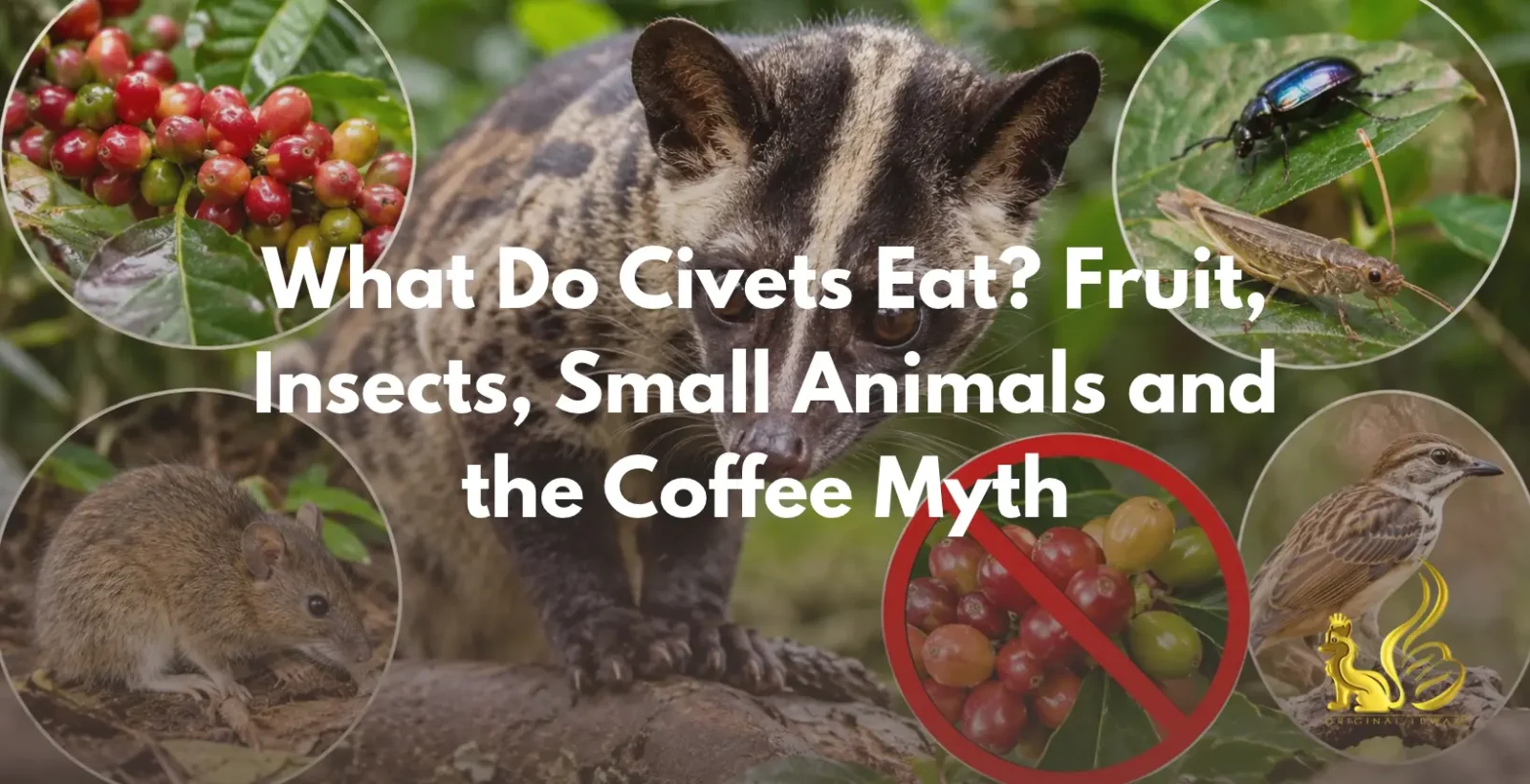
What do civets eat? Mostly fruit, and then almost anything small enough to catch: insects, worms, eggs, snails, rodents, birds and reptiles. Coffee cherries are on the list only where coffee grows, only in season, and only for the pulp. That one fact, that coffee is a snack rather than a diet for a wild civet, is the reason the wild-or-caged question matters so much in kopi luwak, and this guide works through the diet species by species, in the wild, near houses and in cages.
The species figures come from Animal Diversity Web at the University of Michigan and from Singapore’s National Parks Board. The Aceh observations are ours.
Last updated: 13 November 2026
What Do Civets Eat? The Short Answer
Civets are omnivores that lean heavily on fruit. For the Asian palm civet, Paradoxurus hermaphroditus, the animal behind kopi luwak, Animal Diversity Web describes a frugivorous omnivore that eats berries and pulpy fruit first, naming figs, mango, rambutan and papaya, and adds rodents, birds, insects, worms, eggs, reptiles and snails. Our guide to the kopi luwak animal covers the rest of that species’ biology.
The pattern behind what do civets eat is the same across the family. Fruit when it is ripe, protein when it can be caught, and a willingness to switch between the two that explains why civets live everywhere from primary rainforest to city roofs. Here is the short answer as a list you can scan:
- Fruit: figs, mango, rambutan, papaya, bananas and palm fruit, plus coffee cherries where coffee grows
- Invertebrates: insects, worms and snails
- Small vertebrates: rodents, birds and small reptiles
- Eggs: taken from nests and, near farms, from poultry
- Near people: pet food left outdoors and fruit from garden trees
The Civet Diet by Species
Ask what do civets eat across the family and the answer shifts with the species, mainly in how much fruit against how much meat. The table compares the two palm civets most people meet in Asia, using the Animal Diversity Web accounts for each.
| Species | Adult weight | What it eats |
|---|---|---|
| Asian palm civet (Paradoxurus hermaphroditus), the luwak | 1.3 to 5 kg, averaging about 3 kg | Pulpy fruit first (figs, mango, rambutan, papaya), then rodents, birds, insects, worms, eggs, reptiles and snails |
| Masked palm civet (Paguma larvata) | 3.6 to 5 kg | Mainly fruit, with small vertebrates, insects and birds; raids orchards and sometimes takes poultry |
The heavier African species is a more serious hunter and the historical source of civet musk; its range and diet have their own section in our guide to the African civet cat. The masked palm civet, which overlaps with the luwak on Sumatra, is profiled in our masked palm civet guide. Neither of those two makes kopi luwak.
How a Wild Civet Comes to Eat Coffee Cherries
Part of what do civets eat, where coffee grows, is the coffee cherry, and a wild civet eats it for the same reason it eats figs: the ripe fruit is sweet. In Aceh Tengah the Arabica cherry takes nine months to ripen from flower, on trees grown between 1,200 and 1,700 metres, and when it turns red the luwak treats it as one more fruit in a forest full of them. The pulp is digested. The bean inside is not, and it passes through whole.
That is where kopi luwak begins, and it explains three things buyers ask about. First, the civet picks ripe cherries, because unripe ones are not sweet. Second, the supply is seasonal and small, because coffee is a fraction of the animal’s diet and the animal roams freely; our collectors work the civets’ feeding range at forest edges and shade-grown gardens rather than any enclosure. Third, the beans then need everything any specialty coffee needs: collection, washing, drying, and in our case semi-washed, manual dry-hulled processing, which our guide to the luwak coffee process describes step by step.
What the digestion does to the bean has been studied. Marcone’s 2004 study in Food Research International compared civet-processed and ordinary beans and found changes in the beans’ proteins consistent with partial breakdown during digestion, which is the mechanism usually offered for the softer, less bitter cup. That is chemistry on beans, not a health claim about the drink.
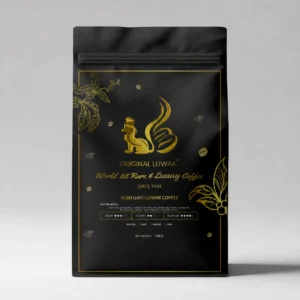
Original Luwak’s 100 g pouch is collected from wild civets eating their own diet in Aceh Tengah, cupped at 84+ per batch and roasted to order.
What Caged Civets Are Fed, and Why It Matters
What a caged civet eats is the ugly part of this industry, and it belongs in any honest answer to what do civets eat. To produce kopi luwak on demand, some producers confine civets in small cages and feed them coffee cherries as the bulk of their diet. A 2016 study in Animal Welfare documented 48 caged civets at 16 civet coffee plantations in Bali: small, barren wire cages, many without clean water, and most animals fed an unnatural diet made up mainly of coffee cherries. Our answer to is kopi luwak cruel sets out both production models in full.
There is also a plausibility argument about the cup, and we state it as that rather than as proof. A civet eating its natural mix of fruit, insects and small animals has a digestive system doing the work it evolved for. A civet fed little but coffee cherries does not. Whether or not that difference can be measured in every batch, it is one more reason the wild model and the caged model are not the same product with different labels.
At Original Luwak the coffee comes from wild, free-roaming civets only, never from cages, and that claim is tied to something you can check: MPKG certification from the Gayo Coffee Protection Community, traceability to six named harvest areas, and a Q Grader cupping score of 84+ on every batch. The certificates are on our certifications page.
What Civets Eat Near Your House
What do civets eat near houses? What the garden and the porch offer. Singapore’s National Parks Board, which deals with common palm civets living in parks, mangroves and the roof spaces of buildings, lists fishtail palm fruit and rain tree seed pods, garden fruit such as mangoes, bananas and chikus, small reptiles, birds, insects and rodents, and leftover pet food left outdoors. The last item is usually why one keeps coming back.
The same agency’s advice is practical: keep cat and dog food indoors, watch from a distance rather than cornering the animal, and leave any young alone, since they start venturing out at two to three months. If your concern is bites or disease rather than the fruit tree, our guide to is civet cat dangerous covers it species by species.
Frequently Asked Questions
What do civets eat in the wild?
Mostly ripe fruit, then small prey. Animal Diversity Web describes the Asian palm civet as a frugivorous omnivore that eats figs, mango, rambutan and papaya first, and adds rodents, birds, insects, worms, eggs, reptiles and snails. Where coffee grows, ripe coffee cherries join the fruit list in season, which is how kopi luwak begins.
Do civets only eat coffee?
No. A wild civet eats coffee cherries only where coffee grows and only when the fruit is ripe, as one item among dozens. Civets fed almost nothing but coffee cherries are caged animals on farms producing kopi luwak on demand, a practice documented by welfare researchers in Bali and the reason wild sourcing has to be verified.
What do civets eat in captivity?
Well-run facilities feed a mixed diet of fruit, eggs and animal protein that mirrors the wild one. The problem cases are coffee farms that confine civets and feed them coffee cherries as the bulk of their diet to force production. Before buying kopi luwak, ask whether the animals were wild and what certification covers that claim.
Do civets eat meat?
Yes. Civets are omnivores, not pure fruit eaters. The Asian palm civet takes rodents, birds, eggs, reptiles and snails alongside fruit, the masked palm civet takes small vertebrates and birds, and the African civet hunts more than either. Fruit is the larger share for the palm civets, but all of them eat animal protein when they can catch it.
What fruit do civets like most?
Soft, sweet, pulpy fruit, the first answer to what do civets eat. Animal Diversity Web names figs, mango, rambutan and papaya for the Asian palm civet; Singapore’s parks agency adds fishtail palm fruit, bananas and chikus. Ripe coffee cherries fit the same description, which is why a wild civet in Gayo eats them in season.
Taste What a Wild Diet Makes
Original Luwak sells kopi luwak coffee from wild Asian palm civets eating their own diet in the forests and shade gardens of Aceh Tengah, never from cages. Every batch is cupped at 84+ by a CQI-certified Q Grader, processed semi-washed and dry-hulled by hand, and roasted to order in light, medium or dark, whole bean or ground.
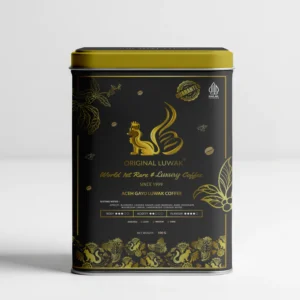
The 100g pouch is $79, roughly seven cups. The 100g gift tin is $99, with an engraved box and a tasting card. Our kopi luwak price guide explains the figures, and you can buy kopi luwak directly from Aceh Tengah, shipped worldwide.