


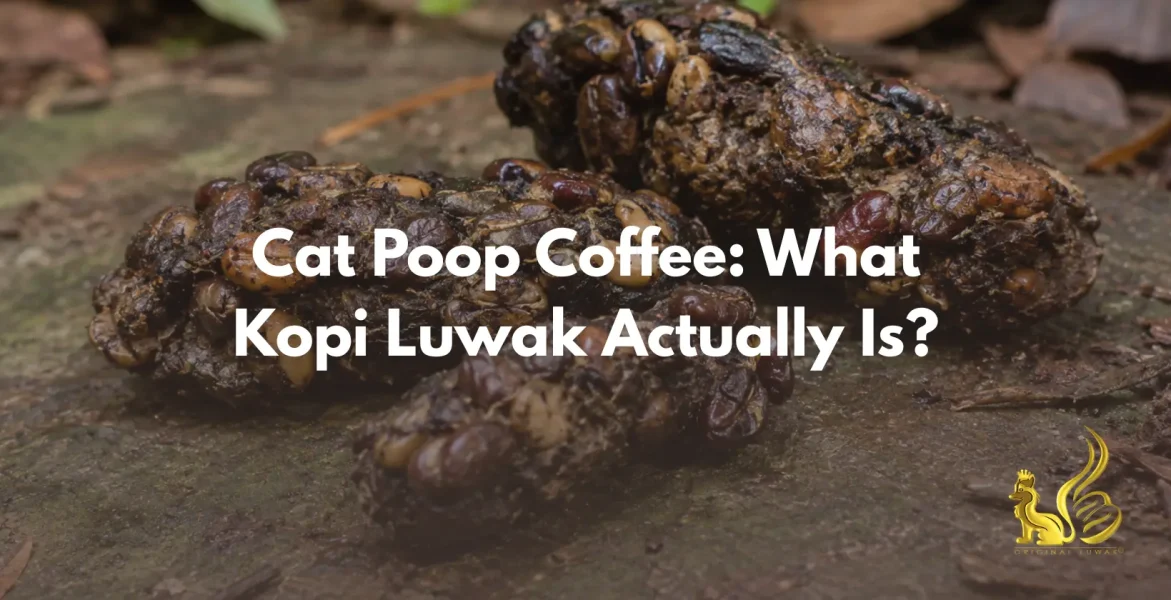
Cat poop coffee, cat feces coffee, cat droppings coffee: three names for one thing. Kopi luwak is coffee made from cherries eaten by a wild Asian palm civet, passed whole in its droppings, then collected, washed, dried, hulled, and roasted. The civet is not a cat, and the droppings never touch the cup, but the nickname stuck because it is the most memorable way to describe how the coffee is made. This guide covers what cat poop coffee is, how it is made, how a wild civet differs from a caged one, and which of the other animal poop coffees on the market are real.
The label is used loosely, though: some products sold as animal poop coffee involve animals chewing or spitting out the coffee fruit rather than passing the seeds. Genuine digestive-tract examples include Indonesian Kopi Luwak, Thailand’s elephant-processed Black Ivory Coffee, and Brazil’s Jacu bird coffee. Bat- and monkey-processed coffees usually belong to a broader animal-assisted category.
Their appeal rests on unusual processing, limited supply, and possible sensory differences, but rarity alone does not prove quality. Food handling, authenticity, traceability, and animal welfare are equally important considerations.
What Is Cat Poop Coffee?
Cat poop coffee is produced from coffee seeds recovered after an animal eats ripe coffee cherries and excretes the seeds. The seeds are separated from foreign material, washed, dried, sorted, hulled when necessary, and roasted. “Animal-processed coffee” is a more accurate umbrella term because some named products never pass through the digestive tract.
A coffee “bean” is botanically the seed contained inside a coffee cherry. Its endosperm is protected by surrounding structures that include the parchment or endocarp.
The animal digests much of the fruit while the relatively durable seed remains recoverable. Microscopy of Kopi Luwak and Jacu samples has identified surface changes associated with gastrointestinal processing, supporting the conclusion that the beans had undergone animal digestion.
This is a post-harvest processing method, not a botanical coffee variety. A product therefore has several separate identities:
- Animal: civet, elephant, bird, bat, or monkey.
- Coffee species: commonly Coffea arabica or Coffea canephora, Robusta.
- Cultivar and origin: the plant genetics and growing environment.
- Animal-processing method: swallowed and excreted, or merely chewed and discarded.
- Post-collection process: dry, washed, semi-washed, or another producer-specific method.
- Roast and brewing method: major determinants of the final sensory profile.
The Cat That Poops Coffee: Meet the Asian Palm Civet
The cat that poops coffee is not a cat. It is the Asian palm civet, Paradoxurus hermaphroditus, a small nocturnal mammal closer to mongooses and genets than to anything domestic. In the forests around Aceh Tengah it eats fruit, insects, and, in season, the ripest coffee cherries it can find. The seeds pass through its gut intact. A wild civet on a mixed diet is the whole point: the enzymes that soften the bean’s bitterness only work properly in an animal that is eating normally. A caged civet fed nothing but coffee cherries does not produce the same bean, which is why Original Luwak collects only from free-roaming animals and verifies that sourcing through MPKG certification.
How Did Animal-Processed Coffee Originate?
The best-known origin story belongs to Kopi Luwak and is connected to Dutch colonial coffee cultivation in Indonesia. The commonly repeated account says plantation workers who were restricted from consuming harvested coffee discovered intact seeds in wild civet droppings, cleaned them, roasted them, and prepared their own coffee. A Pulitzer Center project describes the practice as a loophole within the Dutch Cultivation System.
The broad colonial context is credible, but many retellings present the story with more certainty than the surviving evidence justifies. Exact dates, the scope of restrictions, and the claim that one specific group first invented the practice are difficult to establish from accessible primary records. It is better understood as a documented historical tradition containing details that have also been shaped by repetition and commercial storytelling.
What began as local resourcefulness later acquired a very different identity. International media, tourism, luxury gifting, and curiosity about unconventional food processing repositioned Kopi Luwak as an expensive novelty.
That visibility then encouraged elephant, bird, bat, and monkey products to be marketed alongside it even when their processing methods were fundamentally different.
Animal Poop Coffee Around the World: Which Ones Are Real
The critical classification question is simple: Does the coffee seed pass through the animal’s digestive tract?
| Coffee | Animal | Country or Region | Passes Through Digestion? | General Processing Method | Relative Rarity | Main Ethical or Authenticity Issue |
|---|---|---|---|---|---|---|
| Kopi Luwak | Asian palm civet | Indonesia; related products elsewhere in Southeast Asia | Yes | Cherries are eaten; seeds are excreted, collected, cleaned, dried, and roasted | Limited, although many products use the name | Captive civets, misleading “wild” claims, blending, and false labeling |
| Black Ivory Coffee | Asian elephant | Thailand | Yes | Arabica cherries are fed with other foods; excreted seeds are recovered and processed | Extremely limited, according to the producer | Dependence on producer welfare claims and lot-level traceability |
| Jacu bird coffee | Jacu bird, genus Penelope | Espírito Santo, Brazil | Yes | Wild birds eat ripe cherries; excreted seeds are collected, cleaned, and dried | Very limited | Small-lot verification and producer-specific sourcing claims |
| Bat-processed coffee | Fruit bats; species vary | Documented examples include Madagascar and Costa Rica | Usually no in documented products | Bats chew or strip fruit and leave exposed or partially processed seeds | Very limited | Misleading “bat poop” descriptions and inconsistent documentation |
| Monkey-processed coffee | Macaques or other monkeys; claims vary | Primarily associated with India and Taiwan | Usually no in common descriptions | Animals chew cherries and spit out seeds or parchment | Very limited and poorly documented | Ambiguous names, weak supply-chain evidence, and unverifiable claims |
These classifications are supported by scientific descriptions of civet and Jacu processing, official Black Ivory process information, and reporting on bat- and monkey-assisted coffees.
Kopi Luwak: Civet Coffee from Indonesia
Kopi Luwak is produced when an Asian palm civet—most commonly identified as Paradoxurus hermaphroditus eats coffee cherries and excretes the seeds. Scientific samples have been documented from Aceh Gayo and Mandheling in Sumatra, Kintamani in Bali, and Central and East Java. These examples also demonstrate that Kopi Luwak can undergo either dry or wet post-harvest processing after collection.
Two production systems must be distinguished:
Wild collection involves locating naturally deposited civet droppings in coffee-growing areas or forest-edge environments. In principle, the civet chooses its own diet and cherries.
Captive production confines civets and supplies coffee cherries under controlled conditions. It can produce more predictable quantities, but documented operations have raised serious concerns about housing, nutrition, sanitation, mobility, wildlife capture, and stress.
If you want to taste the real thing rather than read about it, our kopi luwak beans are collected from wild civets in Aceh Tengah, semi-washed, dry-hulled, and cupped at 84+ before packing.
Black Ivory Coffee: Elephant-Processed Coffee from Thailand
Black Ivory Coffee is made from Thai Arabica cherries that are given to elephants with foods such as grasses, bananas, rice bran, or tamarind. The seeds remain in the digestive tract for roughly 10–72 hours, after which they are recovered from the dung, washed, sun-dried, hulled, sorted, roasted, and packed. We compare Black Ivory coffee with wild kopi luwak head to head: price per cup, taste, and the animal question.
The output is limited by low recovery and extensive sorting. The producer’s current pages cite different conversion ratios, approximately 20 kilograms and 33 kilograms of cherries for one kilogram of finished coffee, so the exact figure should be treated as variable rather than universal. The company also reports about 500 pounds of annual output on one Q&A page.
Jacu Bird Coffee and Other Digestive-Tract Coffees
Jacu bird coffee is associated with Fazenda Camocim in Espírito Santo, Brazil. Jacu birds eat ripe Arabica cherries, digest the fruit, and excrete the seeds, which are collected and commonly dry-processed before roasting. Scientific research has examined samples from the farm and identified them as genuinely bioprocessed coffee.
The Jacu is a fruit-eating bird from the genus Penelope found in Latin America’s Atlantic Forest region. A 2025 Reuters report documented Jacu coffee from Fazenda Camocim selling for as much as £960, approximately US$1,300, per kilogram, with demand reported in Japan, Britain, and Brazil. Floral aroma and balanced acidity were descriptions supplied by farm representatives, not universal sensory findings.
Other animal-excreted coffees are occasionally marketed using deer, muntjac, binturong, or other wildlife. Public documentation for many of them is inconsistent or almost entirely promotional. They should not be treated as established categories without a named producer, verified animal species, origin, and documented recovery process.
Are Bat Coffee and Monkey Coffee Really Cat Poop Coffee?
Usually not. The best-documented bat- and monkey-processed coffees involve animals chewing, stripping, or spitting out coffee fruit. The seeds do not complete the digestive tract and therefore are not technically coffee from feces.
In Madagascar, Reuters documented fruit bats chewing ripe Bourbon pointu coffee berries. Saliva and exposure to air affect the fruit while it remains on the plant or is later collected; the beans are not recovered from bat droppings. In 2020, the underlying Bourbon pointu sold domestically for about US$101 per pound, while bat involvement added another premium.
Common descriptions of monkey coffee from India and Taiwan likewise state that rhesus monkeys or Formosan macaques chew ripe cherries and spit out the seeds or parchment. Evidence for the category is largely found in food and trade coverage rather than extensive scientific research, so claims about production volumes, chemistry, and flavor should be treated cautiously.
These products may legitimately be called animal-assisted coffee, but names such as “bat poop coffee” or “monkey poop coffee” misrepresent the documented processing method.
How Is Animal-Processed Coffee Made?
In genuine digestive-tract coffee, an animal eats a coffee cherry, digests much of the surrounding fruit, and excretes the seed. Producers then recover, clean, dry, sort, and roast it. The details vary substantially by animal, origin, sanitation system, and post-harvest method.
A responsible process normally includes:
- Cherry selection or feeding. Wild animals may select cherries themselves; managed systems supply cherries directly.
- Digestive or animal-assisted processing. Acids, enzymes, microorganisms, saliva, and physical movement may affect the fruit and seed.
- Collection. Excreted or discarded seeds are recovered without mixing them indefinitely with soil, stagnant water, or other contamination sources.
- Removal of foreign material. Fecal matter, fruit residues, stones, leaves, and damaged seeds are separated.
- Washing and cleaning. The intensity and equipment differ among producers.
- Controlled drying. Moisture must be reduced sufficiently and evenly for storage.
- Sorting and quality control. Defective, moldy, broken, discolored, or undersized beans are removed.
- Hulling and green-bean preparation. Remaining parchment or dried fruit layers are mechanically removed where applicable.
- Roasting. Heat develops aroma and flavor while serving as an important biological hazard control.
- Packaging and storage. Beans must be protected from moisture, pests, oxygen, contamination, and excessive storage time.
Not all sellers carry out these stages to the same standard. A polished package cannot compensate for weak collection records or poor moisture control.
Poop Coffee, Explained: What the Civet’s Gut Does to the Bean
Poop coffee is a blunt name for a precise process. Inside the civet, enzymes and gut bacteria work on the proteins in the seed for roughly 24 hours, breaking down some of the compounds that turn bitter in the roaster. Once collected, the coffee excrement is broken apart by hand and the parchment-covered seeds are washed until nothing of the droppings remains. Only then are they dried, hulled, and sorted.
Animal digestion may expose coffee seeds to acidic conditions, enzymes, microbial activity, fermentation metabolites, and physical abrasion. Proteolysis—the breakdown of proteins into smaller peptides and amino acids is one proposed mechanism for changing the compounds that later participate in flavor-forming reactions during roasting.
The evidence is real but not uniform. A 2022 study of 13 green Arabica samples found that Jacu digestion was associated with lower caffeine and chlorogenic-acid concentrations and changes in its lipid profile. Indonesian Kopi Luwak samples, however, generally remained within previously reported composition ranges for non-bioprocessed Arabica, and crop year, origin, and post-harvest method also affected their chemistry. The authors emphasized that their limited sample set should be treated as a case study.
A 2025 study comparing unroasted wild-civet Robusta with manually collected Robusta found higher total fat and higher concentrations of two fatty-acid methyl esters in scat-derived beans. It found no significant difference in total protein or caffeine. The researchers also cautioned that roasting substantially changes lipids and generates much of coffee’s flavor, so differences in raw beans cannot be translated directly into guaranteed differences in the cup.
Digestion therefore may alter flavor precursors, but three conclusions would be unjustified:
- Digestion always improves coffee.
- A chemical difference automatically produces a perceptible flavor.
- All civet, elephant, or bird coffees undergo the same biochemical changes.
The final result still depends heavily on cultivar, ripeness, climate, storage, drying, roast development, and brewing.
What Does Feces Coffee Taste Like?
There is no universal feces-coffee flavor profile. Animal digestion is only one variable in a long agricultural and processing chain.
Common descriptions include smoothness, reduced perceived bitterness, mild acidity, chocolate, caramel, nuts, earthiness, syrupy body, fruit, or fermented notes. These are patterns found in studies, producer descriptions, and industry commentary—not promises. A dark-roasted, stale, poorly sorted product may taste flat or harsh regardless of its unusual origin.
| Category | Commonly Reported Characteristics | Important Qualification |
| Kopi Luwak | Smooth body, restrained bitterness, chocolate, caramel, earth, nuts | Origin, species, post-harvest processing, and roast vary widely |
| Black Ivory Coffee | Chocolate, cacao, spice, tamarind, red fruit, tea-like body | Most detailed descriptors come from the producer |
| Jacu bird coffee | Floral aroma, nuts, fruit, balanced acidity | Based on limited lots, scientific samples, and producer descriptions |
| Bat-assisted coffee | Smooth or fruit-forward characteristics | Saliva and fruit exposure, not intestinal digestion, define the process |
| Conventional specialty Arabica | Floral, citrus, stone fruit, berry, caramel, spice, or chocolate | Can be more transparent and complex than animal-processed coffee |
Is Feces Coffee Safe and Hygienic to Drink?
Properly processed animal-digested coffee can be safe to consume, but safety depends on collection, cleaning, drying, roasting, storage, testing, and contamination controls.
The beans must be physically separated from waste, washed appropriately, dried without prolonged conditions favorable to microbial growth, and protected from contamination during hulling, roasting, grinding, and packaging. Safe moisture and water-activity management are essential because sufficiently low available moisture inhibits the growth of undesirable microorganisms during storage.
Roasting is an important kill step. U.S. Food and Drug Administration guidance identifies roasting coffee beans as a process that should significantly minimize biological hazards such as Salmonella and pathogenic E. coli.
That does not mean roasting can repair every failure. Poorly dried beans may develop mold or toxins, foreign matter may remain, and roasted coffee can be recontaminated through dirty equipment or packaging.
A credible supplier should be able to explain:
- Collection and washing procedures.
- Drying targets and moisture monitoring.
- Defect and mold screening.
- Separation of raw and roasted product areas.
- Roasting controls.
- Packaging and storage conditions.
- Microbiological, chemical, or authenticity testing when applicable.
- Compliance with the rules of the market where the coffee is sold.
A voluntary label, producer assurance, laboratory result, regulatory registration, and independently audited certification are not interchangeable. No single worldwide certification automatically guarantees the safety, authenticity, and welfare performance of all animal-processed coffee.
Ethical Concerns, Animal Welfare, and Authenticity
The unusual process cannot be assessed only through cup quality. In Kopi Luwak especially, the way animals are obtained, housed, fed, displayed, and managed may be more consequential than the sensory difference attributed to digestion.
What Are the Main Animal-Welfare Concerns?
A 2024 peer-reviewed study assessed 29 civet-coffee tourism plantations and eight wildlife markets. Researchers recorded 99 civets at plantations and 136 in markets and estimated that 400–800 civets were sold through the surveyed markets annually.
Welfare standards did not meet applicable Indonesian laws and regulations; diet, hygiene, water availability, and mobility affected body condition, and no civet met all five assessed freedoms.
Earlier investigations in Bali similarly documented cramped cages, unsuitable wire flooring, inadequate shelter, restricted movement, poor care, and the use of caged civets as tourist displays. Demand can also encourage wild capture and trade rather than breeding under regulated conditions.
The main risks include:
- Small, barren, or poorly maintained cages.
- Inadequate water and sanitation.
- Restricted or nutritionally unbalanced diets.
- Excessive reliance on coffee cherries.
- Stress, stereotypic behavior, injury, and poor body condition.
- Capture of civets from the wild.
- Tourism facilities presenting captive animals as proof of authenticity.
- Coffee from captive animals being labeled as wild-sourced.
Avoiding sensational language does not require minimizing these documented problems.
Is Wild-Sourced Coffee Automatically Ethical?
No. “Wild-sourced” is intended to mean that beans were collected from droppings deposited by free-ranging animals rather than produced by captive animals. It is not, by itself, a universal or independently controlled certification.
Verification is difficult because coffee may pass through collectors, intermediaries, processors, roasters, exporters, and retailers. A seller can make a truthful claim, an unverifiable claim, or a deliberately misleading one using identical wording.
Wild collection can also create environmental pressure when collectors disturb habitat or when commercial demand encourages the capture of the very animals said to be free-ranging.
Ethical evaluation must therefore occur at lot and supply-chain level. Ask where the coffee was collected, who collected it, how animals were observed without confinement, where processing occurred, and what evidence follows the lot through purchase, roasting, and packaging.
How Can Buyers Evaluate Authenticity and Responsible Sourcing?
Look for specific, checkable information rather than dramatic marketing language:
- A named country, region, farm, forest area, or collector network.
- Coffee species, cultivar when known, harvest period, and lot identifier.
- A clear explanation of whether animals were wild, captive, or managed.
- Processing documentation from collection through drying and roasting.
- A written animal-welfare and wildlife-trade policy.
- Realistic quantities consistent with the sourcing model.
- Independent inspections or laboratory testing where available.
- Packaging that distinguishes pure animal-processed coffee from blends.
- A seller willing to answer detailed questions and correct inaccurate claims.
- No reliance on appearance, aroma, or price as sole proof of authenticity.
Metabolomic methods can screen civet coffee against regular coffee and identify some blends, but consumers generally cannot authenticate it visually or by tasting it. Laboratory identity testing also cannot establish that the civet was wild or treated responsibly.
Readers comparing products can review Original Luwak’s available Kopi Luwak coffee formats while applying the sourcing, processing, welfare, and traceability questions above.
Why Is Feces Coffee Rare and Expensive?
Its price reflects a combination of genuine production constraints and luxury positioning.
Animals consume only part of a crop, and many recovered seeds are unusable. Collection is slow, scattered, and labor-intensive. Washing, drying, hulling, defect sorting, traceability, testing, roasting, and small-batch packaging add further losses and costs. Black Ivory’s own pages illustrate this inefficiency by reporting approximately 20–33 kilograms of coffee cherries for one kilogram of finished product.
Those costs do not explain the entire retail premium. Storytelling, tourism, gifting, limited distribution, unusual packaging, and the desire to purchase an experience can generate a substantial luxury markup. A high price may indicate constrained supply, but it is not reliable evidence of cup quality, ethical sourcing, or authenticity.
The Market and Cultural Influence of Animal-Processed Coffee
How Large Is the Market?
Dependable global totals are limited. The category is fragmented across small collectors, tourism businesses, specialty retailers, luxury hospitality, internet sellers, blends, imitation products, and products whose labels cannot be independently verified. Public estimates from opaque market-report sites often create false precision by counting products that may not be comparable or authentic.
Available examples show high prices but not a large mainstream market:
- Reuters reported in October 2025 that Jacu bird coffee could reach £960, or about US$1,300, per kilogram in the producer’s markets.
- A Black Ivory producer-hosted page available in 2026 quoted US$1,500 per pound and reported approximately 500 pounds of production in 2023.
- As checked in July 2026, Original Luwak listed a standard 100-gram product at US$79 and a 100-gram gift tin at US$99. These are seller-specific retail examples, not global price averages.
The most defensible conclusion is that animal-processed coffee occupies a small luxury niche. Published prices are highly dependent on brand, format, claimed origin, purity, packaging, and place of sale.
How Did Kopi Luwak Become a Global Cultural Phenomenon?
Kopi Luwak combines several elements that travel well through media: an unexpected production method, an Indonesian origin story, high prices, limited quantities, and an immediate conversation topic. Travel coverage and plantation tourism turned the process itself into an attraction, while luxury hotels, gift retailers, and online sellers made the product accessible far beyond Indonesia.
That attention brought benefits and costs. It increased recognition of Indonesian coffee and created income opportunities for collectors and sellers. It also encouraged captive production, vague origin claims, counterfeit products, and tourism experiences in which seeing a caged civet was presented as proof of authenticity.
The category’s cultural influence therefore rests on an unresolved tension: novelty attracts attention, but serious buyers increasingly expect quality, traceability, and welfare evidence that the novelty-focused market has not always provided.
The Future of Feces Coffee
The category is likely to face greater pressure for documented provenance rather than unsupported stories. Sellers that can identify collection areas, lots, processing partners, and welfare safeguards will be better positioned than businesses relying on generic “wild” or “authentic” language.
Scientific authentication may become more practical as metabolomic databases, chemical fingerprinting, and supply-chain records improve. These methods could help detect regular-coffee substitution and undeclared blends, although they will not independently prove ethical sourcing.
Animal-free approaches are also advancing. A 2026 Coffee Science study investigated civet-derived microorganisms as starter cultures for controlled specialty-coffee fermentation. Such work may reproduce selected biochemical effects without requiring beans to pass through an animal. It remains an emerging production approach, not evidence that laboratory fermentation can perfectly duplicate every genuine Kopi Luwak flavor.
The strongest long-term proposition may be coffee sold on verifiable origin, processing skill, and cup quality—not shock value. Operators associated with confinement, deceptive labeling, or unverifiable quantities are likely to face increasing scrutiny.
Final Perspective
Cat poop coffee or feces coffee is made from coffee seeds that have passed through an animal’s digestive tract and are recovered, cleaned, dried, roasted, and brewed. Kopi Luwak, Black Ivory Coffee, and Jacu bird coffee meet that definition. Most documented bat- and monkey-processed coffees do not: animals chew or strip the fruit without excreting the seeds.
Digestion can change green-bean chemistry and may contribute to smoothness, restrained bitterness, altered acidity, or other sensory effects. It does not guarantee superior quality. Origin, cultivar, ripeness, post-harvest processing, roast, freshness, and brewing remain decisive.
A responsible purchase should be based on more than rarity. Examine the named origin, lot information, handling controls, captive-versus-wild disclosure, animal-welfare evidence, seller accountability, and realistic production claims.
For a straightforward tasting format, Original Luwak offers a 100-gram coffee pouch; the 100-gram gift tin is intended for presentation. In either case, evaluate the underlying sourcing information rather than assuming that price or packaging proves authenticity.
Cat Poop Coffee: Frequently Asked Questions
Is cat poop coffee safe to drink?
Yes, when it is handled properly. The droppings are broken apart and the seeds washed until nothing remains but the bean in its parchment. The beans are then dried, hulled, and roasted at temperatures above 200°C, the same step that makes any coffee safe. We cover handling, hygiene, and what to check on the label in our guide to whether kopi luwak is safe to drink.
Why is it called cat poop coffee if the civet is not a cat?
Because the Asian palm civet looks a little like a cat: small, long-tailed, and nocturnal. English speakers reached for the nearest familiar animal, and names like cat feces coffee and cat droppings coffee stuck. Zoologically, the civet belongs to the family Viverridae, alongside genets and binturongs.
Does cat poop coffee taste like poop?
No. By the time the beans are roasted, nothing of the droppings is left. Wild kopi luwak from Aceh Tengah tastes smooth and low in bitterness, with notes of nut, vanilla, chocolate, and a light herbal spice.