

Is kopi luwak cruel? When it comes from caged civets, yes, and the research is not ambiguous. When it is collected from wild civets that were never confined, the case is different, but you should not take any seller’s word for which kind you are holding, ours included. Below: what two studies found inside caged production, what wild collection involves, the checks you can run yourself, and where Original Luwak sits.
Last updated: 08 October 2026
Is Kopi Luwak Cruel? The Short Answer
Kopi luwak is produced in two very different ways, and the answer to “is kopi luwak cruel” depends entirely on which one made your coffee. In caged production, Asian palm civets are confined in small cages and fed mostly or only coffee cherries to force volume. In wild production, wild, free-roaming civets pick ripe cherries from their own range, collectors gather the beans afterwards, and the yield is whatever the season gives.
The caged model is cruel. We do not say that reluctantly: it is what the evidence shows, and the critics who say so are right. The wild model does not confine the animal at all. Original Luwak sources only the second kind, from wild civets in six named harvest areas around Aceh Tengah, listed below so you can check them rather than trust us.
What Caged Production Actually Involves
The clearest evidence on caged kopi luwak comes from tourist plantations in Bali, where civets are kept on show beside a tasting counter. A 2016 study in the journal Animal Welfare, by researchers from Oxford University’s Wildlife Conservation Research Unit and World Animal Protection, scored the housing of 48 Asian palm civets at 16 of these plantations on eight welfare factors. What they found:
- Civets in small wire-floored carrying cages, the largest about half a metre on each side
- A diet the authors call unnatural or semi-natural, limited in variety and inadequate in amount; Mongabay’s report on the study describes animals fed mainly coffee cherries
- Every civet observed had no water, or only limited access to clean water
- Every plantation scored a mean of 2 or less out of 4, where 4 is the best welfare score
All the civets on those farms were also wild-caught. Caged production does not spare the wild population; it draws on it. A later study in the Journal of Applied Animal Welfare Science, published online in 2023, went wider: 99 civets across 29 tourism plantations, plus 136 in the eight wildlife markets that supply them, where 400 to 800 civets are sold each year. Welfare standards did not meet Indonesian law, and no civet met all five freedoms of animal welfare.
Both studies looked at tourist plantations, so neither tells you what share of all kopi luwak is caged. Nobody has published a reliable figure, and we will not invent one.
What Wild Collection Actually Involves
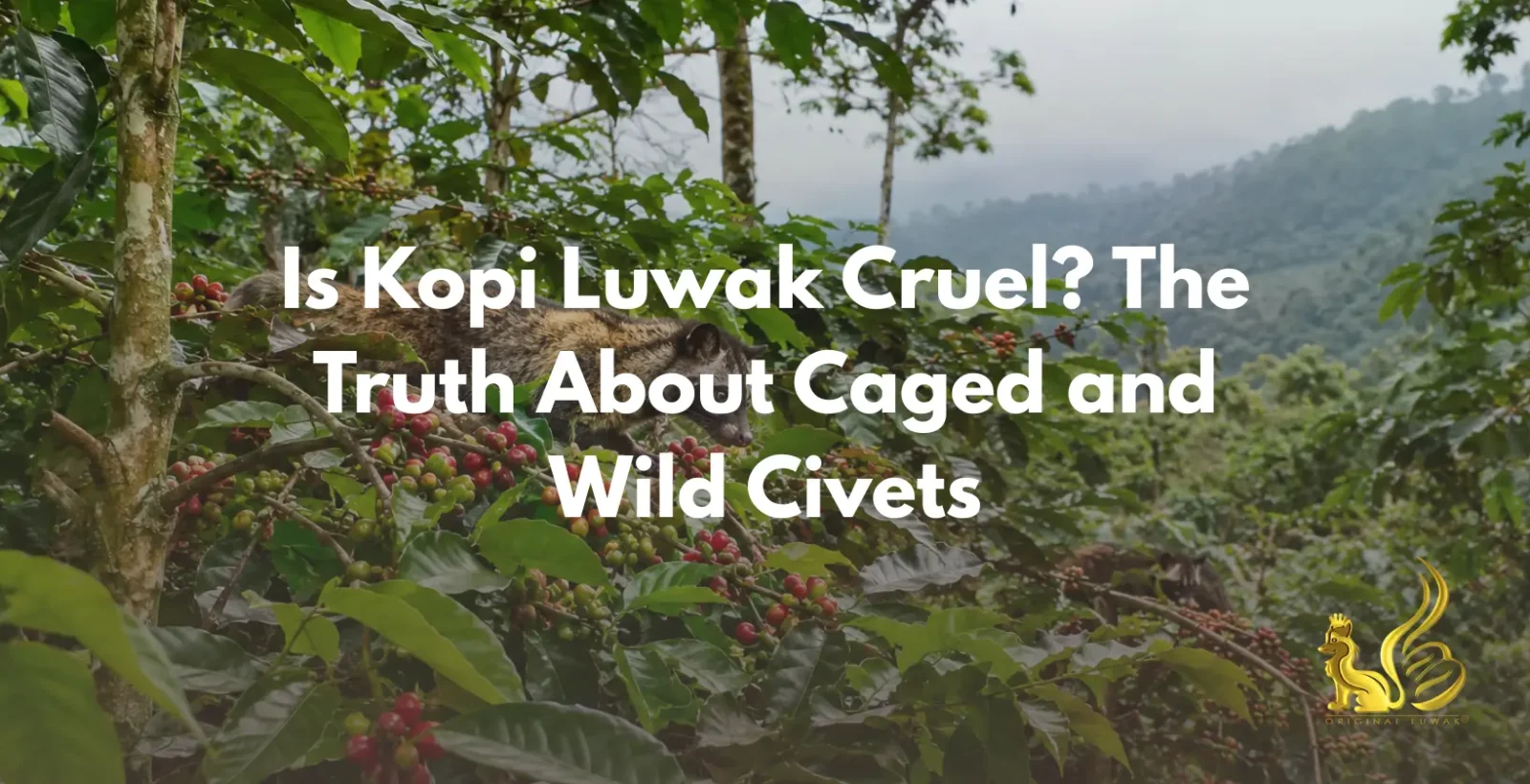
Wild collection starts with an animal that belongs to no one. The University of Michigan’s Animal Diversity Web describes the Asian palm civet as nocturnal and mostly frugivorous, preferring berries and pulpy fruit, with rodents, insects and eggs on the side. Coffee is a seasonal part of that diet, not the whole of it, as our guide to the kopi luwak animal explains.
In Aceh Tengah the civets add ripe coffee cherries to that diet for a few months each year, choosing by scent at night. Our collectors work the civets’ feeding range at forest edges and in shade-grown gardens and gather the beans the animals have passed. No civet is caught, caged or fed: the collection model leaves the animal where it was. What happens to the beans after that is in our guide to the luwak coffee process.
Because the animal roams and the fruit is seasonal, some months bring in very little, and there is no way to order more. The table below puts the two models side by side.
| Caged production | Wild collection | |
|---|---|---|
| The civet | Wild-caught, kept in a cage | Free-roaming, never captured |
| Diet | Mostly or only coffee cherries, chosen by the keeper | Fruit, insects and small animals, with coffee cherries in season |
| Who picks the cherry | The keeper | The civet, by scent, at night |
| Volume | Scaled to demand | Whatever the season gives |
Wild-collected is the only kind Original Luwak sells, traceable to six named harvest areas in Aceh Tengah. If that is the kind you want, buy kopi luwak from our shop.
How You Can Check Which Kind You Are Buying
You cannot see the civet behind a bag of kopi luwak, and the beans will not tell you, so for any single bag the answer to “is kopi luwak cruel” comes down to what the seller can show. Jan Schmidt-Burbach, one of the 2016 study’s authors, told Mongabay that detecting cruel civet coffee “usually remains a constant challenge because of the difficulty in distinguishing between caged and wild source beans.” The useful checks are about the seller:
- Cages on show. Schmidt-Burbach’s clearest warning sign: if you see civets in cages as part of a tour, animal abuse is part of the operation.
- A named place. “Indonesia” is not an origin. A seller who collects wild coffee can name the harvest area.
- A price that fits the yield. As of 2026, wild sourcing stops being plausible below about $600 per kilogram; our kopi luwak price guide shows where the market sits. A cheap bag is caged, blended, or not kopi luwak.
- Stock that runs out. Wild supply is seasonal. A seller offering unlimited volume all year is describing a cage.
- A mechanism, not a slogan. “Ethical” on a label costs nothing. A certification held by a named body can be looked up.
Our buyer’s guide to spotting real kopi luwak takes each check further.
Where Original Luwak Sits, and How It Is Verified
For our own coffee, the answer to “is kopi luwak cruel” is no: Original Luwak sources only from wild, free-roaming civets in Aceh Tengah, never caged and never force-fed. Here are the four mechanisms that claim rests on, strongest first.
- MPKG certification. Our sourcing holds MPKG certification from Masyarakat Perlindungan Kopi Gayo, the Gayo Coffee Protection Community, which we state covers responsible sourcing and animal welfare protection. It is documented on our certifications page, alongside our Halal certification and our AEKI-AICE membership. That page covers those three items only; it does not list harvest areas, which is why we name them here.
- Named harvest areas. Our coffee is traceable to six harvest areas in the Gayo highlands: Takengon, Bener Meriah, Angkup, Sukarame, Bies and Pondok Baru. We have collected wild kopi luwak there since 2008, from our office in Desa Pondok Balik, Kecamatan Ketol, inside the same growing belt.
- The collection model. Forest collection from free-roaming animals: no civet is confined, and our volume rises and falls with the season, which is one reason we sell 100 grams at a time.
- The diet argument, as plausibility. A civet eating fruit, insects and ripe cherries has a working digestive system; a caged civet fed mostly coffee does not. It explains the cup; it does not prove welfare, which is why it comes last.
What we will not tell you is that no civet anywhere is ever harmed. Nobody can verify that across a forest. What we can give you is a certification, six place names and a collection model you can question.
Frequently Asked Questions
If your concern is the cup rather than the civet, our answer to is kopi luwak safe to drink covers hygiene and roasting.
Is all kopi luwak cruel?
No, but caged kopi luwak is. Civets confined in small cages and fed mostly coffee cherries fall short of basic welfare standards, according to studies of Bali plantations published in 2016 and 2023. Wild kopi luwak is collected from free-roaming civets that are never caged. The label alone will not tell you which kind you have.
Where do the civets on caged farms come from?
From the wild, in the farms studied so far. A 2016 study in Animal Welfare found that all 48 civets on the Bali plantations it examined were wild-caught. A 2023 study counted 136 civets in eight wildlife markets supplying the trade, with 400 to 800 sold each year. Caged production draws on the wild population.
How can I tell if kopi luwak is cage-free?
Ask for evidence, not adjectives. A seller of wild coffee can name the harvest area, point to a certification held by a named body, and explain why stock runs out. As of 2026, wild kopi luwak below about $600 per kilogram is not plausible. Civets kept in cages at a plantation or shop are the clearest warning sign.
Is Original Luwak’s coffee cruelty-free?
We source only from wild, free-roaming civets in Aceh Tengah, never caged and never force-fed. The claim rests on MPKG certification, traceability to six named harvest areas including Takengon and Bener Meriah, and a collection model limited by the season. We do not claim more than those mechanisms can show.
Try Wild Kopi Luwak from Original Luwak
Original Luwak sells wild kopi luwak coffee from the forests around Aceh Tengah, collected from free-roaming civets, verified through MPKG certification, and cupped at 84+ by a CQI-certified Q Grader before it is packed. The beans are semi-washed and manually dry-hulled. We roast to order in light, medium or dark, whole bean or ground, and ship worldwide from Aceh.
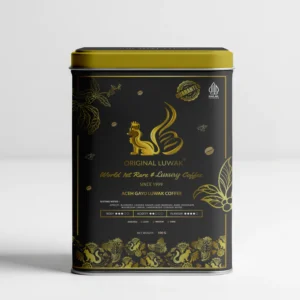
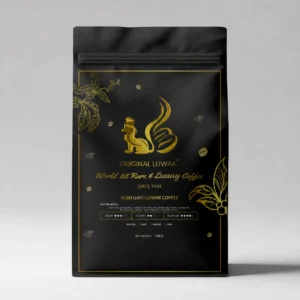
The 100 g pouch is $79 and gives you roughly seven cups. The 100 g gift tin is $99 and arrives with an engraved box and a tasting card. When you are ready, buy kopi luwak direct from the people who collect it.