

Civet cat perfume is built on civet musk, a paste that civets secrete from a gland under the tail, and for about four centuries perfumers prized it. The same family of animals produces kopi luwak, the coffee Original Luwak collects from wild civets in Aceh Tengah, which is why the two get confused. If the coffee is new to you, start with what is civet coffee. This article covers the musk: what it is, which civets produce it, why perfumers now use synthetic civetone, and what musk farming shares with the caged side of the coffee trade.
Last updated: 06 October 2026
What Civet Cat Perfume Actually Is
Civet cat perfume is any fragrance built on civet, the secretion of a pair of perineal glands that civets carry under the tail. The animal uses it to mark territory. Perfumers used it because a tiny amount, diluted far down, holds a fragrance together and makes it last on your skin, the job the trade calls a fixative. Raw, it is a paste with a pungent, faecal smell. Diluted, it turns sweet, which is the whole paradox of the ingredient.
The “cat” in the name is a mistake that stuck. Civets are viverrids, a family closer to mongooses than to any cat, and the same misnomer travels with the coffee on tourist packaging.
The compound that gives civet its character, civetone, is a ring of 17 carbon atoms; musk deer produce a cousin with a 15-carbon ring, muscone. According to Britannica, both were widely used in perfumery until similar synthetic compounds were produced.
Which Civets Make Musk, and Which One Makes Coffee
The civet behind your coffee is not the one in the perfume trade. Britannica names the small Indian civet and the Oriental civets of the genus Viverra as the species employed commercially, and the African civet is the animal behind the Ethiopian industry that supplies most of the world’s musk.
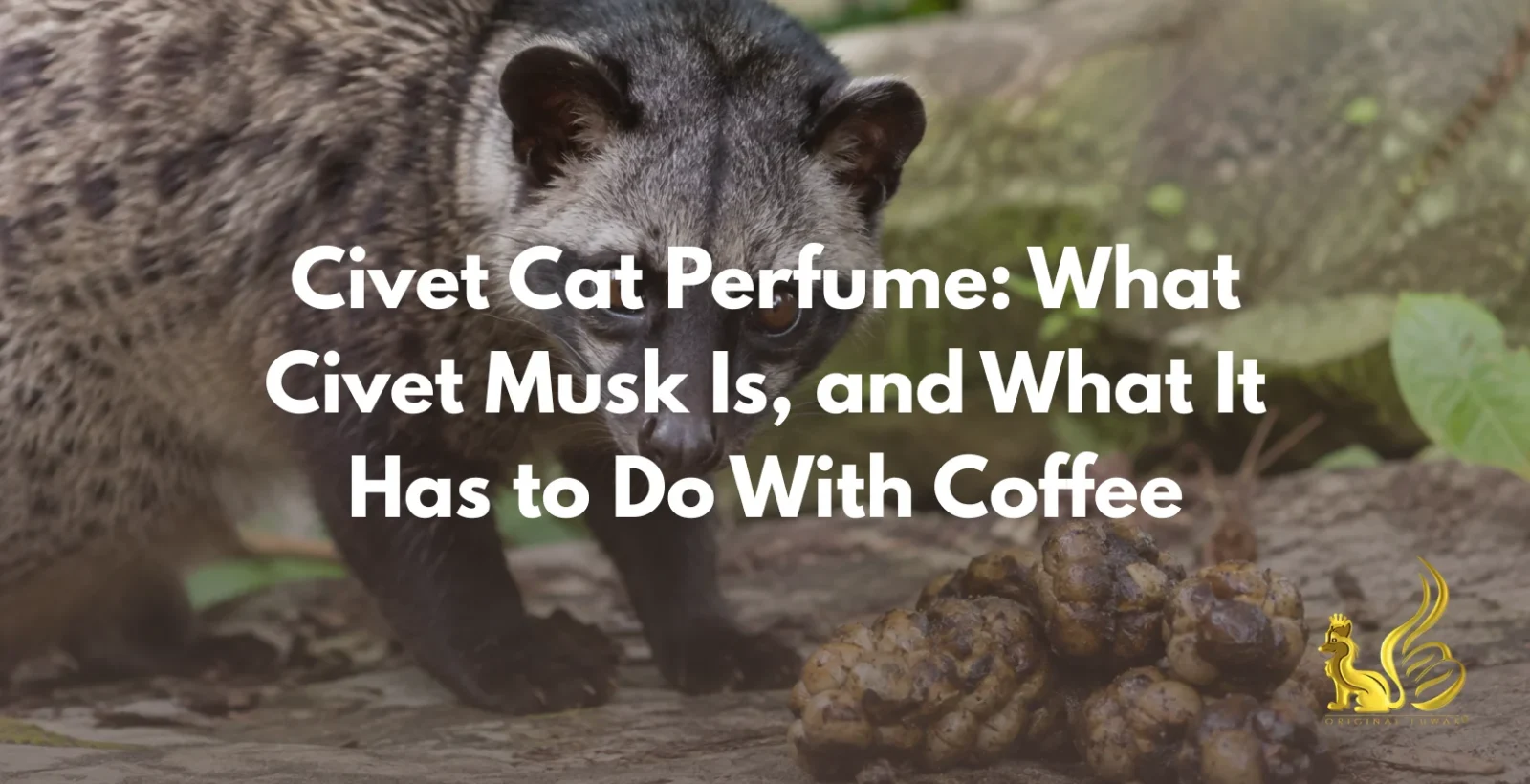
The coffee animal is different. The Asian palm civet, Paradoxurus hermaphroditus, is the small, nocturnal, fruit-eating civet that Indonesians call the luwak. It has a perineal gland too, in both sexes, and the University of Michigan’s Animal Diversity Web notes that the gland is its main means of communication, used to mark its range. It is not among the species the perfume trade relied on. It is the kopi luwak animal, valued for what it does to a ripe coffee cherry, not for its gland.
The table below separates the civets most people run together, and shows which ones civet cat perfume actually came from.
| Civet | Where it lives | What people took from it |
|---|---|---|
| African civet | Africa; Ethiopia supplies about 90% of exported musk | Civet musk for perfume, from captive animals |
| Small Indian civet and the Oriental civets (Viverra) | South and Southeast Asia | Civet musk, used commercially in perfume |
| Asian palm civet (Paradoxurus hermaphroditus) | India and Sri Lanka east to southern China, Indonesia and the Philippines | Kopi luwak: coffee beans passed by the animal. Gland not harvested |
In Aceh Tengah the Asian palm civet feeds in shade-grown coffee gardens at 1,200 to 1,700 metres, where our collectors work. Our Asian palm civet habitat guide covers the rest of its range and what it needs.
Four Centuries of Civet in European Perfume
Civet, the raw material of civet cat perfume, reached the European market in the 16th century and went into medicine, perfumery and a long list of other uses. The Encyclopedia of Smell History and Heritage, a European research project on the history of scent, records that civet farms spread over Europe in the seventeenth century, and that the animals were always kept in cages because they were believed to be ferocious.
The harvesting is the part you should know about. The same source describes “civetting” as a painful practice carried out roughly every ten days, in which the paste was scraped from the gland with silver or wooden spoons. A caged animal worked on a schedule: a very familiar story.
Fashion moved on in the 19th century, but perfume houses kept buying the natural paste as a fixative well into the 20th.
Then the chemists caught up. The Nobel committee’s 1939 award speech for Leopold Ruzicka credits him with discovering, between 1924 and 1926, that muscone and civetone each contain a single ring of carbon atoms far larger than anyone had thought possible. Once the structure was known, civetone could be made in a laboratory. In 1998 Chanel switched from natural civet paste to synthetic civetone, following other houses that had already changed on animal welfare grounds.
The civet’s other famous product needs no gland and no cage. Our 100 g pouch is wild kopi luwak from Aceh, collected from free-roaming civets, cupped at 84+ and roasted to order.
Why Modern Perfumery Uses Synthetic Civetone
Modern perfumery uses synthetic civetone. That is the plain answer to “is civet cat perfume still made from civets”, and it has been true for most of the industry for decades. A few niche producers still buy the natural paste; the civet note in a mainstream bottle is almost always laboratory civetone or one of the synthetic musks that followed it.
Three things drove the switch. Chemistry: once Ruzicka had the structure, a synthetic could be made with the same smell, in any quantity. Welfare: the reason given for Chanel’s 1998 decision. Supply: a 2022 analysis by Takele Taye Desta of Kotebe University of Education, published in The Conversation, describes the Ethiopian trade as an underground industry since animal rights groups raised the treatment of captive civets, with perfumeries tending toward synthetic fixatives instead.
If you are buying civet cat perfume, the consequence is simple: unless the perfumer states that the civet note is natural, assume you are smelling synthetic civetone, and treat a claim of “real civet” as something to question rather than a mark of quality.
What Musk Farming Does to the Animal, and the Same Question in Coffee
Natural civet musk, the ingredient behind traditional civet cat perfume, comes from captive animals, and the welfare record of that captivity is why the trade went underground. Desta’s account of the Ethiopian industry is specific: civets are caught in the wild and kept in captivity, males are preferred because they produce more musk, and the paste is collected by squeezing the perineal glands, typically 3 to 4 grams a week. The welfare problems he lists run from trapping and transport through caging, disease, hygiene and feeding.
If you have read about kopi luwak, that list will sound familiar, because the coffee is produced in two very different ways. In caged production, civets are confined and fed a coffee-only diet to force volume, and a 2016 study in the journal Animal Welfare on plantations in Bali documented the same failures of cage size, diet and hygiene. In wild production, free-roaming civets select ripe cherries from their natural range, and the yield is whatever the season gives. Original Luwak sources only the second, from wild civets around Takengon, Bener Meriah, Angkup, Sukarame, Bies and Pondok Baru in Aceh Tengah.
We attach that claim to things you can check. The sourcing is verified through MPKG certification from the Gayo Coffee Protection Community, which the brand states covers responsible sourcing and animal welfare protection, documented on our certifications page alongside our Halal certification and AEKI-AICE membership. The beans are traceable to the six harvest areas named above, and the collection model itself limits the take: a wild harvest cannot be squeezed on a schedule the way a caged gland can.
One observation from origin. Civet musk is worth harvesting only when the animal is in a cage; nobody collects a scent mark from a forest tree. Wild kopi luwak is the opposite case: the only version worth your money is the one where the animal was never caged, because the cherry selection a free civet makes at night, by smell, is the point of the coffee.
Frequently Asked Questions
What is civet cat perfume made from?
Civet cat perfume is made with civet, a paste secreted by perineal glands under a civet’s tail. Perfumers used it as a fixative, in tiny diluted amounts, to make a fragrance last. Today almost all perfume uses synthetic civetone, the compound behind the natural paste’s smell, rather than material taken from the animal.
Is civet musk still used in perfume today?
Rarely. Modern perfumery uses synthetic civetone, which chemists learned to make after Leopold Ruzicka worked out its ring structure in the 1920s. Chanel switched from natural civet paste to synthetic civetone in 1998, following other houses. A small natural trade continues, mostly from Ethiopia, but the mainstream industry has moved on.
Does the animal behind kopi luwak produce perfume musk?
No. The Asian palm civet, the animal behind kopi luwak, has a perineal gland in both sexes but uses it to mark territory and communicate, and it was not the perfume trade’s musk animal. Commercial civet musk comes from the African civet and from the Oriental civets and small Indian civet of Asia.
Is civet musk cruel to the animal?
The record says yes for the natural trade. Civets are caught wild, kept in cages, and have their glands squeezed for a few grams of paste a week, with documented problems in trapping, housing, disease and feeding. The same cage-versus-wild question applies to kopi luwak, which is why Original Luwak sources only from free-roaming civets, certified under MPKG.
Try Wild Kopi Luwak from Original Luwak
Original Luwak sells wild kopi luwak coffee from the forests around Aceh Tengah, collected from wild, free-roaming civets that were never caged and never force-fed, verified through MPKG certification, and cupped at 84+ by a CQI-certified Q Grader before it is packed. The beans are semi-washed and manually dry-hulled; the cup opens nutty, with vanilla, chocolate and almond, then turns herbal with a gentle spice and a clean finish. We roast to order in light, medium or dark, whole bean or ground, and ship worldwide from Aceh.
The 100 g pouch is $79 and gives you roughly seven cups. The 100 g gift tin is $99 and arrives with an engraved box and a tasting card. Our kopi luwak price guide shows how those figures sit against the market. When you are ready, buy kopi luwak direct from the people who collect it.