


Kopi luwak origin goes back to the coffee plantations of the 19th-century Dutch East Indies, where, by the commonly told account, local workers barred from their own coffee began collecting beans that wild civets had eaten and passed. You will find that story on almost every page about this coffee. It is repeated far more often than it is documented, so this guide separates what the records show from what is only told: the colonial coffee system, the civet, the arrival in the West in the 1990s, and the rise of cages.
Original Luwak collects kopi luwak coffee in Aceh Tengah today, and our collectors do the same job on the forest floor that the old story describes.
Kopi Luwak Origin: Coffee Under the Dutch Cultivation System
You cannot understand the kopi luwak origin story without the colonial coffee economy that came first. Around 1830, Governor-General Johannes van den Bosch founded the cultivation system, the cultuurstelsel, in the Dutch East Indies. A 1986 history by C. Fasseur describes how it obliged the population of Java to grow and deliver coffee, sugar cane, indigo, pepper and other export crops, for crop payments that undervalued the crop against market prices.
Coffee did not stay on Java. A 2018 study in Kemanusiaan: The Asian Journal of Humanities traces coffee forced-farming in the Tapanuli residency of North Sumatra between 1849 and 1928, where local people were also made to carry the beans as coolies from remote storehouses to the port.
The farmer grew the coffee, but the coffee was not really his. Keep that in mind; it is the premise of everything that follows. The words themselves are plain Indonesian: kopi is coffee, luwak is the civet.
The Commonly Told Story: Plantation Workers and the Civet
The version you will read about kopi luwak origin almost everywhere goes like this. Workers on colonial plantations were not allowed to harvest coffee for themselves. They noticed that a small night animal ate the ripest cherries and left the seeds in its droppings, intact. They gathered those seeds, cleaned and roasted them, and drank coffee the plantation could not claim.
Britannica puts it in one sentence: the coffee bean “was discovered and collected by native farmers in Indonesia during the colonial period of the 19th century, when the Dutch forbade local workers from harvesting their own coffee.” We have not found a primary colonial record, a plantation ledger or an official report, that confirms the detail. So you should treat it as the commonly told account: consistent with what the cultivation system did to coffee growers, unproven in its particulars.
The animal is not in doubt. It is the Asian palm civet, Paradoxurus hermaphroditus, the kopi luwak animal Indonesians call the luwak. It eats ripe coffee cherries at night, digests the fruit, and passes the seed, still in its parchment, within about a day.
How Kopi Luwak Reached the West in the 1990s
According to Discover Wildlife, kopi luwak origin was first imported into the West from Indonesia in the 1990s, and the first importer was Tony Wild, then working in the British coffee trade, in 1991. Three things made it sell once it arrived. It was scarce, because wild civets produce only what a season gives. It was strange, which gave you a story to tell at the table. And it was expensive: Britannica notes that a single pound can sell for hundreds of US dollars.
Wild later turned against the trade he helped start, calling it an “utterly preposterous, utterly hideous trade.” The next section explains why. The habit the old story describes is still how your coffee is gathered when you buy from us: wild civets in Aceh Tengah, beans semi-washed and dry-hulled by hand. When you want to taste it, buy kopi luwak direct from the people who collect it.
The History of Kopi Luwak Takes a Turn: The Rise of Cages
Demand changed how kopi luwak is produced. A 2016 study in the journal Animal Welfare put it plainly: the coffee was traditionally made from scat collected in the wild, but the trend for caged civet coffee, with live civets taken from the wild and kept in captivity, is increasing. The researchers scored 48 wild-caught palm civets at 16 tourist plantations in Bali on mobility, hygiene, shelter, food, water and social contact, and found the conditions inadequate, problems they noted are not associated with the traditional collection of scat from wild-living civets. A 2013 BBC investigation found kopi luwak headed for British shelves as “wild” that came from civets in battery cages in Sumatra.
So kopi luwak is now produced in two very different ways. In caged production, civets are confined and fed a coffee-only diet to force volume, and the coffee can come from anywhere. In wild production, wild, free-roaming civets select ripe cherries from their natural range, and the yield is whatever the season gives. The first model is the newer one. The second is the one the colonial story describes.
Original Luwak sources only the second, from the forests around Aceh Tengah, and has done since 2008. You can check that two ways: MPKG certification from the Gayo Coffee Protection Community, documented on our certifications page alongside our Halal certification and AEKI-AICE membership; and traceability to six named harvest areas, Takengon, Bener Meriah, Angkup, Sukarame, Bies and Pondok Baru. Our story explains how a company from Ketol came to sell wild kopi luwak and nothing else.
The Colonial Story Against Today’s Collection
The timeline below gives you each step from a worker picking seeds off the ground to the trade you buy from today, with its source.
| When | What happened | Source |
|---|---|---|
| Around 1830 | The cultivation system obliges Java’s farmers to grow and deliver coffee | Fasseur (1986) |
| 1849 to 1928 | Coffee forced-farming in the Tapanuli residency, North Sumatra | Agustono and Junaidi (2018) |
| 19th century | Local workers collect civet-passed beans, by the commonly told account | Britannica |
| 1991 | First import into the West | Discover Wildlife |
| 2013 | “Wild”-labelled kopi luwak traced to battery-caged civets in Sumatra | BBC, as reported by Discover Wildlife |
| 2016 | 48 caged civets at 16 Bali plantations found in inadequate conditions | Carder et al., Animal Welfare |
| Today | Two models: caged civets on a coffee-only diet, or collection from free-roaming civets | Original Luwak sources wild only |
Here is what has not changed since the kopi luwak origin story. In Aceh Tengah our collectors still work the civets’ feeding range at forest edges and in shade-grown gardens, and some months there is very little to find. Our guide to the luwak coffee process covers what happens after collection.
What has changed is everything you can now ask a seller to prove. Our beans are semi-washed and manually dry-hulled, not wet-hulled, and every batch is specialty graded and cupped at 84+ by a CQI-certified Q Grader before it is roasted to order. If you want the modern answer to how is kopi luwak made, our Luwak Journey page walks you through it from forest floor to roaster.
Frequently Asked Questions
Where did kopi luwak originate?
Kopi luwak originated in Indonesia during the 19th-century Dutch colonial period. The coffee economy behind it was the cultivation system, which from around 1830 obliged Java’s farmers to grow coffee for export; coffee forced-farming was also imposed in North Sumatra. The first civet-passed beans were collected by local workers, by the commonly told account.
Why did plantation workers collect civet droppings?
By the commonly told account, colonial plantation workers were not allowed to harvest the coffee they grew for themselves. Civet-passed seeds lying on the ground were not part of the harvest, so workers collected, cleaned and roasted them. Britannica repeats this account, but we have found no primary colonial record confirming the detail.
When did kopi luwak become famous outside Indonesia?
Kopi luwak reached the West in the 1990s. Discover Wildlife credits the first import to Tony Wild, then working in the British coffee trade, in 1991. Scarcity, a strange story and a high price made it famous, and as demand grew, more producers turned to keeping civets in cages.
Is kopi luwak still made the traditional way?
Some of it is. Traditional kopi luwak comes from wild, free-roaming civets whose droppings are collected from the forest floor. Caged production, where civets are confined and fed a coffee-only diet to force volume, grew as demand rose. Original Luwak collects only from wild civets in Aceh Tengah, verified through MPKG certification.
Try Original Luwak from Aceh Tengah
Original Luwak has collected from wild, free-roaming civets in Aceh Tengah since 2008, in six named harvest areas, verified through MPKG certification and cupped at 84+ by a CQI-certified Q Grader. The cup opens nutty, with vanilla, chocolate and almond, then turns herbal with a gentle spice and a clean finish. We roast to order in light, medium or dark, whole bean or ground, and ship worldwide from Aceh.
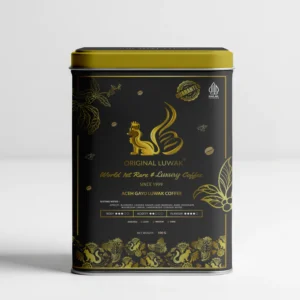
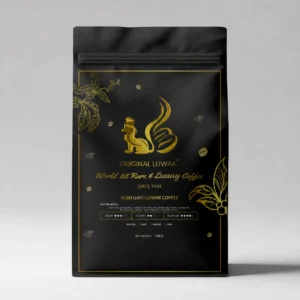
The 100 g pouch is $79 and gives you roughly seven cups. The 100 g gift tin is $99 and arrives with an engraved box and a tasting card. Our kopi luwak price guide shows you how those figures sit against the market. When you are ready, buy kopi luwak from people who still do what the kopi luwak origin story describes.