

A coffee Q Grader is a licensed coffee taster who has passed a standard set of sensory and grading exams and who recalibrates with other graders on a fixed schedule. The licence exists so that a score given in Aceh means the same as a score given in Antwerp. For a buyer, that is the whole point: “84+” on a bag is a claim you can check only if a licensed grader gave the number. This guide explains what the credential tests, how it is kept, what changed when the programme moved from the Coffee Quality Institute to the Specialty Coffee Association in October 2025, and how we use it at Original Luwak.
Last updated: 30 October 2026
What a Coffee Q Grader Actually Does
A Q Grader evaluates green and roasted coffee against a shared protocol and records a score. The protocol is the part that matters. Anyone can say a coffee is good; a Q Grader has to find the same defects, identify the same roast level and arrive at a score close to what other licensed graders would give for the same cup. Our guide to how specialty coffee is graded walks through the system itself: screen size, moisture, defect counts and the cupping score out of 100.
In practice, the grader’s work on a lot looks like this:
- Inspect the green sample: screen size, moisture, defects, and anything that disqualifies the lot before it is roasted.
- Roast a sample to a standard light level for the cupping table, separately from the roast a customer will receive.
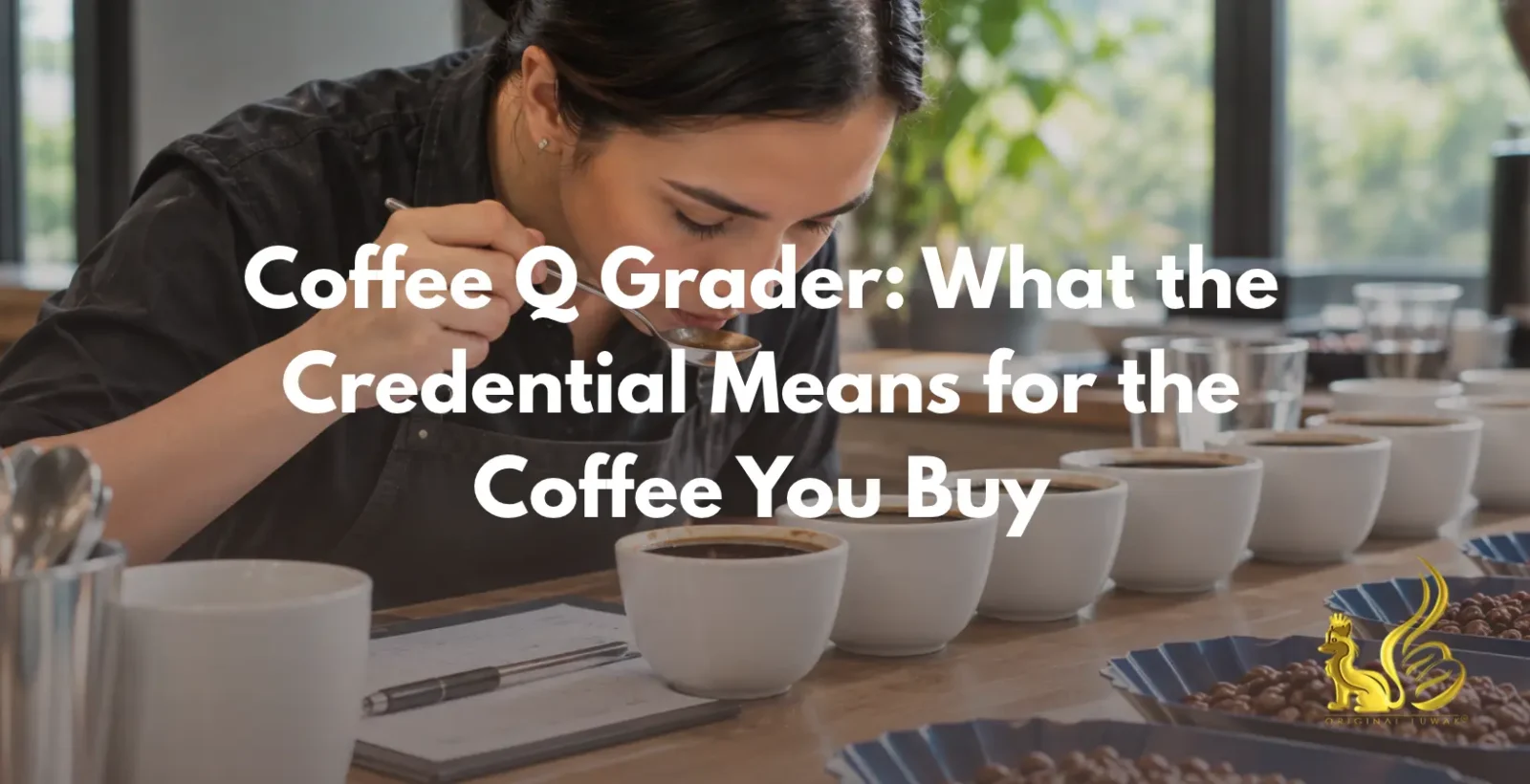
- Cup the sample across several bowls, scoring fragrance, flavour, aftertaste, acidity, body, balance, uniformity, clean cup, sweetness and overall impression.
- Record the score and the notes, which then travel with the lot.
The output is a number with a signature. “84+ by a licensed Q Grader” can be verified; “premium quality” cannot.
What the Licence Tests
For two decades the Q Grader programme was run by the Coffee Quality Institute. Its published course outline, in CQI’s description of Q Grader exams and calibrations, gives a clear picture of what a candidate had to pass:
- A six-day course: three days of review and practice, then three days of exams.
- 20 exams across 9 modules for the Arabica licence, covering cupping protocols, sensory skills, green defect identification, roast level identification and matching coffee acids.
- Recognising flavour standards in water solutions, the same reference flavours every other grader trains on.
- Every exam had to be passed. A grader who failed a cupping or general knowledge exam had to return to a later course to retake it in person.
A certificate was valid for 36 months. To keep it, a grader attended an in-person calibration course every third year and had to pass at least two of three cupping flights. That calibration is the quiet part of the system that buyers never see, and it is why the score on a bag from one grader can be compared with the score from another.
Every 100 g pouch we sell comes from a batch cupped at 84+ by a licensed Q Grader before it is roasted to order, and the cupping notes travel with the batch.
What Changed in October 2025
On 1 October 2025 the programme moved. The Specialty Coffee Association and CQI announced the transfer in April 2025: from that date the SCA operates an “evolved” Q Grader programme, and CQI is no longer involved in running it. The new course is built on the SCA’s Coffee Value Assessment, the framework it introduced in 2023 to replace the 2004 cupping form.
The SCA’s page for the evolved Q Grader describes a six-day programme: two days on physical assessment of green coffee, then four days on sensory assessment, covering descriptive, affective and extrinsic evaluation. The SCA states that an existing Q Grader certification remains valid until the expiry date printed on the certificate. Current and lapsed Q Graders could move to the evolved licence by completing a two-day CVA for Cuppers course before 31 December 2025; after that date the route is the full course.
The change was not universally welcomed. Reporting in Perfect Daily Grind in May 2025 put the number of certified Q Graders worldwide at about 10,000 and quoted graders who felt the value of their credential had shifted overnight, and a Global Coffee Report feature noted that the SCA still treats scoring as part of the picture rather than the whole story. For a buyer, the practical reading is simple: a grader licensed under CQI is still a licensed grader until their certificate expires, and a grader licensed under the SCA has been trained on the newer framework.
Why It Matters More for Kopi Luwak Than for Most Coffee
Most coffee is graded at a scale that makes fraud unprofitable. Kopi luwak is the opposite: a tiny volume sold at a very high price, with a label that is easy to print and hard to check. The grader’s score is one of the few things on that label that an outsider can verify.
Three things a licensed grader’s score tells you about a kopi luwak batch:
- It was cleaned and sorted properly. A lot with mould, heavy ferment or a taint is rejected at the table before it gets a number. Our guide to kopi luwak taste explains what a clean luwak cup should and should not show.
- The score is comparable. 84 from a calibrated grader in Aceh sits on the same scale as 84 anywhere else. The specialty line is 80.
- Someone signed it. A batch that names its grader is a batch with a person behind the claim. That is the kind of check our buyer’s guide to spotting real kopi luwak asks you to make before paying.
What a score does not tell you is whether the civet was wild or caged. Roasting and cupping cannot see the cage. That is a sourcing question, answered by certification and traceability, not by the cup. Our wild kopi luwak comes from free-roaming civets in six named harvest areas of Aceh Tengah, and the mechanisms behind that claim, MPKG certification, Halal certification, AEKI-AICE membership and Q Grader batch verification, are set out on our certifications page.
How Original Luwak Uses a Q Grader
Every batch we sell is cupped by a licensed Q Grader before it is packed, and it must score 84 or above. The grader checks screen size (15 to 19), moisture (under 13%) and defect triage (3 to 6%) at the same time. The notes are what let us tell you what a pouch tastes like before you open it: nutty, with vanilla, chocolate and almond, then herbal and gently spiced, with a clean finish.
Our grader’s licence was earned through CQI. Under the SCA’s transition rules it stays valid until the expiry date on the certificate, and renewal from now on runs through the SCA. We will say which it is when it changes, because the point of the credential is that you can ask.
Frequently Asked Questions
What is a coffee Q Grader?
A coffee Q Grader is a licensed coffee taster who has passed a standard set of exams in cupping, sensory skill, green defect identification and roast identification, and who recalibrates with other graders on a fixed schedule. The licence was run by the Coffee Quality Institute until 1 October 2025 and is now operated by the Specialty Coffee Association.
How do you become a Q Grader?
Under CQI the course took six days, three of practice and three of exams, with 20 exams across 9 modules, and every exam had to be passed. The SCA’s evolved programme, launched in October 2025, is also six days: two on physical assessment of green coffee and four on sensory assessment using the Coffee Value Assessment. Anyone can enrol.
How long does a Q Grader certificate last?
A CQI Q Grader certificate was valid for 36 months and was kept by attending an in-person calibration course every third year. The SCA states that existing certificates remain valid until the expiry date printed on them, with renewal now handled by the SCA.
Does a Q Grader score prove kopi luwak is wild?
No. A cupping score shows that the batch was cleaned, sorted and roasted well enough to score, and that the number is comparable with other graded coffee. It cannot show whether the civet was wild or caged. That claim depends on certification and traceability to named harvest areas, which a seller should be able to document separately.
Buy Coffee That a Q Grader Has Signed Off
Original Luwak sells kopi luwak coffee from wild, free-roaming civets in six named harvest areas of Aceh Tengah, cupped at 84+ by a licensed Q Grader and roasted to order, light, medium or dark, whole bean or ground. We ship worldwide.
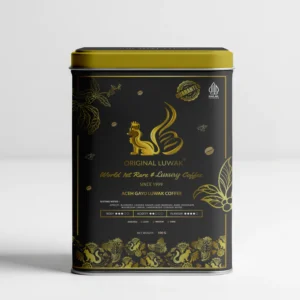
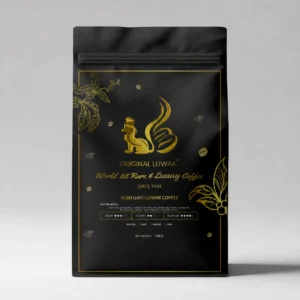
The 100g pouch is $79 and gives you roughly seven cups. The 100g gift tin is $99. Our kopi luwak price guide puts those figures in context. When you are ready, buy kopi luwak direct from the people who collect it.